Gulf Shores Police Opens Applications for Its 2026 Citizens Police Academy
Gulf Shores Police is accepting applications for its free, eight-week 2026 Citizens Police Academy, giving residents a behind-the-scenes look at K9, SWAT, Marine Unit and narcotics operations.
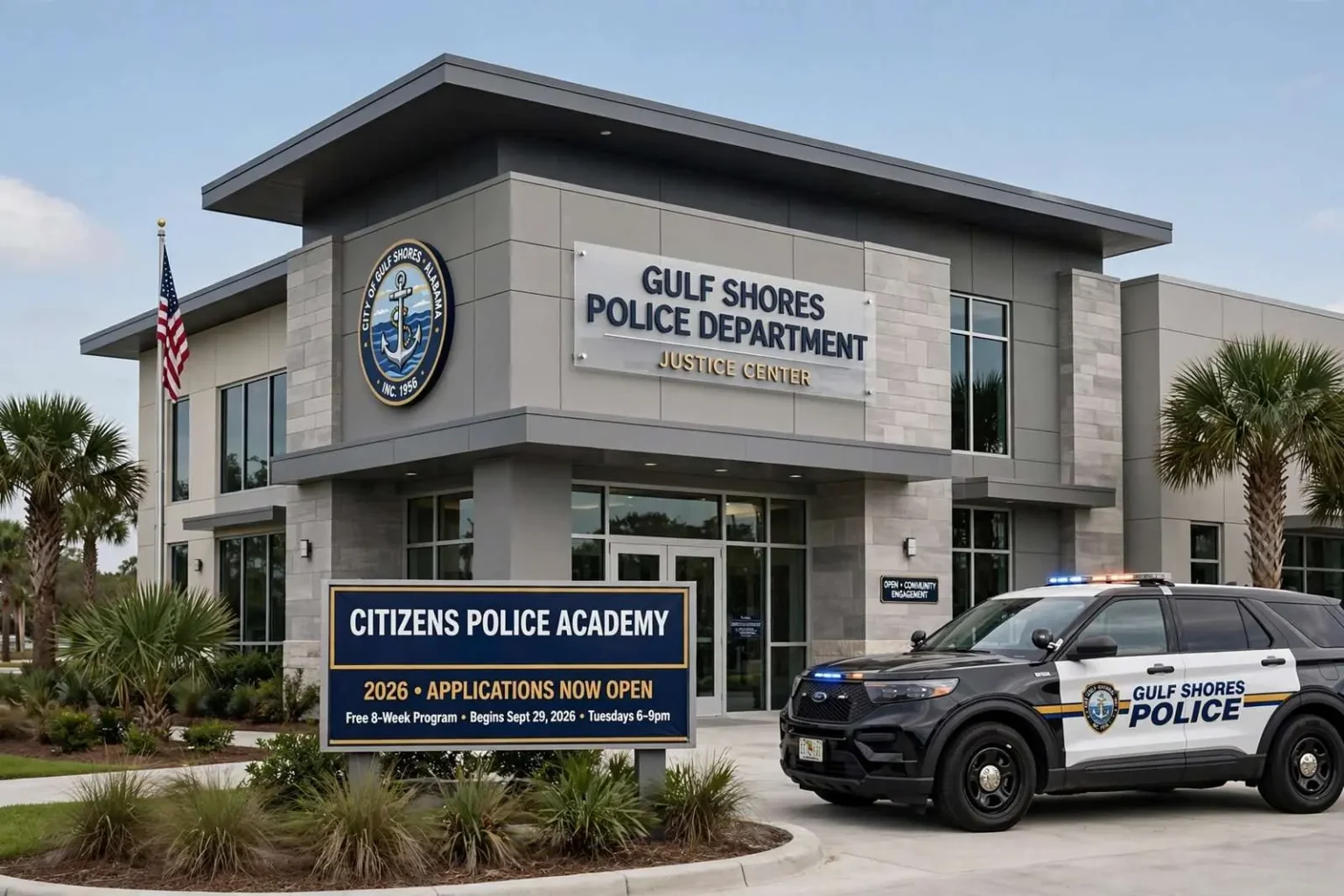
The Gulf Shores Police Department is now accepting applications for its 2026 Citizens Police Academy, a free eight-week program designed to give residents an inside look at how the department operates.
Classes are scheduled to begin September 29, 2026, and will run weekly through November 17, with sessions held from 6 to 9 p.m. at the department’s new Justice Center, a modern facility built for hands-on training.
The Citizens Police Academy model has become one of the most widely adopted community policing programs in the country, and Gulf Shores has run its own version for years as a core piece of the department’s public outreach. The concept is simple: invite residents behind the scenes, walk them through how investigations, patrols and specialty units actually work, and answer the questions the public rarely gets to ask. Departments nationwide have found that graduates become some of their most informed advocates — and often their best source of neighborhood intelligence.
The academy is open to anyone 18 or older who lives or works within the City of Gulf Shores. That residency-and-employment standard is designed for the program’s real audience: the people whose daily lives intersect with the department, from year-round residents to the business owners and workers who staff the city’s restaurants, hotels and shops through the tourist season.
Gulf Shores presents a distinctive operating environment for a municipal police department. The city’s population swells dramatically each summer as hundreds of thousands of visitors arrive for the beaches, festivals and concerts that anchor the Alabama coast, and the department must handle traffic management, alcohol enforcement, missing persons and the full range of tourist-season calls at a scale its permanent population never suggests. A Citizens Police Academy class that runs in the fall, after the season winds down, gives participants a candid look at both the quiet months and the summer surge.
What Participants Will See
Over the course of the eight weeks, participants will get an in-depth look at criminal and narcotics investigations, K9 operations and the department’s Marine Unit, along with SWAT demonstrations, case studies and presentations from other specialty units. The program is intended to give residents a clearer understanding of how their local police department functions day to day.
The lineup covers the units residents most often ask about. Narcotics investigations sessions walk through how drug cases are built — from tips through surveillance to arrest — and what the evidence trail looks like. The K9 demonstration is a perennial favorite, showing how trained dogs search for drugs and track suspects, and how handlers and animals work as a team. The Marine Unit’s role is unusually prominent in a coastal city, where officers patrol the back bays, waterways and beachfront that draw boaters, anglers and swimmers through the season.
SWAT demonstrations and case studies round out the curriculum, and the case-study format has become a hallmark of well-run citizens academies: taking a real incident — anonymized and resolved — and walking participants through the decisions officers faced at each step. Presentations from other specialty units fill out the schedule, giving every division in the department a turn in front of the class.
The hands-on training spaces at the new Justice Center make that curriculum possible. Gulf Shores’ move into a modern public safety facility gave the department dedicated room for the kind of demonstrations and scenario work that older stations could not accommodate — rooms where a class can watch a K9 search a building, examine narcotics displays up close or step through a staged incident scene. Hosting all eight sessions in-house also means participants see the department on its own ground, from the dispatch perspectives to the evidence and records functions the public rarely thinks about.
Who Should Apply
There is no cost to attend, but space is limited, and the department is encouraging interested residents to apply early. All applicants must consent to a background check before being accepted, and because seating is limited, accepted participants are expected to attend every session — missing classes could affect a participant’s standing in the program.
The attendance expectation reflects how the academy is structured: each week builds on the last, with units and topics sequenced toward the graduation at the end of the eighth session. Departments treat the class as a cohort, and graduates are often invited into an alumni network that supports the department through volunteer work, citizen feedback and recruitment word-of-mouth. Someone who drops out mid-program occupies a seat another applicant wanted, which is why the commitment is stated upfront.
The background check is standard practice for citizens academies across the country and should not deter ordinary applicants. Departments screen for disqualifying criminal history, not for criticism of police or for ordinary life experience, and the goal is a classroom of engaged residents rather than a sealed club. Gulf Shores officials have consistently described the academy as a two-way exchange: officers hear what the community expects, and residents leave understanding why officers make the calls they make under pressure.
Applications can be submitted online at gulfshoresal.gov/552/Citizens-Police-Academy. Residents with questions can email [email protected] or call 251-968-2431. The department said it welcomes anyone with an interest in law enforcement to take advantage of the opportunity.
The online application takes minutes to complete and asks for basic contact information and background-check consent. With classes limited by the training space, early applicants have the best odds of a seat, and the department typically confirms acceptances ahead of the September 29 start so participants can plan their Tuesday evenings through mid-November.
Why Citizens Academies Matter
For the department, the payoff is community trust that compounds over time. Residents who have watched a narcotics case built step by step, seen the judgment required in a SWAT scenario or ridden along — even briefly — with the Marine Unit tend to judge news coverage and viral videos with more context, and they carry that understanding into conversations at church, at work and online. In an era when police departments nationwide face scrutiny and recruiting challenges, the citizens academy has proven one of the most durable bridges between agencies and the public they serve.
For participants, the eight weeks offer something rarer than a lecture: a realistic picture of modern policing in their own city. Graduates often say the biggest surprise is the range of skills the job demands — from report writing and courtroom testimony to crisis intervention and the physical demands of beach patrol — and the biggest takeaway is a roster of names and faces they can call when something in their neighborhood needs attention.
The 2026 academy’s Tuesday evening schedule keeps the program accessible to working adults, and the fall timing avoids the height of hurricane season’s operational demands. For Gulf Shores residents and workers who have ever wondered what happens after the blue lights come on, the application window is open now — and the department is ready to show them.
The Program in Context
Gulf Shores’ academy belongs to a national tradition that took root in the 1990s as departments looked for ways to rebuild confidence in community policing. The structure — weekly evening sessions, rotating specialty units, a graduation ceremony with certificates — has proven remarkably durable, and Baldwin County’s communities have adopted versions of it alongside their neighbors across the bay. Departments in Daphne, Fairhope and Foley run similar programs, and graduates of one city’s academy frequently spur friends in neighboring cities to apply to theirs.
The timing of this year’s academy also matters against the backdrop of Gulf Shores’ continued growth. The city has added residents, businesses and attractions year over year, and each new development brings new traffic patterns, new calls for service and new expectations. A class of informed residents entering the winter with a working knowledge of the department’s operations gives the city a baseline of public understanding heading into the next tourist season — when the department’s workload and its visibility both reach their annual peak.
Prospective applicants should gather their questions now. The academy’s question-and-answer format works best when participants arrive curious, and the officers presenting each unit expect to be asked the things residents wonder about but rarely have the chance to ask: how long a narcotics investigation takes, what happens when a K9 makes a find, how the Marine Unit coordinates with other agencies on the water, and what a SWAT callout looks like from the officers’ side of the tape.
Graduation closes the eight weeks with the same ceremony departments use nationwide — certificates, a photo with the chief, and an invitation to stay involved. Many graduates go on to volunteer at city events, join the department’s alumni activities or simply serve as the well-informed neighbor every police department needs. For eight Tuesday evenings and no cost beyond the time, the program remains one of the most valuable exchanges a resident can make with their city government.