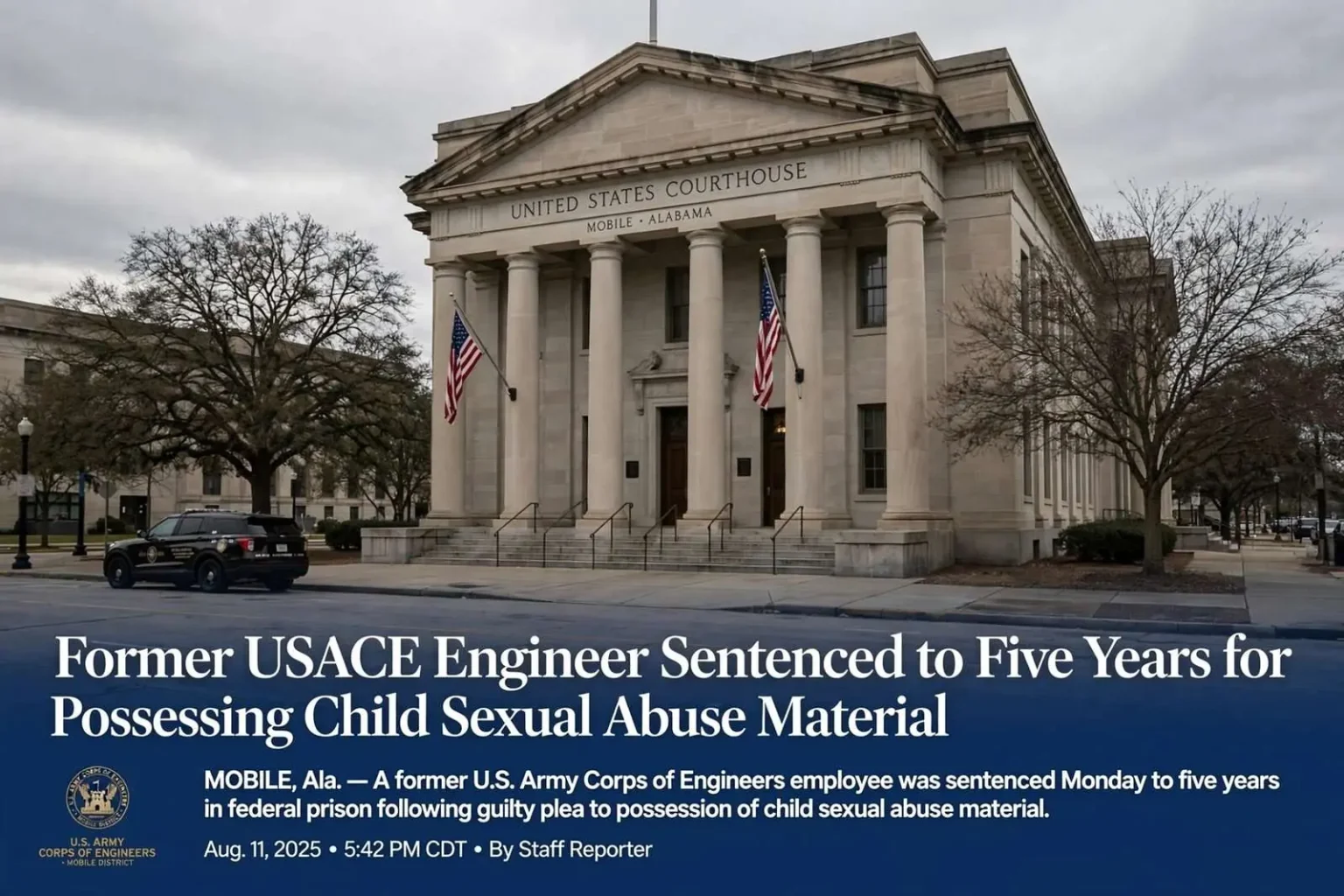
MOBILE, Ala. — A former U.S. Army Corps of Engineers employee who admitted to possessing more than 600 images of child sexual abuse material was sentenced Monday to five years in federal prison.
Bradford William Simmons, 51, of Mobile, was sentenced Aug. 10 by Chief U.S. District Judge Jeffrey U. Beaverstock following an April guilty plea to one count of possession of child pornography. Simmons, appearing through attorney Arthur Madden, did not object to the findings of a presentence investigation report, which was unavailable in the public docket at the time of publication.
The 60-month sentence will be served in Federal Bureau of Prisons custody, followed by 15 years of supervised release. Simmons was also ordered to pay $17,500 in restitution and a $100 special assessment.
He received two days of credit toward the sentence for time spent in state custody in 2024, and Judge Beaverstock ordered the federal sentence to run concurrently with any sentence still to be imposed in Simmons’ pending state case. Simmons was remanded to the custody of the U.S. Marshals Service following the hearing.
Beaverstock also recommended that Simmons be housed in a federal facility as close to home as possible and that he participate in substance abuse, mental health and sex offender treatment programs while in custody.
The five-year term matched the sentence jointly recommended by Simmons and federal prosecutors under a plea agreement filed earlier this year. In exchange for the guilty plea, prosecutors agreed to dismiss five remaining federal charges after sentencing, a routine structure in federal child-exploitation cases where a single plea resolves an indictment that might otherwise have gone to trial on multiple counts.
What Simmons admitted in court
According to a factual resume filed with his plea, Simmons admitted his offense involved more than 600 images of child sexual abuse material and that he used a file-shredding program in an attempt to conceal or destroy the material. Federal investigators found the program had been run repeatedly in March 2024, including 11 times on March 9 alone.
File-shredding utilities differ from ordinary deletion tools in that they are designed to overwrite files multiple times so the data cannot be recovered with standard forensic software. In child-exploitation prosecutions, evidence that such a program was used — and used repeatedly over a short span of days — is often presented to show consciousness of guilt and a deliberate effort to defeat law enforcement. Forensic examiners can frequently still recover fragments, logs, and traces of deleted material from hard drives, which is how investigators document both the original files and the attempts to erase them.
The factual resume is a standard component of federal guilty pleas. It lays out the conduct the defendant agrees the government could prove at trial, and it anchors the sentencing calculation that judges rely on under the federal advisory guidelines. By admitting the contents of the resume, Simmons avoided a contested evidentiary hearing on how the material was found, how much of it existed, and what he did to hide it.
A career with the Corps of Engineers
Simmons was a former hydrologic technician with the U.S. Army Corps of Engineers’ Mobile District. The Mobile District, headquartered in downtown Mobile, is one of the Corps’ major regional offices, covering Alabama, Mississippi, and parts of the Florida Panhandle and Georgia. Its engineers and technicians manage navigation channels on the region’s rivers and harbors, operate flood-control reservoirs, regulate wetlands work under the Clean Water Act, and respond to hurricane recovery missions along the Gulf Coast.
Hydrologic technicians in that organization work with stream gauges, rainfall data, and reservoir operations — the day-to-day measurements that feed flood forecasts and water management decisions. Nothing in the court record suggests Simmons’ offenses were connected to his government work; the charges concerned material found on personal devices and activity investigated away from his federal duties. He is no longer employed with the agency.
Employment with a federal agency adds a practical layer to cases of this kind. A felony conviction for possession of child pornography ends any federal career, and agencies coordinate with prosecutors when an employee is arrested to determine whether the individual should remain on the rolls, be placed on leave, or be separated. The Corps does not typically comment on individual personnel matters, and no agency action in Simmons’ case was announced publicly.
How the investigation began
Simmons was first arrested by Mobile County investigators in June 2024 following an investigation by the Mobile County Sheriff’s Office Internet Crimes Against Children Task Force. Authorities had previously alleged that thousands of images and videos of child sexual abuse material were discovered during the investigation, a substantially larger figure than the 600-plus images he formally admitted to in the federal factual resume.
Internet Crimes Against Children task forces are a nationwide network of federally funded, locally operated units that investigate online exploitation of minors. The Alabama ICAC program coordinates deputies and officers from sheriff’s offices, municipal police departments, and state agencies who receive specialized training in digital forensics, undercover chat operations, and peer-to-peer network monitoring. Investigations typically begin with a tip from a national reporting hotline, a referral from another agency, or detection of illicit file sharing on a public network, and can run for months before an arrest is made while analysts image drives and trace accounts.
The June 2024 arrest by county investigators preceded the federal case entirely. In child-exploitation matters, a local arrest often comes first because task force members identify probable cause through their own work, then coordinate with the U.S. Attorney’s Office to determine whether state charges, federal charges, or both are the appropriate vehicle for prosecution.
From the state courthouse to federal court
Simmons was indicted in Mobile County Circuit Court in April 2025 before federal prosecutors brought separate charges later that year. Parallel state and federal prosecutions are common in child-pornography cases because possession and distribution offenses violate both Alabama law and federal statutes, and the two systems are considered separate sovereigns for double-jeopardy purposes. In practice, prosecutors often resolve one case with a plea and then use the admissions from that proceeding to streamline or dismiss the other, which is the path this case followed, with five federal counts set for dismissal after sentencing.
Mobile County Circuit Court, located in downtown Mobile, handles the county’s felony docket, and child-exploitation indictments there carry serious potential penalties under Alabama law. The pending state case against Simmons remains active, with a hearing scheduled next week to address the case ahead of trial. Judge Beaverstock’s order that the federal sentence run concurrently with any state sentence means that if Simmons is later sentenced in state court, the time will not stack on top of the federal term, though supervised release obligations would still follow any period of incarceration.
What the sentence requires after prison
The terms imposed Monday will follow Simmons long after his release from Bureau of Prisons custody. The 15-year term of supervised release is more than double the length of the prison sentence itself. During supervised release, Simmons will be subject to sex offender registration requirements and will face restrictions on computer use and contact with minors. He will report to a federal probation officer, submit to searches of his residence and any devices he is permitted to use, and can be returned to prison for any violation without a new jury trial.
Sex offender registration for federal convictions operates under the national framework commonly known as SORNA, the Sex Offender Registration and Notification Act, which requires registration with the state where the offender lives, works, or studies and public notification through state registries. In Alabama, registry compliance is administered by the Alabama Law Enforcement Agency, and failure to register or keep registration current is itself a felony.
The $17,500 in restitution reflects a shift in federal law that removed the need to prove a specific dollar loss for child-exploitation offenses. Federal statutes now direct judges to order restitution to victims of child sexual abuse material, and courts have held that every person whose abuse is recorded in an image suffers ongoing harm each time it is viewed or shared. Restitution in these cases is typically distributed to victims or to funds administered on their behalf, and the amounts can be revisited if additional victims come forward. The $100 special assessment is a fixed fee applied to every federal felony conviction.
The sentence also removes Simmons from Mobile for a substantial period during a stage of life when, at 51, he would otherwise have decades ahead of him. For the task force investigators who built the case across two court systems, the outcome represents the culmination of an investigation that began with digital evidence and ended with admissions in a federal courtroom that the material existed and that he tried to destroy it.
Child-pornography cases from the Mobile division of the Southern District of Alabama are handled in the federal courthouse on St. Joseph Street, where Chief Judge Beaverstock presides over a docket that regularly includes prosecutions referred by the Mobile County ICAC task force and other Gulf Coast law enforcement partners. The Aug. 10 sentencing hearing concluded a case file that spanned more than two years from the first county-level arrest to the final federal judgment.