EPA Weighs Letting Alabama Take Over Oversight of Coal Ash Pond Closures
A federal proposal would hand Alabama state regulators oversight of coal ash pond closures, a plan critics say could leave millions of tons of ash buried near the state's rivers, including the Mobile-Tensaw Delta.
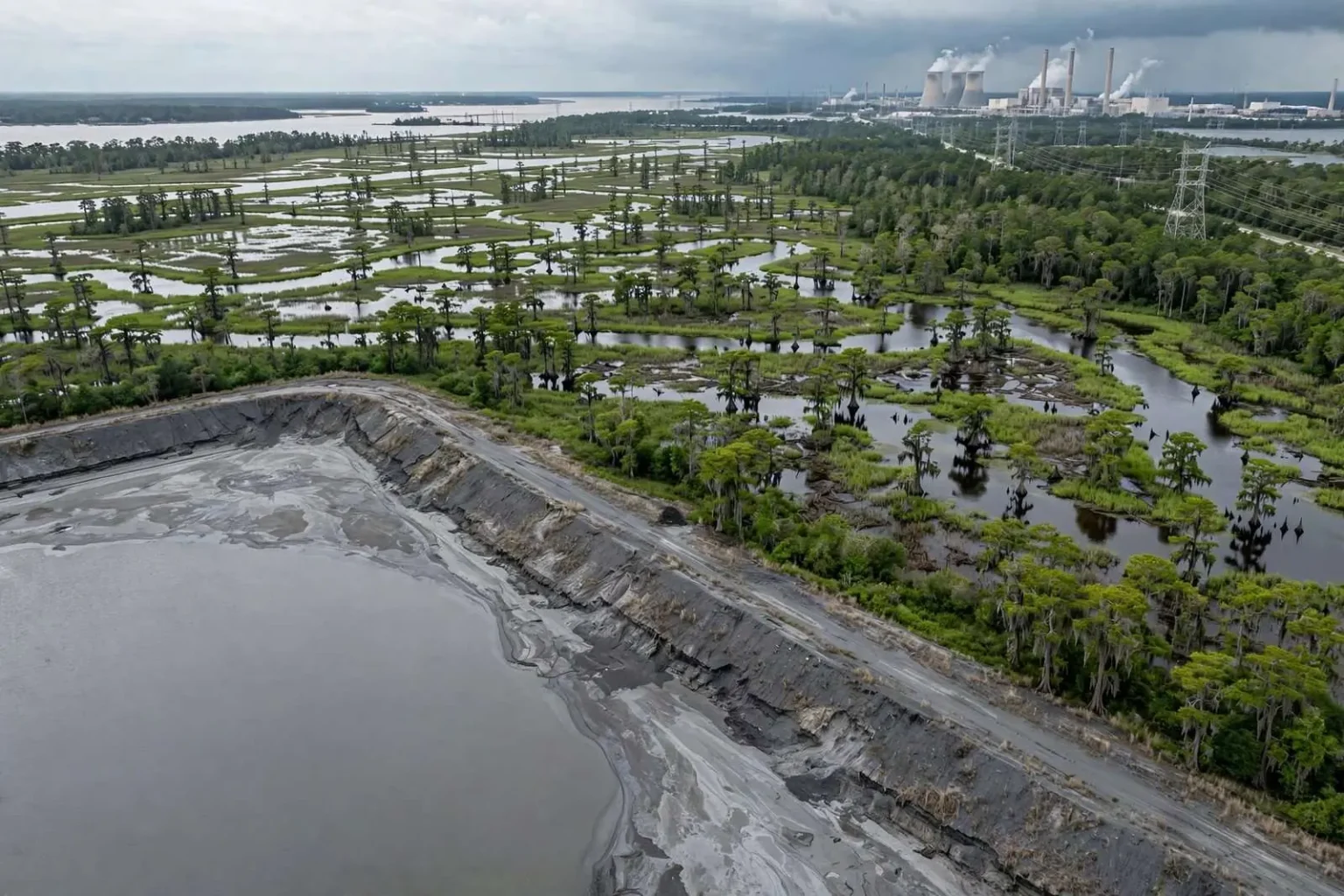
Federal regulators are considering a proposal that would give the state of Alabama oversight of how coal ash ponds are closed at power plants across the state, a shift that critics warn could leave millions of tons of toxic ash buried in place alongside major waterways. The Environmental Protection Agency has proposed approving Alabama’s own coal ash permitting program, which would let state regulators oversee closure of ash ponds at the state’s major power plants rather than the EPA. A similar version of the plan was rejected by federal regulators in 2024 for failing to meet minimum federal safety standards.
Much of the concern centers on the “cap-in-place” approach, which leaves ash sitting where it is and covers it rather than excavating it to a lined landfill. Critics argue that much of the material sits in or near groundwater, where it can leach into the surrounding environment.
Alabama Power, which operates six major coal ash ponds around the state, holds a state permit allowing it to cap at least one major pond rather than remove the ash.
The view from Mobile Bay
Concerns about the practice have circulated for years around Mobile Bay, where a trio of retirees calling themselves the Coal Ash Action Group spent years raising alarms about ash storage near the Mobile-Tensaw Delta, an ecologically rich network of rivers and wetlands sometimes nicknamed “America’s Amazon.”
The group was co-founded by the late Sallie Smith, who continued campaigning even after a stage-four cancer diagnosis. Smith, who was also an Alabama Power shareholder, said in 2023 that she wanted to see the ash moved rather than capped in place. “We want that coal ash moved,” she said. “We are educating people so people know how big the issue is.”
Smith died following her cancer battle, but her advocacy work later helped inspire independent filmmakers to produce a documentary about her efforts, which premiered at a Colorado film festival.
Diane Thomas, 75, another member of the group, said the trio has tried to warn residents about the risk posed by ash sitting close to the water. “When we go out, we tell people there’s a ticking time bomb, 20 miles from the head of the bay,” Thomas said. The group’s third co-founder, 79-year-old Savan Wilson, has focused on spreading the message through social media.
The women have pushed for Alabama Power to follow the lead of utilities in Virginia, North Carolina, South Carolina and Georgia, where coal ash is being excavated and relocated to lined landfills rather than capped in place along rivers and streams. They argue the ecologically diverse waterways feeding Mobile Bay are vulnerable to a major flood event that could spread contamination further into the watershed.
In response to the EPA’s proposal, Alabama Power said it remains committed to following all applicable rules. “We remain committed to complying with all state and federal environmental rules and regulations,” the company said.
What the EPA’s decision would change
Federal coal ash rules adopted after the 2008 Tennessee spill that buried riverside homes in sludge required utilities across the country to close their ash ponds, either by excavating the ash to dry, lined storage or by capping it where it lies. Enforcement of those rules has run through the EPA in states without approved programs, which is why the question of Alabama’s application matters: if the state takes over permitting, decisions about how each pond is closed would move from Washington to Montgomery.
Alabama’s proposed program became a flashpoint precisely because of that shift. Environmental groups point to the state’s 2024 rejection, in which federal regulators concluded the earlier version failed to meet minimum federal standards, as evidence that the state’s framework still falls short. Supporters of state oversight, including the utility and state officials, argue that Alabama regulators are better positioned to evaluate site-specific conditions at each plant and that the state can act faster than a federal docket.
The stakes are measured in millions of tons. Coal combustion residuals, the ash left after coal is burned, contain arsenic, mercury, lead and other contaminants that pose risks to groundwater and surface water when they escape containment. At the six major ponds Alabama Power operates, closure decisions will determine whether that material stays in unlined ponds near rivers and aquifers or moves to engineered landfills designed to isolate it.
The Mobile-Tensaw Delta’s exposure
The Mobile-Tensaw Delta, where the Mobile and Alabama rivers converge into a labyrinth of bottomland hardwood swamp, open marsh and braided channels, is one of the most biologically diverse regions in North America. Its waters feed Mobile Bay, the nursery for Gulf fishery species and the anchor of a seafood economy that has sustained communities around the bay for generations. Conservationists have long warned that a contamination event in the watershed would be extraordinarily difficult to contain once it spreads through the delta’s channels.
That geography is what turned the Coal Ash Action Group’s three founders into activists. The women, all retirees, began attending utility meetings and studying permit filings after concluding that ash ponds upstream of the delta sat in low-lying ground connected to the same groundwater that feeds the river system. Their campaign, carried through public meetings, letters and years of community presentations, made the delta’s exposure a recurring theme in the state’s coal ash debate.
Smith’s role in the group became its defining story. Diagnosed with stage-four cancer while the campaign was underway, she continued speaking at meetings and organizing residents until her health failed, insisting to the end that the ash be moved rather than buried. The documentary that followed her death introduced her campaign to audiences far beyond Baldwin and Mobile counties, screening at a Colorado festival and drawing new attention to the ponds near the delta.
Thomas and Wilson have carried the group’s work forward, with Thomas speaking at community gatherings and Wilson managing the group’s online outreach. Their argument to state officials has remained constant: the neighboring states that excavated their ash did so because the cost of leaving it in place, measured in groundwater monitoring failures and flood risk, was ultimately higher.
Where the regional comparison stands
Utilities across the Southeast have made sharply different closure choices, and those differences now frame Alabama’s debate. In Virginia and the Carolinas, court orders and regulatory decisions required major utilities to excavate millions of tons of ash from riverside ponds and haul it to lined landfills, a costly but definitive removal. In Georgia, the state’s largest utility committed to closing its ash ponds through excavation at most sites. Alabama Power, by contrast, has pursued cap-in-place closures at its own sites, a path the company says is safe and far less disruptive to surrounding communities.
Groundwater and flood risk at the center
The technical heart of the dispute is groundwater. Federal monitoring data filed by utilities across the country have shown exceedances of contaminant levels in wells around unlined ash ponds, and Alabama’s ponds are no exception, with monitoring networks around the state’s plant sites detecting elevated constituents in the shallow aquifers beneath them. Regulators weigh those readings against modeling that predicts how quickly contaminants would travel to drinking water wells or surface water, and it is on those assumptions that the cap-versus-excavate argument turns.
Climate and flood risk sharpen the question in the Gulf Coast context. The hurricane seasons that regularly threaten south Alabama bring storm surge up Mobile Bay and push flood crests down the rivers that feed the delta. Engineers charged with assessing cap-in-place closures must account for the possibility of pond berms being overtopped or saturated by a major flood, and critics of the approach argue that the risk analysis understates what a direct strike from a major hurricane would do to ash impoundments sitting along the river system.
State regulators and the utility counter that modern closure designs, with engineered caps, stormwater controls and long-term monitoring, meet or exceed the requirements the federal rule imposes. They note that excavation carries its own risks and enormous costs, costs that ultimately flow to customers through rates, and that trucking millions of tons of ash across state highways would take years of continuous hauling.
The permitting path ahead
The EPA’s proposal to approve Alabama’s program now moves through the federal comment and review process, where the 2024 rejection of the earlier version looms over the analysis. Federal regulators will have to decide whether the revisions the state has made address the deficiencies that sank the prior application, and comments from environmental groups, the utility and residents around each plant site will become part of the record that decision rests on.
Approval would mean the state’s environmental agency issues and enforces the closure permits for each of the state’s major ash ponds, with the EPA providing only backstop oversight. Critics of the transfer argue that the same state agency that issued the utility its existing permit to cap a major pond is unlikely to demand excavation where the utility has not planned it, and they point to the states that excavated only after regulatory compulsion or court order.
For the residents around Mobile Bay who have followed the issue since the Coal Ash Action Group began its campaign, the EPA’s decision will determine who holds the pen over the delta’s future. Thomas and Wilson have pledged to keep speaking at hearings and organizing online regardless of the outcome, arguing that public attention is the only leverage residents have over how the utility closes its ponds.
The choice facing regulators is ultimately between two visions of closure. One leaves the ash where generations of power generation left it, capped and monitored in place beside the rivers; the other digs it out and moves it to engineered storage, at a cost measured in billions and a timeline measured in decades. Alabama’s six major ponds, and the waterways that flow past them toward Mobile Bay, will live with whichever answer prevails.