If Romney Wins, Who Becomes U.S. Attorney for South Alabama? The Names Being Floated
With the presidential race too close to call, Republicans in Southwest Alabama were already trading names of possible candidates to become the next U.S. Attorney for the Southern District of Alabama.
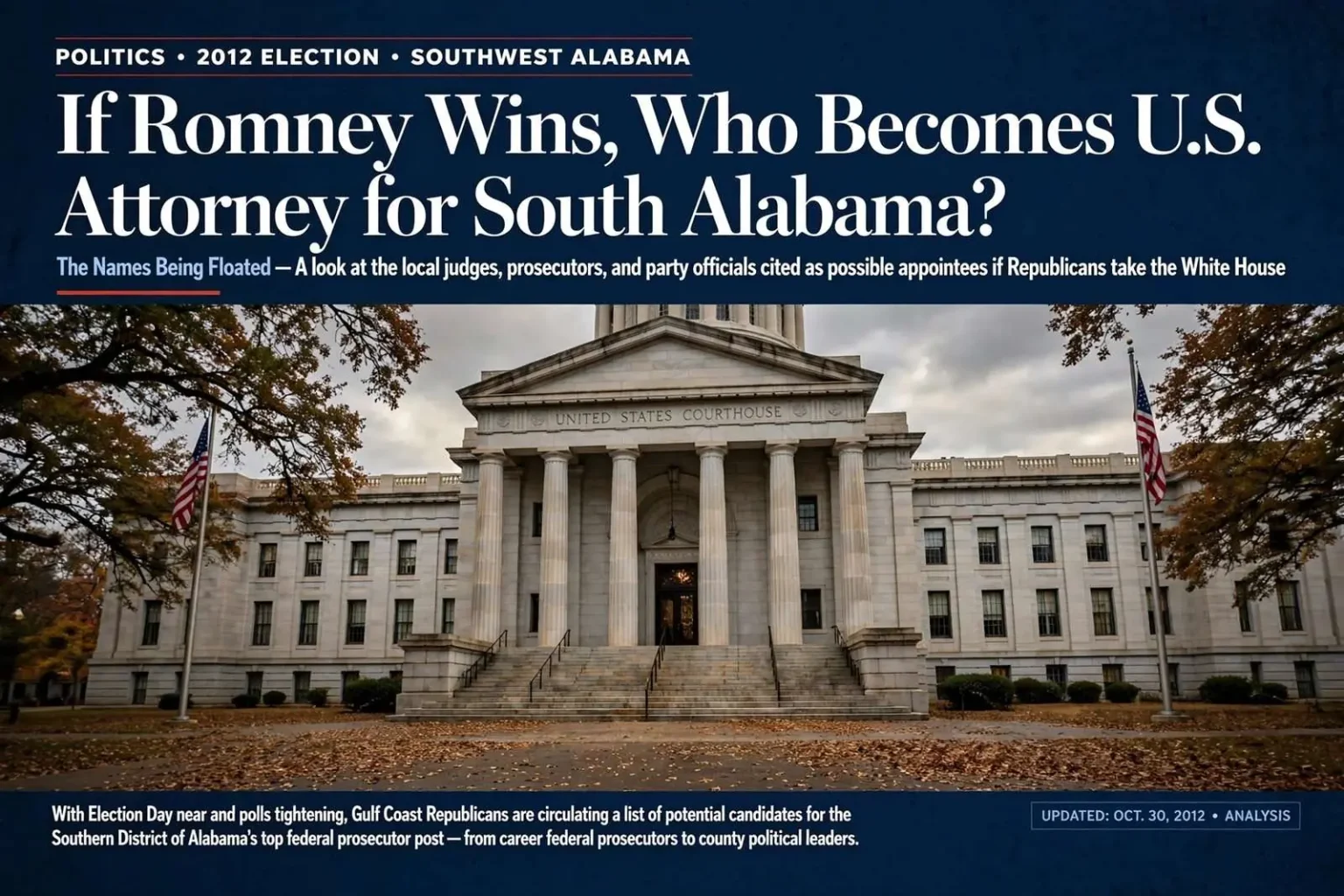
With Election Day near and some polls showing the presidential race tightening, Republicans across Southwest Alabama were already looking ahead to the spoils of a possible victory. High on the list of coveted posts was one of the region’s most powerful federal jobs: U.S. Attorney for the Southern District of Alabama.
A long list of contenders
Among those drawing mention as possible appointees was a deep bench of local legal talent. The names in circulation included current Assistant U.S. Attorney Sean Costello; Washington think-tank lawyer and former Mobilian Mike Wermuth; Escambia County District Judge Dave Jordan; former Chief Assistant U.S. Attorney Richard Moore; and Mobile attorney Dan Cushing.
The speculation extended further to Mobile County Assistant District Attorney Matt Simpson, who also chaired the Baldwin County Republican Party; Mobile Municipal Judge Matt Green, who headed the local Federalist Society; County Attorney Jay Ross; and Mobile attorney Mark Erwin, a former chairman of the Mobile County Republican Party.
Others mentioned were Baldwin County attorney David Green, a former assistant district attorney who lost a runoff bid for district attorney in 2010; Mobile lawyer Brian Pugh; Walter Honeycutt, a one-time GOP nominee for district attorney of Mobile County; Mobile County District Attorney Ashley Rich; Mobile attorney Harry Satterwhite, a member of the Mobile County Republican Executive Committee; and Chickasaw City Councilman Adam Bourne.
Read together, the roster maps the machinery of Gulf Coast Republican politics. It mixes career federal prosecutors with county-level officeholders, sitting judges with party chairmen, and private practitioners whose names carry weight in courthouses on both sides of the bay. Some live in Mobile, some in Baldwin County, one in Escambia County — a reminder that the Southern District’s territory spreads well beyond the Port City itself.
What unites them is eligibility. U.S. Attorney appointments traditionally go to lawyers with prosecutorial experience, party credentials or both, and every name on the list carries at least one of the two. Several carry deep institutional resumes — former chief assistants, sitting district judges, a sitting district attorney — while others offer political loyalty built over years of campaigns and committee work.
Why the post matters
The U.S. Attorney for the Southern District of Alabama serves as the region’s top federal prosecutor, overseeing cases that range from public corruption and drug trafficking to fraud and violent crime across a broad stretch of Southwest Alabama. Because the position is a presidential appointment, its occupant typically changes with the party in the White House — which was precisely why the parlor game of naming successors had begun before a single vote was counted.
The office’s reach is easy to underestimate. Federal prosecution touches the region’s biggest stories — corruption cases at city hall and the statehouse, trafficking rings moving contraband through the Port of Mobile, fraud schemes aimed at the region’s banking and health care systems. The U.S. Attorney sets those priorities, allocates the office’s resources among the district’s divisions, and answers directly to the Justice Department in Washington.
Formally, the process runs through the White House and the Senate. Home-state senators traditionally screen candidates and forward recommendations, the administration nominates, and the Senate confirms. In practice, the local filtering begins long before that — in exactly the kind of name-floating underway across Mobile and Baldwin County, where allies quietly lobby senators’ offices and supporters gauge whether a candidate’s resume will survive scrutiny.
For the hopefuls, the math is straightforward: a Republican victory opens the seat; an Obama win closes it. That is what made the speculation both urgent and entirely premature.
Not so fast
The speculation came with an obvious caveat: the election had not been decided. The Obama campaign had hardly conceded, and neck-and-neck polling made the outcome too close to call heading into the homestretch. Most of the calculus gave the Republican challenger an edge in the popular vote but a more favorable picture for the incumbent in the more meaningful Electoral College. Should the incumbent win a second term, the guessing would be moot.
An Obama second term would likely mean a second term for the sitting U.S. Attorney, Kenyan Brown, leaving the roster of hopefuls to wait for another day. Brown, the Obama administration’s choice to lead the district, would hold the office at the pleasure of the president, and a re-elected president would have little reason to make a change.
That asymmetry — one party’s candidate list against the other party’s incumbent — is built into the structure of federal prosecution. Unlike local district attorneys, who answer to voters, the nation’s 93 U.S. Attorneys serve at the administration’s discretion, and each presidential transition in modern history has produced a nearly wholesale turnover in the ranks. The anticipation of that turnover is what turns every tight presidential race into a job market for ambitious lawyers.
For Mobile’s legal community, the stakes carry a particular edge because the Southern District is a small, close professional world. The prosecutors, defense counsel and judges who would work alongside any new U.S. Attorney already know most of the names under discussion — as colleagues, adversaries or classmates. An appointment reshuffles relationships that have taken decades to build.
The timing also matters within the party. A Romney victory would have set off a scramble for influence with Alabama’s Republican senators, whose recommendations would carry decisive weight. Candidates with chairmanship experience — Simpson in Baldwin County, Erwin in Mobile County — or long-standing committee service like Satterwhite’s would enter that competition with ready-made claims on the party’s gratitude.
A window into local ambition
The exercise offered a revealing snapshot of the region’s legal and political landscape — a roll call of prosecutors, judges, party officials and private attorneys, each with the credentials and connections to be mentioned for a plum federal post. Whether any of them would get the chance depended entirely on a national election whose result remained genuinely uncertain.
For the moment, the names floated as a measure of ambition and standing in Southwest Alabama’s tight-knit legal community, a list of who’s who waiting to see how the votes would fall.
Lists like this one serve a purpose beyond parlor games. They signal to incoming administrations which lawyers are available, which have support among the party’s elected officials, and which combinations of credentials the local bar would consider credible. The mention itself is a kind of currency — not a nomination, but a marker that a lawyer’s name is in circulation for federal consideration.
Several names on the list appeared in multiple categories of service at once. A sitting district attorney, a sitting district judge, a municipal judge, a county attorney and a city councilman all appearing on the same speculative roster illustrates how thin the membrane is between local office and federal ambition in Alabama — where a single election in Washington can redraw career paths across two counties’ courthouses.
The days after the election would settle it one way or the other. A Romney win would convert the list into an actual candidate field, complete with senatorial screening and competing endorsements. An Obama win would send the hopefuls back to their practices and courtrooms to wait for the next opening — with the comfort, common to every generation of Alabama lawyers, that federal posts come around again with each change of administration.
Either way, the episode captured something true about the region: in Southwest Alabama, law and politics have always run on parallel tracks, and the lawyers who run them watch national elections with local eyes.
The geography of the list deserves note as well. Candidates rooted in Mobile proper share billing with figures from Baldwin County and even Escambia County, reflecting how the Southern District’s work extends from the port and downtown courthouses to the growing communities across the bay. Any appointee would run an office whose docket spans beaches, ports, farm towns and two of the state’s largest cities — and whose priorities shift with the terrain, from white-collar fraud in the banking district to drug trafficking along the interstate corridors.
Party service, the common thread among many of the names, functions as the entry ticket in such competitions. Chairing a county party, serving on an executive committee, or carrying a losing nominee’s banner in a tough race builds the relationships through which federal appointments are won. Prosecutorial experience, meanwhile, supplies the credibility that senators look for before forwarding a name. The strongest candidacies — and several on this list qualify — combine both.
For the applicants themselves, there is little downside to being mentioned. A lawyer floated for U.S. Attorney is presumed to be in good standing with the party, the bar and the federal bench — a reputational dividend that survives even a race the other party wins. That is one reason such lists grow rather than shrink as Election Day approaches: the cost of aspiring is low, the honor of being named is real, and only the calendar knows which names will matter.