Alabama Unemployment Rate Hits 37-Year High as Mobile, Baldwin Counties See Steep Job Losses
Alabama's unemployment rate jumped to 12.7 percent in April, its highest mark in 37 years, with Mobile and Baldwin counties both seeing more than a quarter of their labor force file for benefits since the COVID-19 pandemic began.
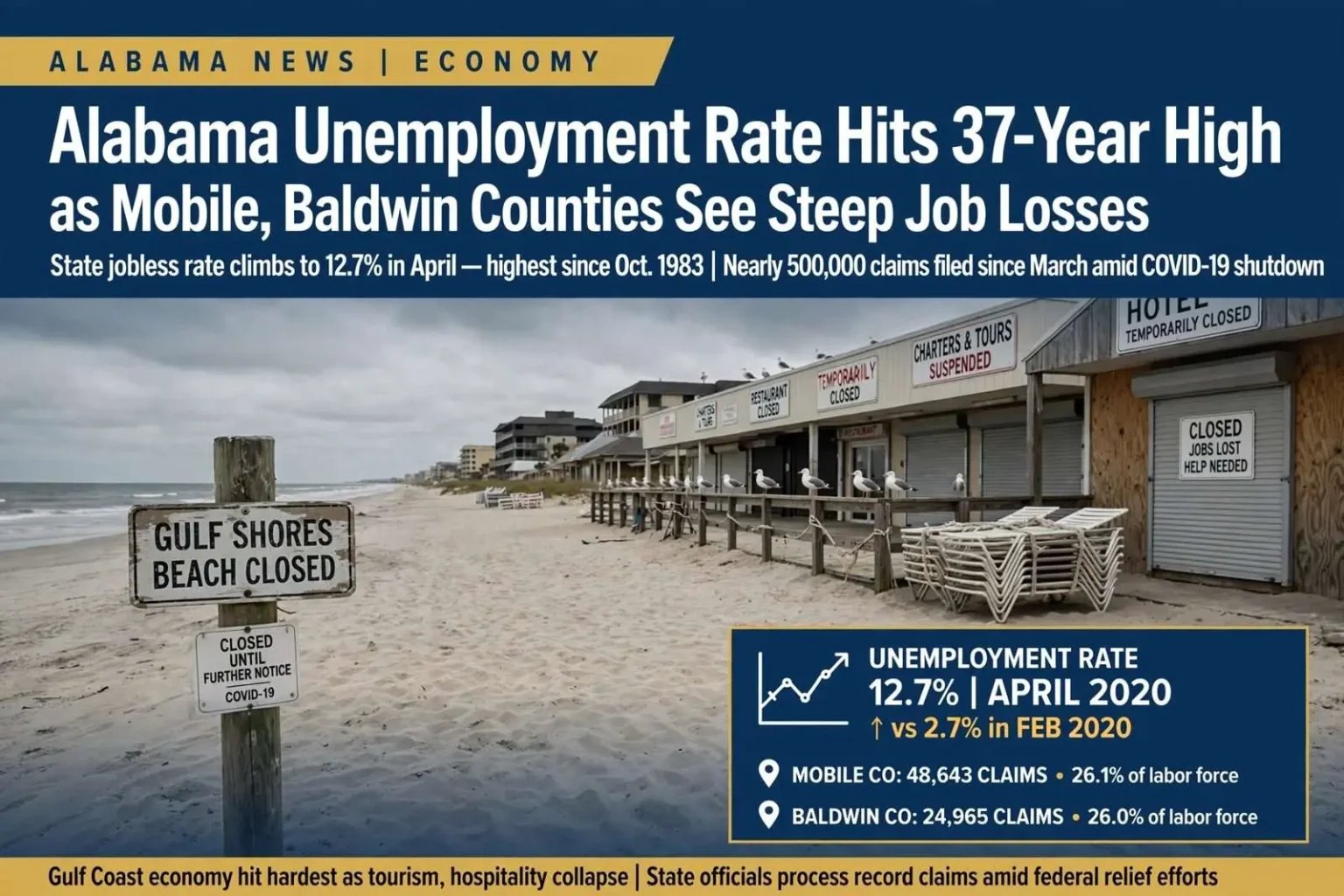
Alabama’s unemployment rate climbed to 12.7 percent in April, the highest level recorded in the state in 37 years, according to figures released this week by the U.S. Bureau of Labor Statistics. The last time joblessness reached a comparable level was in October 1983, when the rate hit 12.8 percent. The federal figure translates to 283,787 people out of work statewide, based on household and business surveys conducted during the week of April 12-18. But state officials say the true scope of the crisis is even larger. The Alabama Department of Labor’s own weekly claims data shows nearly 500,000 residents have filed for unemployment benefits since the COVID-19 pandemic forced widespread business closures in mid-March, a total that represents roughly 21.5 percent of the state’s more than 2.2 million-person civilian labor force.
The impact has hit south Alabama especially hard. In Baldwin County, 24,965 residents have filed unemployment claims since March 14, amounting to 26 percent of the county’s labor force. Mobile County has seen an even steeper toll, with 48,643 filings over the same period, or 26.1 percent of its workforce. Both counties are running well above the statewide average, underscoring how deeply the pandemic-driven shutdown of tourism, hospitality, retail and service industries has cut into the region’s economy. The swing is especially stark given where the state stood just months earlier. In February, before the coronavirus reached Alabama, the unemployment rate sat at a historic low of 2.7 percent.
Governor’s Response and Federal Relief
Gov. Kay Ivey addressed the report in a statement, acknowledging the toll the shutdown has taken on workers while defending the state’s response. “While we are certainly disappointed to see our unemployment rate rise so sharply this month, it’s not surprising,” Ivey said. “This global pandemic and national disaster has certainly impacted Alabamians’ ability to work. We know that hundreds of thousands of people have filed for unemployment benefits, and we are working around the clock to process those claims and get money into the hands of those who need it most.” The governor’s office highlighted the state’s participation in federal relief programs, including the Pandemic Unemployment Assistance program that extended eligibility to self-employed workers, independent contractors, and gig economy workers who traditionally did not qualify for state unemployment insurance.
The Alabama Department of Labor, led by Secretary Fitzgerald Washington, has faced unprecedented claim volumes that overwhelmed the agency’s legacy claims processing systems. The department deployed additional staff, extended call center hours, and implemented emergency rule changes to expedite determinations. By late April, the department reported that over 80 percent of eligible claimants had received at least one payment, though backlogs persisted for complex cases involving identity verification, wage discrepancies, and employer disputes. The federal CARES Act provided an additional $600 per week in Federal Pandemic Unemployment Compensation through July 31, 2020, a supplement that significantly increased the replacement rate for low-wage workers who dominate the tourism and hospitality sectors.
Sectoral Impact: Tourism and Hospitality Devastation
The disproportionate impact on Baldwin and Mobile counties reflects the structure of the Gulf Coast economy, where leisure and hospitality account for a larger share of employment than the state average. In Baldwin County, the tourism industry centered on Gulf Shores, Orange Beach, and Fort Morgan generates an estimated $5.5 billion in annual visitor spending and supports over 50,000 jobs directly and indirectly. The spring break season, typically the industry’s revenue kickoff, was effectively canceled in 2020 as beach closures and travel restrictions took effect in March. Hotels, restaurants, charter fishing operations, and attractions such as the Alabama Gulf Coast Zoo and Waterville USA faced months of zero revenue with fixed costs continuing to accrue.
Mobile County’s economy, while more diversified with shipbuilding, aerospace, and port operations, still derives substantial employment from the hospitality sector concentrated in downtown Mobile, the Causeway, and the Mobile Bay area. The cancellation of Mardi Gras 2021 parades and events — announced months in advance — eliminated a major economic driver that typically generates over $400 million in direct spending during the carnival season. The Mobile Convention Center, the Saenger Theatre, and the Mobile BayBears’ former stadium (now home to the Southern League’s relocated franchise) all sat dark, eliminating secondary spending on lodging, dining, and transportation. The Port of Mobile maintained cargo operations throughout the pandemic, but reduced global trade volumes affected throughput and related logistics employment.
Manufacturing and Industrial Resilience
Not all sectors experienced equal disruption. Airbus’s Mobile assembly line at the Mobile Aeroplex at Brookley temporarily paused production in April 2020 but resumed operations with enhanced safety protocols within weeks, preserving the facility’s 1,500 direct jobs and its extensive supply chain. Austal USA, the Australian shipbuilder that constructs littoral combat ships and expeditionary fast transports for the U.S. Navy at its Mobile shipyard, maintained production schedules driven by defense contracts deemed essential. The region’s chemical and steel manufacturing facilities, including Olin Corporation’s chlor-alkali plant and AM/NS Calvert’s steel mill, operated at reduced capacity but avoided widespread layoffs.
This industrial resilience highlights the dual nature of the south Alabama economy: a tourism-dependent coastal tier that suffered catastrophic job losses, and an industrial inland tier that benefited from federal defense and infrastructure spending continuity. The divergence complicates recovery policy, as blanket reopening strategies risk reigniting viral spread in communities where healthcare capacity — already strained in rural counties — could be overwhelmed. The Alabama Department of Public Health’s data showed that Mobile and Baldwin counties consistently ranked among the state’s highest per-capita case rates during the spring 2020 surge, a pattern attributed to population density, tourism-related travel, and the prevalence of multigenerational households in the region’s African American and Hispanic communities.
Disparities and Demographic Dimensions
The unemployment crisis has exposed and amplified existing economic and racial disparities. Alabama’s African American workers, who constitute approximately 27 percent of the state’s labor force, filed unemployment claims at a rate disproportionate to their population share, reflecting their overrepresentation in the service, hospitality, and retail sectors most affected by shutdowns. In Mobile County, where African Americans make up 35 percent of the population, community leaders reported barriers to accessing unemployment benefits including limited broadband access for online filing, language access issues, and distrust of government systems rooted in historical experience. The Alabama Department of Labor’s partnership with community organizations and libraries to provide in-person filing assistance addressed some gaps but could not fully bridge the digital divide.
Women have also borne a disproportionate burden, both nationally and in Alabama, as the closure of schools and childcare centers forced many to exit the labor force to assume caregiving responsibilities. The Bureau of Labor Statistics’ April report showed that women’s unemployment rate exceeded men’s for the first time in decades, a reversal of the pre-pandemic trend. In south Alabama, where single-parent households headed by women are more prevalent than the state average, the loss of income combined with the loss of childcare created a compound crisis that federal stimulus payments and expanded unemployment benefits could only partially mitigate.
Recovery Outlook and Policy Challenges
Economists at the University of Alabama’s Center for Business and Economic Research and Auburn University’s College of Business projected that Alabama’s unemployment rate would remain elevated through 2020 and into 2021, with a gradual recovery contingent on the trajectory of the virus, the pace of vaccination, and the restoration of consumer confidence in travel and dining. The tourism sector’s recovery timeline is particularly uncertain, as it depends on factors beyond state control: national infection rates, airline capacity, international travel restrictions, and the willingness of families to book beach vacations amid ongoing health concerns. Baldwin County’s lodging tax collections, a real-time indicator of tourism activity, showed year-over-year declines exceeding 60 percent in April and May 2020, with only partial recovery during the summer months.
Policy responses at the state level have focused on balancing public health with economic reopening. Gov. Ivey’s “Safer at Home” order, which replaced the stricter stay-at-home directive in late April, allowed retail, restaurants, and personal services to reopen at reduced capacity with sanitation requirements. The order was extended and modified through the summer as case counts fluctuated. Business liability protections, enacted by the Alabama Legislature in a May 2020 special session, shielded employers from COVID-19-related lawsuits provided they followed public health guidance, a measure supported by the Business Council of Alabama and opposed by trial lawyers and worker advocates.
Long-Term Structural Questions
Beyond the immediate crisis, the pandemic has raised structural questions about the Gulf Coast’s economic model. The region’s heavy reliance on tourism, while historically profitable, has proven vulnerable to global disruptions that are likely to recur. Economic development leaders in both Mobile and Baldwin counties have accelerated efforts to diversify, targeting logistics, advanced manufacturing, and technology-enabled remote work as growth sectors. The Amazon distribution center proposal in Spanish Fort, the ALDI regional headquarters in Loxley, and the expansion of the Port of Mobile’s container terminal all reflect a strategy to build an economy less dependent on seasonal visitor spending. Whether these investments can generate enough quality jobs to replace those lost in hospitality — and whether displaced workers can transition into them — will shape the region’s economic trajectory for years to come.