Alabama voters will have the opportunity in the upcoming election to vote on a recompiled, reorganized state constitution that removes racist language, deletes repeated provisions, and reorganizes sections by county. The ballot measure represents the most significant step toward constitutional reform the state has taken in decades, putting before the public a document that advocates hope will finally retire language from an era most Alabamians thought was long behind them.
Drafted in 1901, the Alabama State Constitution is known as the longest in the world, with nearly 1,000 amendments. Its length is the product of a design choice, not an accident: rather than granting local governments broad home-rule powers, the constitution funnels even minor local questions — mosquito control, bingo, junkyard regulation — through statewide amendments, each one adding to the document’s bulk. The result is a governing text measured in hundreds of thousands of words, far outstripping the constitutions of other states and even the U.S. Constitution.
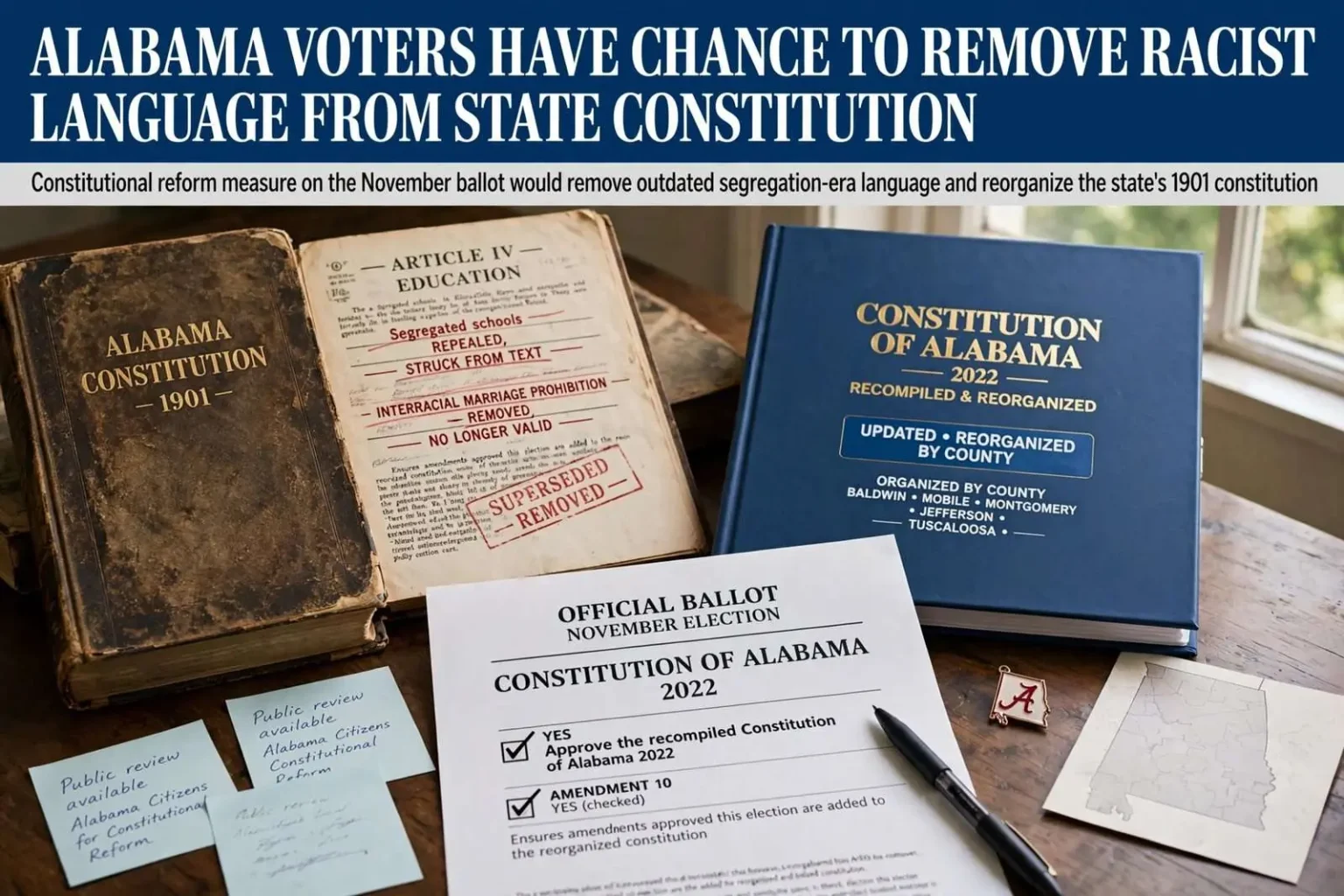
The document contains outdated and offensive language, including provisions that explicitly banned interracial marriage and mandated segregated schools. While federal court rulings and later amendments rendered those provisions unenforceable long ago, they remained embedded in the text — symbols that reformers say have cost the state in reputation and in the daily message they send to Alabamians reading their own founding document.
What Reformers Say Needs to Change
Policy analyst Mike Nicholson with Alabama Arise, the Montgomery-based advocacy organization that focuses on tax and budget policy affecting low-income Alabamians, says the state constitution has been in dire need of changes and no longer represents Alabama in 2022. “Our Constitution was written in a way to disenfranchise Black people in our state and poor people in our state,” Nicholson said. “But it was written in a way to make it really difficult for anyone to do anything without approval from the state legislature.”
That centralized control is a signature of the 1901 document. Delegates at the constitutional convention that year openly pursued a framework that would concentrate power in the legislature and preserve the political dominance of the state’s industrial Black Belt interests, and the structure they built — tight limits on local taxing and governing authority — remains the architecture Alabama local governments operate within today.
Mobile native Sue Cato Winter with the Alabama Citizens for Constitutional Reform explained that the new constitution has already been written and is available for public review before citizens cast their votes. “What they did is they deleted all the racist language, all the illegal language,” Winter said. “And they reorganized it so that all of these amendments that we talk about are now going to fall” into their proper places in the reorganized document.
Long, Still — But Organized
With 997 amendments, the new constitution will not be any shorter, but the language will be different and more organized. The recompilation arranges local amendments by the county they apply to, removes duplicated provisions and strikes language invalidated by courts or superseded by later change. Advocates describe it as a housekeeping measure with symbolic weight: nothing about the balance of power in state government shifts, but the document Alabamians live under will no longer carry the segregation-era text that has embarrassed the state for generations.
Lawmakers approved placing the recompiled constitution on the ballot, with legislators pushing for this change since 2019. The legislative route followed years of study by a citizens’ committee and successive bills that died in session before the recompilation finally cleared both chambers — a reminder that even technically noncontroversial reform has struggled in a Statehouse where touching the constitution has long been politically fraught.
A First Step, Advocates Say
Nicholson says approving the recompiled state constitution is a first step toward making Alabama a better state. “Approving this change doesn’t fix all those problems,” Nicholson said. “But it does open the door. And it does put our foot on the path to creating a more equitable and more fair state and in writing some of the wrongs that our state has committed.”
Winter expressed optimism that enough voters will come to the polls to get the new constitution in place, noting that Governor Ivey has publicly expressed her support. Bipartisan backing from the governor’s office and legislative leaders has given the measure a profile that earlier reform efforts never achieved, though advocates acknowledge that constitutional ballot items rarely draw attention next to the races at the top of the ticket.
To vote in favor of the new constitution, voters must choose YES under “Constitution of Alabama 2022.” Voters will also have the option to vote in favor of Amendment 10, which would add any amendment approved in the election to the new constitution — a companion measure that ensures local amendments passed at the same election are not orphaned outside the reorganized text.
Why the 1901 Constitution Still Matters
Understanding what is on the ballot requires understanding what the 1901 constitution was built to do. Its framers convened with an explicit agenda of disenfranchisement, and the document they produced imposed poll taxes, literacy tests and property requirements that stripped the vote from most Black Alabamians and tens of thousands of poor white voters as well. The same convention deliberately weakened county and municipal government, reserving real authority to a legislature elected under the system the constitution itself rigged.
The consequences outlasted the civil rights era. Counties cannot raise their own revenue or govern their own zoning without legislative approval, which is why local matters appear on statewide ballots and why Alabama’s constitution keeps growing. Cities such as Mobile and Birmingham have spent years asking the legislature for the limited-home-rule powers other states grant as a matter of course. The recompiled document leaves that structure untouched — reformers say deliberately, to keep the measure focused and passable — which is precisely why they describe approval as a beginning rather than an end.
The practical stakes for voters are modest: the recompilation does not change taxes, term limits or local powers. The symbolic stakes are what supporters emphasize. A constitution that no longer instructs school segregation or bans interracial marriage, arranged so that a reader can find what applies to their county, removes a daily reminder of the document’s original purpose. For the organizations that have campaigned for reform for more than two decades, a YES vote is the first page of a new chapter in a governing text that has carried the old one for 121 years.
The Long Road to the Ballot
The measure on this year’s ballot did not appear overnight. Alabama Citizens for Constitutional Reform and allied groups have campaigned for a citizen-led convention or legislative recompilation since the early 2000s, when a coalition of civic, business and religious organizations made constitutional reform a standing item on the state’s civic agenda. Past efforts stalled over fears — aired in legislative hearings and campaign-season editorials — that touching the constitution would reopen divisive questions about taxes and home rule, and several recompilation bills died without ever reaching a floor vote.
The breakthrough came when legislators narrowed the question. Instead of a convention that could rewrite the document wholesale, the approved approach is a technical recompilation: delete what courts have invalidated, remove what is duplicated, arrange the rest by county, and change nothing of substance. That framing won support from lawmakers who would never back a broader rewrite, and it assembled the votes that had eluded reformers since 2019’s push began in earnest.
Public review has been a deliberate part of the strategy. The recompiled text has been made available ahead of the election so that voters can see for themselves what was removed and how the document is now arranged, an effort to counter the suspicion that often surrounds anything labeled “constitutional reform” in Alabama politics.
How the Amendments Pile Up
The strangeness of Alabama’s constitution is easiest to see in its amendments, which range from the consequential to the comically local. The document’s amendment count has been driven by hundreds of measures that apply to a single county or even a single city — provisions covering everything from livestock and landfills to police jurisdictions and funeral processions. Because the constitution grants so little self-governance to local governments, a town that wants to regulate a nuisance or levy a modest tax must ask the entire state to amend the constitution on its behalf.
The recompilation does not stop that process, and with 997 amendments it cannot pretend the document will be brief. What it does is impose order: local amendments grouped under the counties they govern, so a resident of Baldwin or Mobile County can find the provisions that actually apply at home without wading through measures written for the Tennessee Valley or the Black Belt. Reformers describe the new arrangement as the difference between an archive and a usable governing document — still sprawling, but navigable, and no longer quoting the worst of its own history.
For Alabama Arise and the Alabama Citizens for Constitutional Reform, the election is the moment when voters decide whether the state’s founding legal text will enter the next decade still carrying the language of 1901 or finally cleaned of it. Both organizations urge a YES vote — not because the recompiled constitution transforms state government, but because, in Nicholson’s words, it opens the door.