Alabama’s 10 Biggest-City Mayors Convene in Mobile to Tackle Mental Health
Mayors of Alabama's 10 largest cities met in Mobile for a panel on mental health, crisis response and court partnerships, joined by Chief Justice Sarah Stewart and other experts.
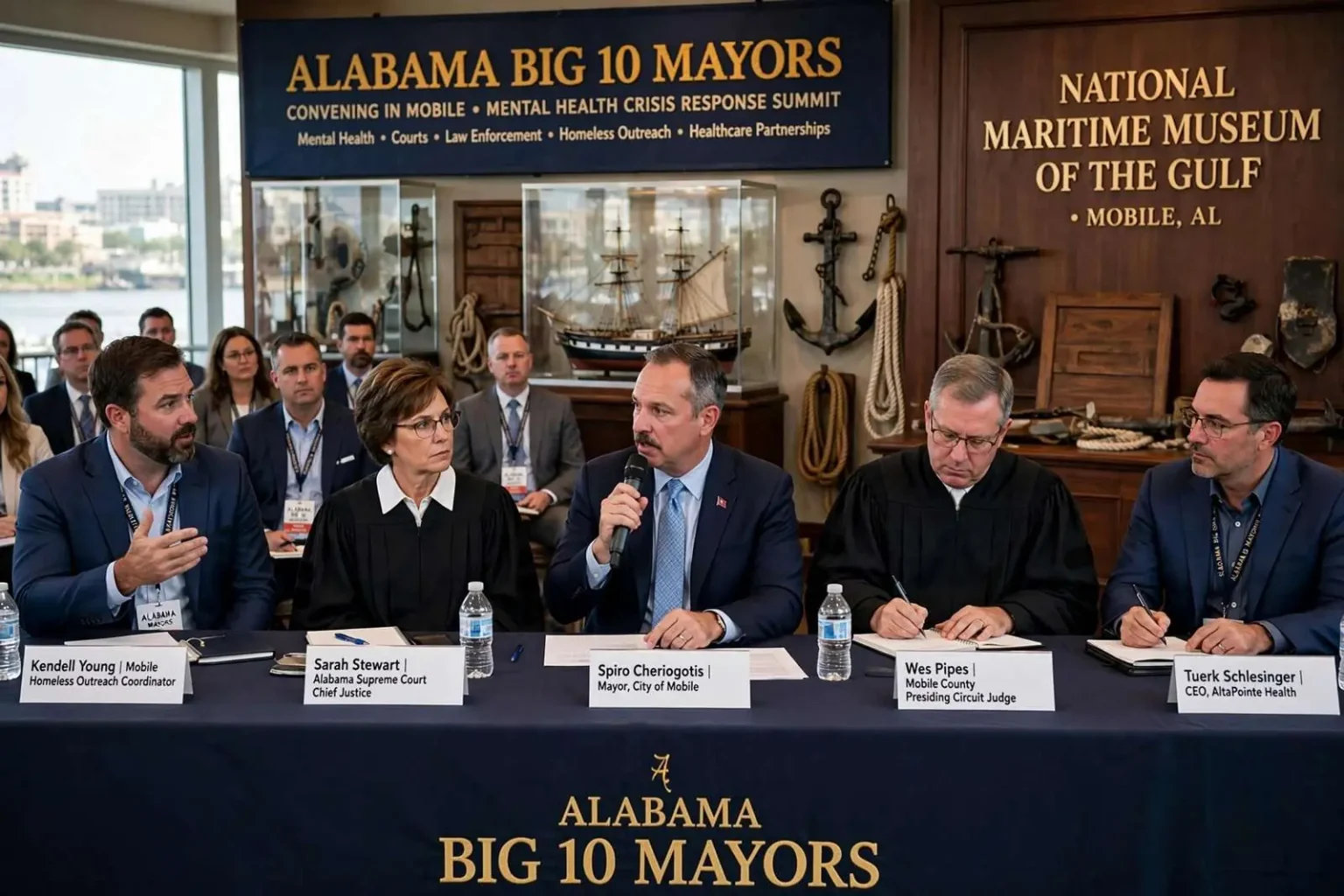
MOBILE — The mayors of Alabama’s 10 largest cities gathered in Mobile this week to advance one of their top shared priorities: improving how communities respond to mental health needs. As part of their ongoing work on the issue, the Alabama Big 10 Mayors convened leaders from health care, law enforcement and the judicial system for a panel discussion at the National Maritime Museum of the Gulf, focused on crisis response, court partnerships and outreach strategies.
Experts at the Table
Mobile Mayor Spiro Cheriogotis moderated the panel, which included Alabama Supreme Court Chief Justice Sarah Stewart, Mobile County Presiding Circuit Judge Wes Pipes, AltaPointe Health CEO Tuerk Schlesinger and Kendell Young, the city of Mobile’s homeless outreach coordinator. The discussion gave the mayors a chance to hear directly from experts working at the intersection of mental health, public safety, the courts and homelessness, while identifying approaches that could be shared and strengthened across Alabama’s largest cities.
The mix of voices was deliberate. A chief justice can speak to how the court system handles defendants in mental health crisis; a presiding circuit judge sees the docket-level reality of cases where illness, addiction and the law collide; a hospital system executive sees the treatment side and the bed shortages that follow; and an outreach coordinator works the street level, where unmet needs first show up in camps, shelters and 911 calls. For mayors, who sit at the bottom of the funnel where every one of those systems deposits its hardest cases, the panel offered a cross-section few other forums could match.
Mobile’s Own Crisis Model
Mobile leaders highlighted the city’s own crisis intervention and outreach efforts, including partnerships among the city, AltaPointe Health and the Mobile Police Department. The mayors also compared best practices and lessons learned from communities across the state. Mobile has spent years building a model in which mental health professionals are woven into the response to calls that once fell to police officers alone, aiming to connect people in crisis with treatment rather than jail cells whenever circumstances allow.
AltaPointe Health serves as the community mental health authority for the region, operating crisis services, inpatient care and outpatient programs across Mobile County and beyond. Its role in the city’s crisis response reflects a national shift: communities that pair dispatchers, clinicians and trained officers consistently report better outcomes for people experiencing psychiatric emergencies, including fewer arrests, fewer emergency room transports and more people steered into treatment on their first contact with the system.
The court side of that pipeline matters just as much. Judges and court leaders described the role of specialized dockets and court partnerships that redirect appropriate cases toward supervision and treatment, an approach that has spread through Alabama’s judiciary as evidence mounts that incarceration alone does nothing to treat the underlying illness driving repeat contact with the law.
A Shared Agenda for Ten Cities
The meeting builds on the Alabama Big 10 Mayors’ commitment to make mental health a central focus of their collaborative work. Although each city faces different needs, the mayors said Alabama’s largest communities share many of the same challenges and can benefit from working together to identify effective solutions, strengthen partnerships and better connect residents with resources.
“Mental health is one of the most important challenges facing our cities, and it is a priority for all ten of us,” the Alabama Big 10 Mayors said in a joint statement. “Our cities see every day what happens when people cannot get the help they need. We also see what is possible when mental health professionals, law enforcement and the courts work together.”
The Big 10 coalition gives the state’s urban centers a unified voice on issues that cross municipal boundaries. Mental health has proven to be the issue where that unity carries the most weight, because the problems — hospital bed shortages, jail overcrowding, homelessness, first-responder strain — look remarkably similar whether a city sits in north Alabama, the Black Belt or the Gulf Coast.
Why Mayors Carry the Mental Health Load
City halls across Alabama have watched mental health needs flow into services they fund directly: police departments fielding thousands of behavioral-health calls a year, municipal jails holding people whose primary condition is illness rather than criminality, park and sanitation crews clearing encampments, and emergency rooms and shelters absorbing the overflow. Mayors do not run the mental health system — the state does — but their cities pay the price when it fails, which is why the Big 10 mayors elevated the issue to a shared legislative and programmatic priority.
The coalition’s approach has been to push for systemic change at the state level while improving what cities can control locally: how calls are dispatched, how officers are trained, how outreach teams engage people living unsheltered, and how municipal courts route people into treatment instead of fines they cannot pay. The Mobile panel was designed to sharpen exactly those levers by letting mayors question the people who run the systems day to day.
The Crisis Response Continuum
Nationally, the model gaining ground is a full crisis continuum: a three-digit crisis line for people to call, mobile crisis teams that can respond in person, and receiving facilities where law enforcement can drop off someone in crisis quickly and get back on the street. Each piece reduces the pressure on the next. When a mobile team resolves a call clinically, no arrest happens; when a receiving center takes a patient in minutes, officers are not stuck in an emergency room for hours; when treatment follows, the same person is less likely to call 911 again next month.
Panelists walked the mayors through how the pieces fit together in practice, including the funding mechanics — federal Medicaid options, state appropriations and local contributions — and the operational details that determine whether a program works in a mid-sized Southern city as opposed to a large coastal metropolis. The mayors, in turn, shared which pieces their cities have built and which remain missing, a comparison that helps each mayor see the next step for their own community.
Homelessness at the Center
The presence of Mobile’s homeless outreach coordinator on the panel underscored how tightly homelessness and mental illness are braided in Alabama’s cities. Outreach teams encounter a population in which untreated psychiatric conditions and substance use are common, and in which a hospital discharge, a jail release or an eviction can set off the spiral into the street. Cities that build outreach capacity — workers who know individuals by name and can shepherd them through benefits applications, treatment appointments and housing waitlists — consistently move more people off the sidewalk than enforcement alone ever has.
For the visiting mayors, Mobile’s experience offered a working example of coordination between city government, a regional mental health provider and police leadership. The model’s premise is simple: the same people keep showing up in different systems, and connecting the systems is cheaper and more humane than letting each one fail the person in turn.
The Courts as a Front Door to Treatment
Chief Justice Stewart and Judge Pipes brought the judicial perspective to the discussion, an increasingly important seat at the table as Alabama’s courts expand mental health dockets and diversion programs. Specialized courts screen defendants whose offenses stem from untreated illness, then supervise treatment plans that can include medication, counseling and housing support, with charges potentially dismissed upon completion. The approach relieves jail overcrowding, reduces recidivism and, its advocates argue, treats the actual problem for the first time.
Presiding judges also see the upstream failures. By the time a person reaches a felony docket, years of missed treatment opportunities have usually passed — a first psychotic break nobody followed, a family that could not navigate the commitment system, an arrest that resolved nothing. Judges and mayors comparing notes on those failures is precisely the kind of systems-level conversation the Big 10 coalition was formed to host.
The National Maritime Museum as a Meeting Ground
The choice of venue placed the discussion at the National Maritime Museum of the Gulf on Mobile’s riverfront, a facility that celebrates the working maritime history of the Gulf Coast and has quickly become a gathering place for civic events in the city. Hosting the panel there put the mayors in one of downtown Mobile’s most visible public buildings, a short distance from the city government, courthouse and hospital districts where the policies under discussion play out.
Mobile’s turn as host fits the rotation-style rhythm of the coalition, which meets in member cities across the year and uses each gathering to spotlight local programs. For Mobile, the meeting was a chance to show off the crisis-response infrastructure it has built with AltaPointe and the police department, and to press its peers to adopt comparable systems in their own cities.
What Comes Next for the Coalition
The mayors left the panel with a clearer picture of the state’s mental health landscape and a set of shared takeaways: crisis response works when clinicians lead, courts work when diversion is available early, and outreach works when someone is responsible for following a person over time. The coalition’s next steps involve translating those takeaways into unified advocacy at the Statehouse, where funding for mental health crisis centers, community services and judicial programs is decided.
For the ten cities, the stakes are practical rather than abstract. Every improvement in the crisis system shows up in their police call loads, their jail populations, their downtown streets and their emergency rooms. The Alabama Big 10 Mayors have made mental health their centerpiece precisely because no single city can fix it alone, and this week’s Mobile meeting moved the collective work one panel, one comparison and one shared strategy further along.