
Alabama’s Alligator Hunt Registration Opens June 2, With 100 Tags Set for Southwest Alabama
Alabama opens alligator hunt registration June 2 with 260 tags statewide, including 100 for the Southwest Alabama zone in Mobile and Baldwin counties.
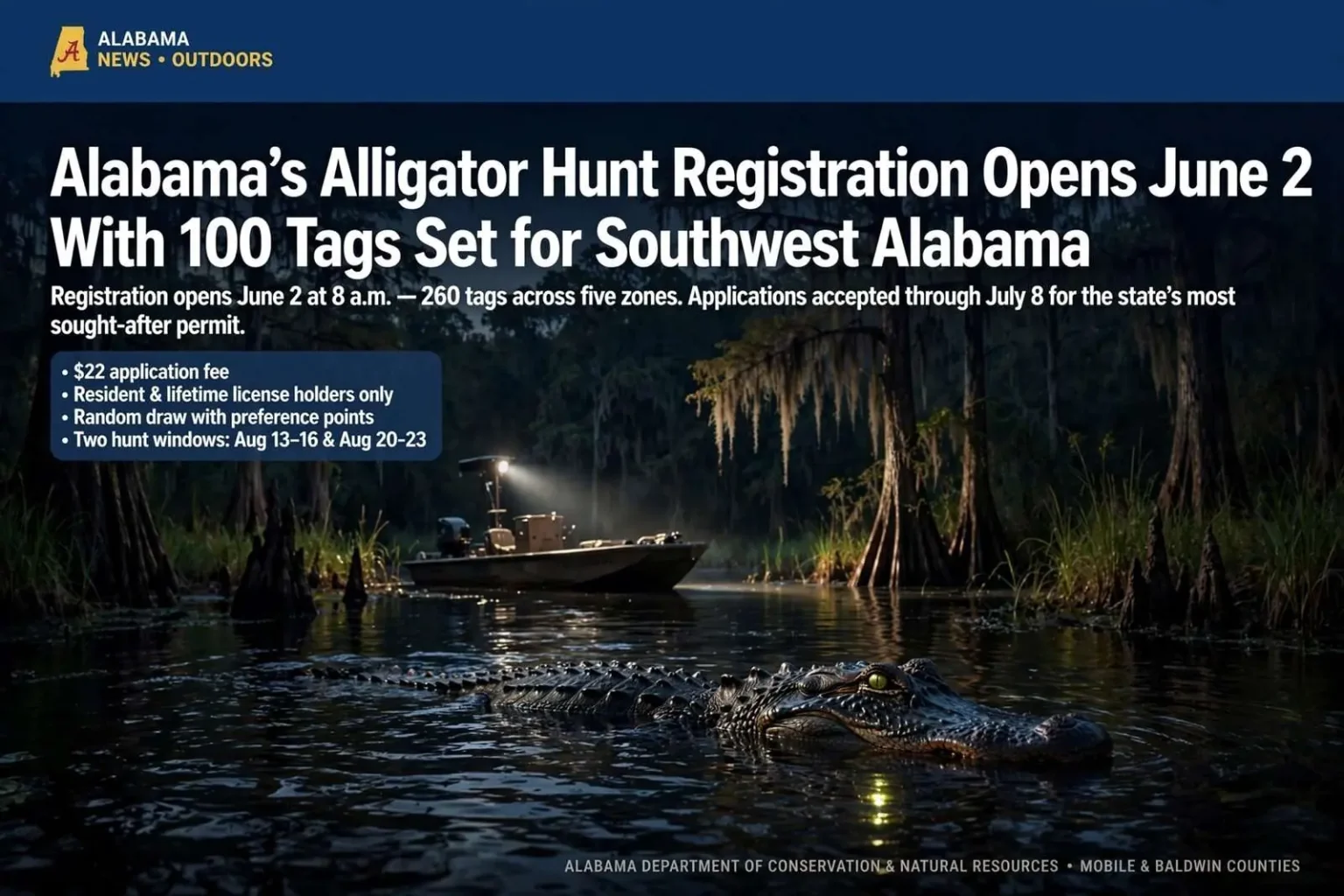
Registration for Alabama’s regulated alligator hunts opens at 8 a.m. on June 2, and hunters across Mobile and Baldwin counties will be competing for the largest block of tags in the state. The Alabama Department of Conservation and Natural Resources will accept online applications until 8 a.m. on July 8. A total of 260 Alligator Possession Tags will be distributed across five hunting zones, with a $22 administrative fee to apply. Applicants may register once per zone.
The annual drawing has become one of the most sought-after permits in the state’s outdoor calendar, with demand for the limited tags far exceeding supply in the south Alabama zones where the state’s alligator population is densest. The tag itself is free, but selected hunters and their assistants must carry valid hunting licenses while in the field.
Who can apply
Only Alabama residents and Alabama lifetime license holders who are at least 16 years old may apply. Lifetime license holders remain eligible even if they have moved out of state. The residency restriction keeps the limited tags in the hands of the state’s own hunters, and the lifetime-license provision recognizes hunters who bought into the state’s licensing system years ago and retain a stake in it regardless of where life has since taken them.
The age minimum aligns the alligator hunt with the state’s general hunting license requirements, and every participant in a harvested hunt — the tag holder and any assistants — must hold the licenses that Alabama law requires for the take. Assistants matter more in alligator hunting than in most pursuits: the work of locating, hooking, subduing and securing an animal that can exceed ten feet is rarely a one-person job in a boat at night.
How hunters are selected
Tags are awarded by random computer draw, one per selected hunter, and are non-transferable. The draw uses a preference point system that improves the odds for people who apply year after year. Skipping a year — or being selected and accepting a tag — resets that accumulated preference.
The preference structure rewards persistence while preserving an element of pure chance. An applicant who registers annually and goes unselected builds points that improve subsequent odds; an applicant who takes a break starts the accumulation over; and a successful draw wipes the slate, so no hunter can bank a selection and dominate the tag pool year after year. The design spreads opportunity across the applicant pool over time, which is exactly what a limited-quota hunt on a public resource is meant to do.
Applicants can check their status after noon on July 8, and those selected must confirm acceptance online by 8 a.m. on July 15. Alternates are notified afterward to fill any openings. Anyone drawn must complete an online alligator training course before accepting hunter or alternate status. A hunter drawn in more than one zone must choose a single location, and the forfeited slot goes to an alternate.
The training course is a recent-generation addition to the process, covering the techniques, regulations and safety practices specific to alligator hunting. The confirmation deadline keeps the tag pool moving — an unconfirmed selection releases the slot to an alternate rather than letting it expire unused — and the alternate system matters because August’s hunts are booked years of applications in advance. An unfilled tag is a wasted opportunity for the hunter who wanted it, and the department’s alternates exist to prevent that waste.
South Alabama zones and dates
The Southwest Alabama Zone carries 100 tags, the most of any zone. It covers private and public waters in Baldwin and Mobile counties north of Interstate 10, along with waters in Washington, Clarke and Monroe counties east of U.S. Highway 43 and south of U.S. Highway 84. The Coastal Zone covers Baldwin and Mobile county waters south of Interstate 10. Both run from sunset August 13 to sunrise August 16, and again from sunset August 20 to sunrise August 23.
The two south Alabama zones together account for well over half of the state’s 260 tags, a proportion that reflects the alligator population’s distribution. The Mobile-Tensaw Delta, the Mobile River system and the tributary swamps of Baldwin, Washington, Clarke and Monroe counties hold the state’s densest concentrations of alligators, in a landscape of braided rivers, oxbow lakes and flooded timber where the animals have thrived for generations. The Delta alone, one of the largest river deltas in the country, offers habitat — and trophy-sized animals — that draw hunters from across the region.
The zone boundaries split the region at Interstate 10, the highway that crosses Mobile Bay on the causeway and separates the coastal marshes and brackish waters to the south from the river systems to the north. Hunting in both zones is done by boat, mostly at night, with hunters locating alligators by the reflective shine of their eyes across the water before attempting a hookup.
The split-season dates — two four-night windows in mid- and late August — spread hunting pressure across the summer’s end and give selected hunters some flexibility around weather. August nights on the Gulf Coast are hot, humid and punctuated by thunderstorms, and the two-window structure lets the season absorb a weekend lost to lightning or rough water without ending an entire tag holder’s hunt.
Elsewhere, the Southeast Alabama Zone has 40 tags across eight counties, the West Central Alabama Zone has 50 tags in Monroe County north of U.S. 84 plus Wilcox and Dallas counties, and the Lake Eufaula Zone has 20 tags in public state waters of the Walter F. George Reservoir. Each zone carries its own character: the southeast zone’s creek and river systems hold a dispersed rural population of alligators, the west central zone’s Black Belt rivers produce large animals in remote country, and Lake Eufaula offers a public-water hunt on a reservoir famous for its bass fishing, where alligators are a lesser-seen but established presence.
Harvest rules
Each tag holder may take one alligator during the season. An eight-foot minimum length applies in the Lake Eufaula Zone; there is no minimum in the other zones. Baiting is prohibited. Every harvested alligator must be tagged immediately with the temporary possession tag and reported as directed for that zone, with the permanent tag issued after the hunt by Wildlife and Freshwater Fisheries Division staff.
The rules reflect how the state manages the hunt’s footprint. The one-animal limit and immediate tagging keep the harvest tightly accounted; the baiting prohibition keeps the hunt a pursuit of wild, free-ranging animals rather than a feed-and-shoot operation; and the reporting requirement feeds the department’s biological data — lengths, weights, locations — that guide each future season’s tag allocations. The Lake Eufaula minimum, unique among the zones, protects the reservoir’s younger animals in a hunt conducted on open public water.
Hunting hours run from official sunset to official sunrise in the Southwest, Coastal, Southeast and West Central zones. The Lake Eufaula Zone permits both daytime and nighttime hunting. All state hunting and boating regulations apply. The nighttime structure defines the hunt’s difficulty: hunters navigate dark water in the hours when alligators are most active, using spotlights to find reflective eyes, close distance quietly, and attempt to hook and secure an animal whose strength in the water exceeds the capabilities of any individual holding the other end of the line.
Boating regulations take on particular weight in an alligator hunt. The activity combines nighttime navigation, heavy gear, restrained wild animals and excited participants in a small vessel, and the state’s boating laws — life jackets, lights, capacity limits, and the rules governing navigation after dark — apply exactly as they would on any other night on the water. Enforcement officers from the Wildlife and Freshwater Fisheries Division patrol the zones during the season, checking tags, harvest reports and compliance.
A conservation turnaround
The American alligator is the largest reptile in North America, capable of exceeding 14 feet and 1,000 pounds. Unregulated harvesting for meat and hides pushed the species toward collapse in the 1920s, 1930s and 1940s. The market hunting era treated the alligator as an extractable commodity, and the harvest of breeding animals from accessible swamps and rivers crashed populations across the species’ range before any regulatory structure existed to stop it.
Alabama is believed to have been the first state to protect alligators, outlawing unlimited harvests in 1938. The state’s early action came decades ahead of the federal framework that would eventually follow, and it preserved the core populations in Alabama’s river systems that would later seed the species’ recovery across the Gulf Coast.
Other states followed, and the U.S. Fish and Wildlife Service listed the species as endangered in 1967. The alligator was removed from that list in 1987 and populations have expanded since. The twenty-year arc from federal listing to delisting made the alligator one of the Endangered Species Act’s most visible success stories, and the recovery was durable enough that regulated hunting became part of the management model rather than a threat to it.
The modern hunt is the product of that turnaround. The 260 tags Alabama now distributes each summer are a managed harvest, set by biologists against population data, and the demand for them — far exceeding supply in every zone — reflects both the species’ restored abundance and the hunt’s reputation. For the hunters drawn each August, the alligator tag is among the rarest and most distinctive permits in American hunting: a night pursuit of North America’s largest reptile, in the swamps and rivers where its recovery began.
The June 2 opening of registration starts that cycle again. Applicants have until 8 a.m. on July 8 to enter, a $22 fee per zone, and — with any luck and enough preference points — an August night on south Alabama’s dark water, waiting for a pair of eyes to shine back from the surface.