University of South Alabama Fairhope
Alan Samry Named New Director of Fairhope Museum of History
The city of Fairhope has tapped longtime Fairhope Public Library staffer and museum volunteer Alan Samry to lead the Fairhope Museum of History, bringing years of local history research and archival experience to the role.
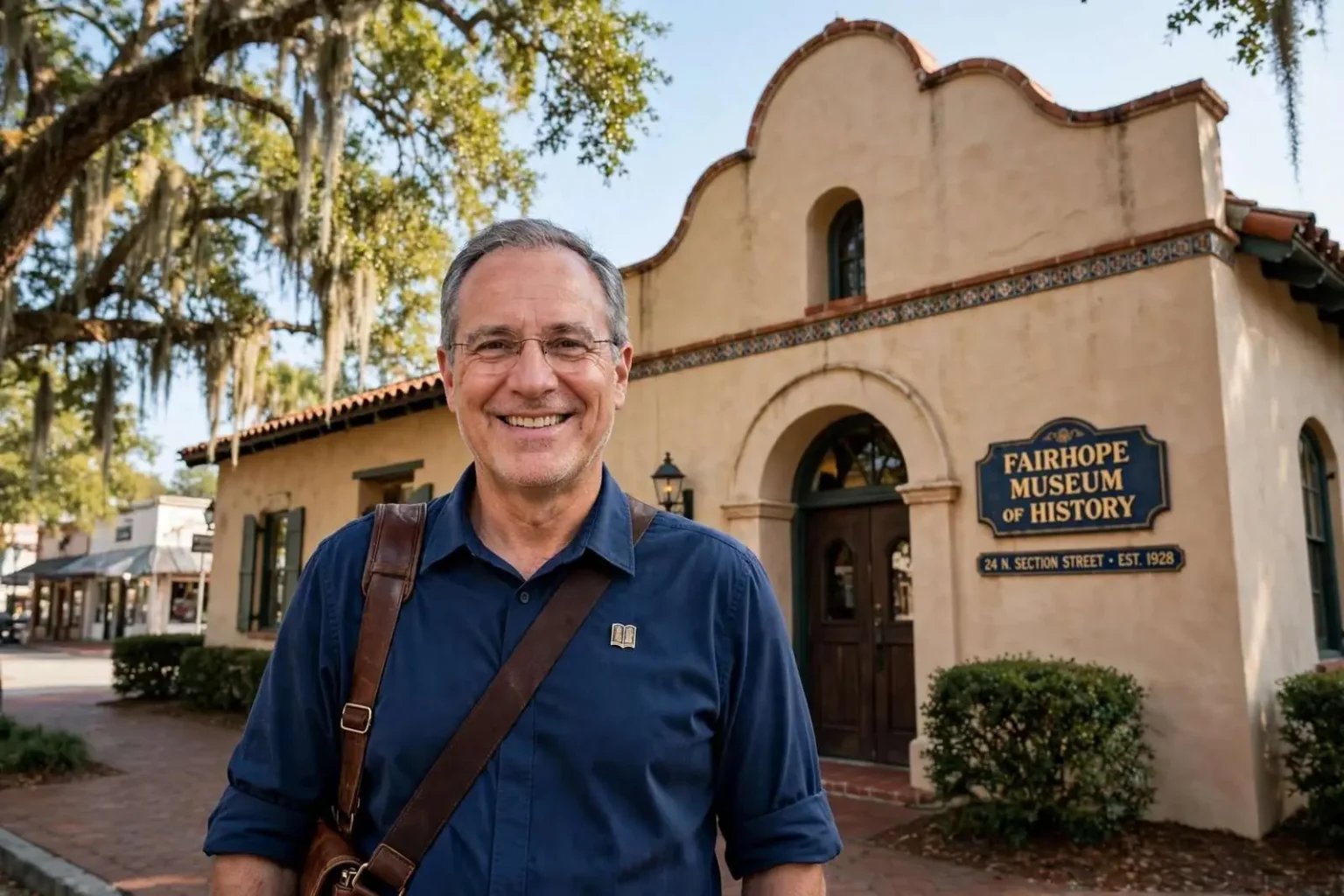
The city of Fairhope has named Alan Samry as the new director of the Fairhope Museum of History, moving him from a longtime post at the Fairhope Public Library to lead the small museum that chronicles the city’s Single Tax colony roots, its literary heritage and its evolution along Mobile Bay. The appointment keeps one of the community’s best-known keepers of local history working a few steps from where he has spent years fielding questions about the city’s past. City officials framed the move as a continuation rather than a departure: a new collection to learn, in a place he already knows well.
Fairhope Mayor Karin Wilson praised the hire, saying Samry’s deep familiarity with the city’s past made him a natural fit to guide the museum’s next chapter. “Our Museum is a treasure, and I am certain that under Alan’s leadership we will be able to preserve and present even more of Fairhope’s history,” Wilson said. “I look forward to seeing the ideas, innovation and programming he will bring to the table to make us the best we can be.”
Samry is not new to the museum. He has worked at the Fairhope Public Library since 2007, where he became known as a go-to resource for residents and researchers digging into local history, and he has also served the Fairhope Museum of History as a volunteer and board member. He additionally brings experience from the Baldwin County Department of Archives and History, giving him a broad background in preserving and interpreting the region’s records and artifacts.
“I loved being the go-to person at the library for Fairhope history,” Samry said of his new role. “Moving across Bancroft Street to the museum is a natural progression and a new challenge. It’s a whole new collection to learn, but a great opportunity to serve the community of Fairhope.”
A career built around local records
Samry’s academic background spans several disciplines relevant to the job. He holds a degree in history from the University of South Alabama, a Master of Fine Arts in Creative Writing from Spalding University in Kentucky, and a Master of Library and Information Studies from the University of Alabama. The combination — historical training, writing craft and formal library science — maps closely onto the daily work of a small-town museum director, where the same person may be cataloging artifacts one day, drafting exhibit text the next and answering a researcher’s question the day after that.
Over the years he has conducted extensive research and writing on topics tied to Fairhope’s built and cultural history, including the story of Clay City Tile, profiles of past Fairhope librarians, and historical analyses of several of the city’s notable buildings. That body of work has appeared in local outlets and presentations over the years and has made him a familiar reference point for anyone tracing a house, a business or an institution back through Fairhope’s past. In a city where historic preservation debates and development questions regularly intersect, a director who has already written about the surviving structures themselves brings a practical advantage.
The transition also says something about the relationship between the library and the museum in Fairhope. The two institutions sit near one another in the city’s compact downtown core, separated by Bancroft Street, and they have long functioned as companion stops for people researching local history. Researchers who start with newspaper clippings and city directories at the library frequently end up at the museum, standing in front of photographs, maps and objects that document the same subjects. With Samry now leading the museum after years at the library, that informal pipeline between the two institutions should only get easier to use.
A literary thread in a literary town
Samry is also a published author. His book, “Stump the Librarian: A Writer’s Book of Legs,” reflects an interest he plans to carry into his new position: promoting the literary history that has long been part of Fairhope’s identity, from its ties to writers and publishers to the storytelling traditions embedded in the community. The book grew out of his dual life as a librarian and a working writer, and it captures the same curiosity about odd questions and overlooked stories that has defined his reference-desk reputation.
The literary angle is not incidental for a museum in this particular town. Fairhope was founded in 1894 as a Single Tax colony, an experiment by Midwestern reformers who came to the eastern shore of Mobile Bay to build a community around the land-value tax ideas of economist Henry George. The colony’s promise of cheap land, free inquiry and reform-minded company attracted not only farmers and craftsmen but educators, idealists, publishers and writers, and that intellectual strain never left the town. Generations of authors, essayists and small-press publishers have lived in or passed through Fairhope, and the town’s bookstores, writing groups and library programming have kept that inheritance visible.
A museum director who is himself a published author and a creative writing teacher of sorts by training is an unusually good fit for that legacy. Under his direction, exhibits and public programs that connect Fairhope’s writers and publishers to the broader story of the colony — and of Baldwin County — are a natural area for growth. Samry indicated as much himself.
“I’m so excited to share the Fairhope stories I’ve discovered, but I’m looking forward to learning so much more about the city’s past,” Samry said. “I know many of the docents at the museum and they love sharing Fairhope’s history as much as I do. For me, Fairhope history never gets old.”
A working historian at home in Fairhope
The appointment also reflects the way local history careers actually develop on the Gulf Coast. Samry’s route ran through the Baldwin County Department of Archives and History, where he worked with the records of one of Alabama’s oldest counties — land files, court records, photographs and family papers that document settlement along the bay — before settling into the Fairhope Public Library in 2007. Volunteers and board members at the Fairhope Museum of History came to know him through that work, and his service to the museum made the transition from supporter to director a short one.
Samry and his wife, Susan, a second-grade teacher at Daphne East Elementary, live in Fairhope. That residency matters in a town that takes its own story seriously. A director who lives in the city, shops in the downtown he interprets, and fields questions from neighbors at the grocery store has an accountability to his audience that is different from what a newcomer would face. Fairhope residents are famously protective of their history and quick to notice when it gets a detail wrong, and the museum’s leadership has always reflected that.
The city’s growth adds urgency to the work. Fairhope has been one of Baldwin County’s fastest-growing communities in recent years, drawing new residents who arrive with little knowledge of why the town looks the way it does — the park system, the streets, the public waterfront, the colony-era houses scattered along the bluff. The museum is the front door to that story, and a director whose specialty is answering exactly those questions positions the institution to absorb the newcomers without losing the narrative.
The museum and its home
The Fairhope Museum of History is housed in the historic circa-1928 Spanish mission-style former City Hall at 24 N. Section Street. The building served as Fairhope’s seat of municipal government for decades before the museum moved in, and its distinctive architecture — stucco walls, curved gables and the proportions of the Spanish mission revival style — makes it one of the most recognizable civic buildings in downtown Fairhope. The structure is itself an exhibit of sorts, a physical reminder of the city’s growth from colony experiment to bayfront municipality.
The building’s permanent exhibits trace the city’s founding and growth, walking visitors through the establishment of the Single Tax colony, the development of the Fairhope Single Tax Corporation, the town’s emergence as a resort and arts destination on Mobile Bay, and the everyday lives of the families who built it. A mezzanine gallery hosts rotating and large-scale changing exhibits throughout the year, giving the museum room to explore single topics in depth — a shipwreck, a school, a neighborhood, an industry — while the permanent displays hold the through-line.
The museum is open from 9 a.m. to 5 p.m. Tuesday through Saturday, and admission is free. That free-admission policy has made it a regular stop for school groups, visiting families and travelers walking Section Street, and it fits the institution’s identity as a civic resource rather than a commercial attraction. Residents with questions can reach the museum at 251-929-1471.
What the appointment means for the museum’s next chapter
Samry’s appointment comes as the museum continues to serve as a hub for residents and visitors interested in Fairhope’s Single Tax colony origins, its development as a resort and arts community, and its ongoing role as a keeper of local memory. The institution has a mandate that keeps expanding: every year brings new donations of family photographs, letters, tools and keepsakes from longtime Fairhope families, and every year of rapid growth on the Eastern Shore makes the documented past more valuable to the people living through the change.
City officials said they expect his combined library, archival and museum experience to help expand programming and community engagement in the years ahead. In practice, that likely means more of what Samry has already demonstrated as a librarian: talks, walking-tour-style storytelling, published short histories, research assistance for homeowners and students, and partnerships with the schools and civic groups that keep local history in circulation rather than in storage. Docents — the volunteers who know the collection best — will remain central, and Samry’s familiarity with them should smooth day-to-day operations from the start.
For a museum, leadership continuity built on local knowledge is worth more than any single exhibit. Samry’s years at the reference desk taught him which questions people actually ask about Fairhope’s past, and his archival background taught him how to find answers in records most visitors never see. Carrying that skill set across Bancroft Street into the building at 24 N. Section Street puts the collection in the hands of someone who spent years learning the stories behind it — and who, by his own account, does not find any of it old.