Albritton Unveils New Bills to Bring Casino, Lottery Vote Before Alabama Voters
State Sen. Greg Albritton has introduced new constitutional amendment legislation that would let Alabama voters decide on a state lottery, expanded casino gambling and sports betting, with Mobile County's greyhound track among five sites eligible for a casino license.
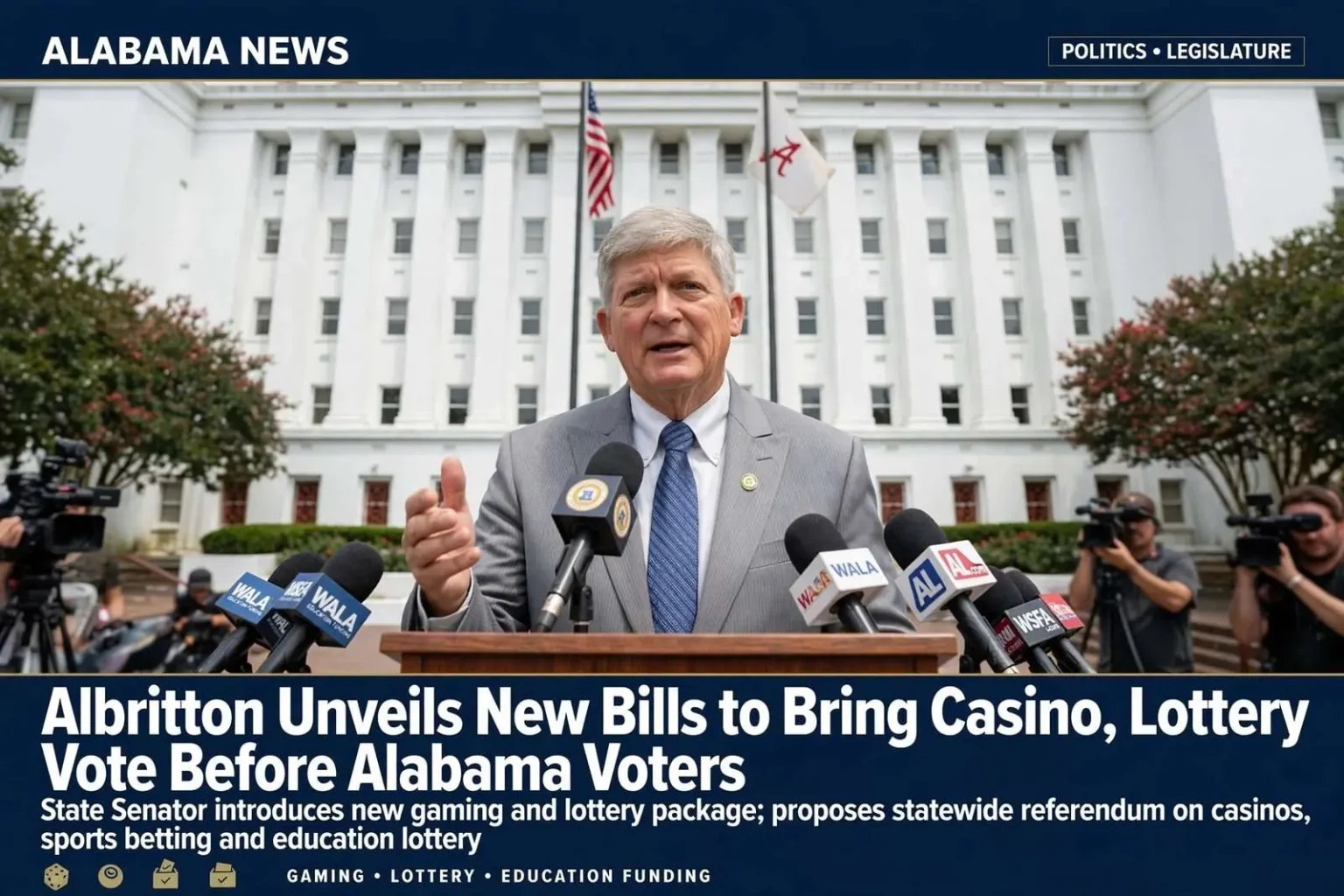
State Sen. Greg Albritton has introduced a new pair of gambling and lottery bills in the Alabama Legislature, reviving a long-running push to bring a statewide vote on casinos, sports betting and an education lottery before Alabama voters.
The Escambia County Republican, whose District 22 seat stretches across a swath of south Alabama, unveiled the legislation at a State House press conference, describing it as the latest version of a comprehensive gaming package that stalled in the House of Representatives during last year’s session. Albritton has carried the gaming file in the Senate through multiple attempts, and the new bills represent another reworking of the same basic bargain: regulation, taxation and a lottery, traded against limits on where casinos can operate.
The proposal would ask voters to approve a constitutional amendment creating a new Alabama Education Lottery Commission with authority to regulate a limited expansion of gambling statewide. Under the plan, the amendment would establish the Alabama Education Lottery alongside casino-style games, sports betting, bingo and raffles, all placed under the oversight of the new commission.
What the Package Would Allow
Licensed casinos would be capped at five locations across the state, a list that includes the Mobile Greyhound Track in Mobile County. The cap is the heart of the compromise — enough sites to give existing major operators a path into a legal, taxed system, and few enough to keep gaming from spreading county by county through future local amendments.
The legislation would also pave the way for a compact between the state and the Poarch Band of Creek Indians that could expand gaming on tribal land. The Poarch Band, the only federally recognized tribe in Alabama, operates gaming facilities in Atmore, Wetumpka and Montgomery, and a compact has long been viewed as the mechanism that would bring those operations under a formal state agreement.
The bills call for a 20 percent tax on net revenues generated by casinos and sports betting, with a portion of that money directed to cities and counties for capital projects. Money raised through the lottery would fund new scholarships intended to help Alabama residents pursue postsecondary education or training tied to the state’s workforce needs — a design that echoes lottery-funded scholarship programs in neighboring states, where tuition assistance has been the central selling point of education lotteries.
One Question, Not Several
Because the proposal requires a change to the state constitution, it would have to go before voters in a statewide referendum. Under Albritton’s bills, casinos, sports betting and the lottery would all appear as a single combined question on the ballot rather than as separate items voters could weigh individually.
That structure has consequences both ways. Supporters of a lottery-only approach lose the ability to vote for one without the other; opponents of gaming cannot reject the casinos while keeping the scholarship funding. Albritton’s argument is that the pieces only hold together as a package — the statewide regulation and revenue justify the expansion, and the expansion makes the regulation worth passing.
Albritton framed the legislation as an attempt to bring order to an industry he said already operates widely in Alabama without meaningful state oversight. He pointed to existing gambling operations in Greene and Jefferson counties, along with online sports betting, as evidence that gaming is already common across the state even without a regulatory framework in place.
“This is an industry that needs to be regulated by the state, this is an industry that is running rampant in the state,” Albritton said. “Alabama has no control over any of these activities or benefits from these activities yet we’re suffering the consequences of it.”
The Patchwork Problem
Albritton noted that roughly 20 separate local constitutional amendments currently govern the state’s scattered gambling operations, a patchwork he argued provides little consistency or accountability. In Alabama, where gambling has historically been legalized — or not — county by county and amendment by amendment, the rules a casino or bingo hall operates under can change dramatically at a county line, and enforcement has depended on shifting legal rulings rather than a single regulatory code.
He said his legislation would instead create a single statewide commission empowered to regulate, cap and tax existing gaming entities immediately, without waiting for voters to weigh in. Because the commission’s regulatory authority would be established separately from the ballot referendum itself, Albritton said it could begin collecting tax revenue from existing gambling operations as soon as the underlying law takes effect — an arrangement designed to give the state something to show even if the referendum part of the package ultimately stalls.
The Money on the Table
Albritton did not offer a specific revenue estimate for his current proposal, but he referenced a 2020 report from Gov. Kay Ivey’s Study Group on Gambling Policy, which projected that a broader expansion of gaming statewide could generate between $300 million and $400 million a year, with a state lottery adding another $200 million to $300 million annually.
Albritton said Friday that combined, the figures could add up to as much as $800 million a year in new state revenue. For a state that funds education and general government from one of the leaner tax bases in the country, that scale of recurring revenue is the argument that has kept gambling legislation alive through successive sessions, even as earlier versions collapsed under the weight of their own compromises.
The Path Through the Legislature
Passage of the bills will require a three-fifths supermajority in both the House and Senate, meaning the legislation will need bipartisan support to clear the Legislature. A constitutional amendment cannot be passed on a simple majority vote, so the package needs not only agreement but agreement of unusual breadth — enough votes to bring along lawmakers whose districts have little direct stake in gaming and others whose constituents oppose it on principle.
While statewide polling has generally shown broad public support for expanded gambling in Alabama, the issue has proven difficult to resolve legislatively for nearly two decades, with competing interests among existing gaming operators, anti-gambling groups and lawmakers representing different regions of the state repeatedly derailing past efforts.
Albritton acknowledged the legislation is likely to face amendments and opposition as it moves through the process this session.
“There’s going to be controversies and challenges involved with this,” he said. “There are enemies against this plan. I suggest we will have amendments to this both in committee and on the floor, and the House will do the same. But I believe we have a product and a vehicle — and we’ve done this enough times — that we can put a package together that will benefit the state.”
What It Would Mean for South Alabama
For Mobile County, the most immediate detail in the package is the inclusion of the Mobile Greyhound Track among the five permitted casino locations. A license there would determine whether the facility transitions into a full-scale gaming destination — with the jobs, construction activity and tourism traffic that accompany such facilities — or remains on the outside of a system it has long sought to join.
The proposed compact with the Poarch Band of Creek Indians carries its own regional significance. The tribe’s operations in nearby Atmore draw visitors from across south Alabama and the Florida Panhandle, and a compact could reshape what is offered there — and what share of the proceeds flows to the state — under a formal, enforceable agreement rather than the current arrangement.
The scholarship component would touch students statewide. Directing lottery proceeds to postsecondary education and workforce training ties the proposal to Alabama’s persistent gap between the credentials employers seek and the training residents hold, and gives voters who do not gamble a reason to support the amendment anyway.
The Road to the Ballot
If approved by the Legislature, the constitutional amendment would then go before Alabama voters for final approval before any new lottery, casino licensing or sports betting framework could take effect. That two-step requirement — supermajority first, referendum second — means the debate will be renewed twice: once among legislators and once among voters.
Albritton’s bet is that the same broad public support reflected in polling will hold up on election day if the question reaches the ballot, and that the harder obstacle has always been the State House, where nearly two decades of attempts have foundered. His latest package is built to survive that history: a capped number of casinos, a single commission regulating what already exists, revenue that begins flowing without a referendum, and a combined question that leaves opponents one vote and supporters one package.
Whether that structure can hold through committee, the floor and the House — and then through a statewide campaign — will decide whether Alabama’s gambling question, debated since the 1999_vidas era and beyond, finally gets the answer voters have never directly been allowed to give.