ALDI Breaks Ground on Loxley Distribution Hub Set to Fuel 35 New Gulf Coast Stores
Gov. Kay Ivey and local officials broke ground on a $100 million ALDI distribution center in Loxley that will support up to 35 new Gulf Coast grocery stores and create about 200 jobs.
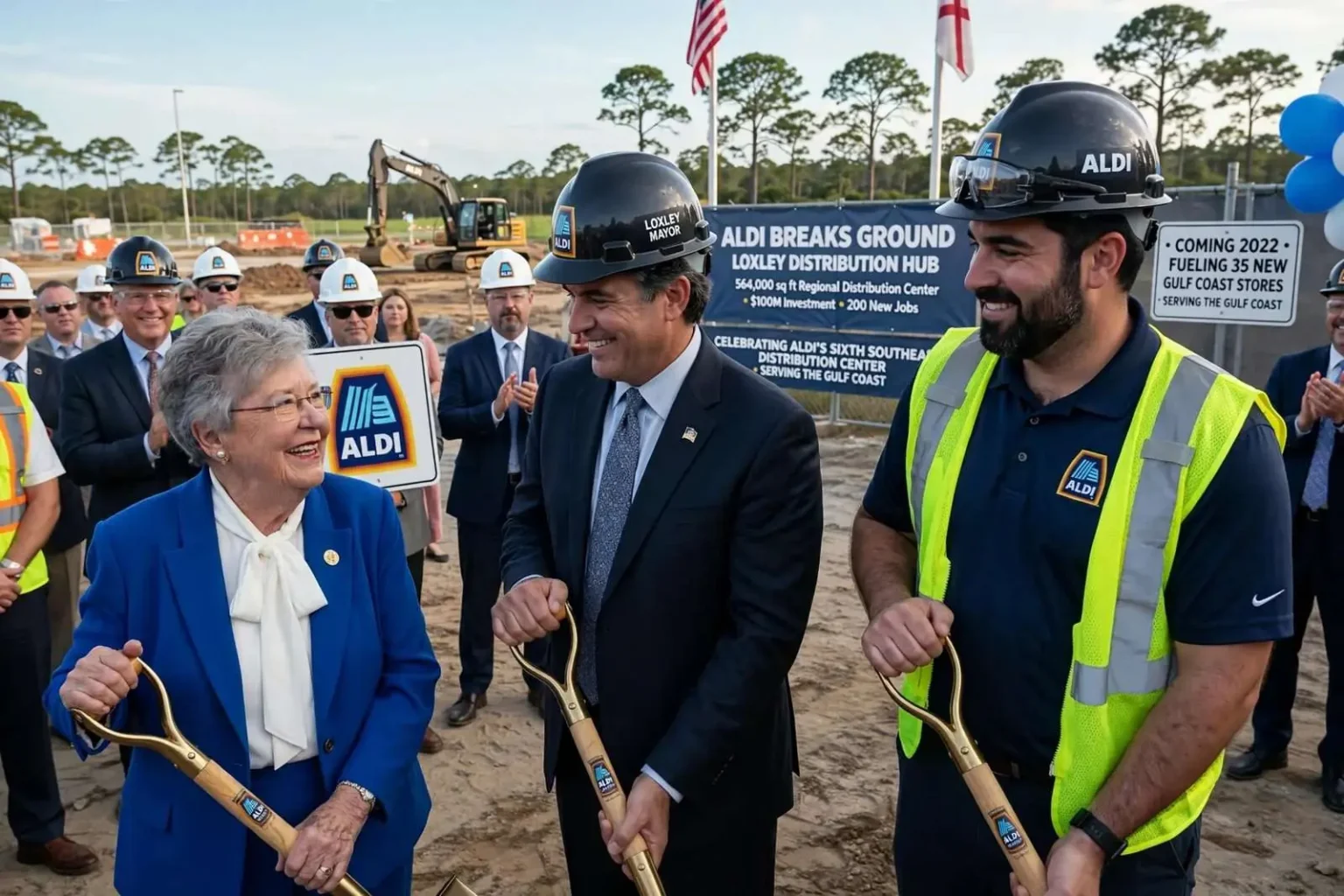
State and local leaders gathered in Loxley this week for the official groundbreaking of a massive new ALDI distribution center, marking the German discount grocer’s first major foothold in South Alabama and setting the stage for dozens of new stores across the Gulf Coast in the next two years.
Governor Kay Ivey joined Loxley Mayor Richard Teal and other elected officials at the site to celebrate the start of construction on the 564,000-square-foot regional headquarters and distribution facility, a $100 million investment that ALDI says will create roughly 200 full-time jobs once it opens. The scale of the project makes it one of the largest single industrial investments in central Baldwin County, and the ceremony drew the kind of bipartisan crowd that economic development announcements in fast-growing suburbs tend to attract.
The Loxley facility will be ALDI’s sixth distribution center in the Southeast and is expected to be fully operational in 2022. Company officials say it will supply as many as 100 stores stretching across South Alabama, the Florida Panhandle, south Georgia and Mississippi, supporting the opening of up to 35 new retail locations along the Gulf Coast over the next couple of years. The distribution model is the engine behind ALDI’s store growth: each regional center radiates product to stores within a day’s drive, keeping the company’s famously lean supply chain lean and its prices low.
Until now, ALDI’s Alabama presence has been concentrated well north of the Gulf Coast, with more than 30 stores already operating in the Montgomery, Birmingham and Huntsville areas. The Loxley hub represents the company’s first significant push into the southern part of the state, and property records show ALDI has already been acquiring land for future store sites in Fairhope, Spanish Fort and Foley. Those purchases — made before the distribution center even opened — signaled how quickly the company intends to move once the supply chain is in place.
Leaders Welcome the Investment
Governor Ivey praised the project as a win for the region’s economy. “We welcome the company’s plans for a regional headquarters and distribution hub in Loxley, and we’re proud to stand behind ALDI’s commitment to bringing value to the people of Alabama and the Gulf Coast region,” she said at the ceremony.
Mayor Teal said city leaders were thrilled to land the project, which will rise near an existing ACE Hardware distribution center that has operated in Loxley since 2000. “We are eager for the new job opportunities that are to come for citizens as well as the economic growth and development for our community,” Teal said.
The pairing of the two distribution centers gives Loxley a claim as one of the Gulf Coast’s quiet logistics strongholds. A small city along the U.S. 90 and Highway 59 corridors, positioned between I-10 and the growing shoreline communities, Loxley has converted its location into a development asset — first with hardware, now with groceries, and with the promise of more to follow as the industrial acreage around the sites fills in.
A Grocer on the Rise
Founded in Germany, ALDI has grown rapidly across the United States in recent years and is on pace to become the country’s third-largest grocery retailer by store count by 2022. The company has leaned into that growth with an aggressive store expansion plan alongside investments in curbside pickup, which it plans to roll out to many of its locations this year as more shoppers turn to contactless and convenience-focused options.
The chain’s low-price model — smaller stores, limited selections, private-label-heavy shelves and customers bringing their own bags — has proven durable in both good times and hard ones, and the company’s expansion has continued even as other national grocers have slowed. For shoppers across Baldwin and Mobile counties, the arriving stores will introduce that model to a market long dominated by national supermarket chains and regional players.
ALDI U.S. CEO Jason Hart said the investment reflects the company’s broader growth strategy even as many retailers navigated a difficult year. “We’re incredibly proud to continue growing in all aspects of our business, from opening new stores to enhancing our eCommerce offerings, especially in light of the challenges businesses have faced in the last year,” Hart said. “Our commitment to our shoppers, new and existing, is the same — we will do everything in our power to offer the lowest possible prices every day — and we look forward to supporting more communities across the country with amazing ALDI products at a value that can’t be matched.”
What It Means for Baldwin County
For Baldwin County, the project adds to a wave of industrial and commercial investment that has followed the area’s rapid population growth. Local officials have pointed to the region’s location along major highway corridors and its proximity to the Port of Mobile as key advantages in attracting large-scale logistics operations like ALDI’s.
Baldwin County has been one of the fastest-growing counties in Alabama for years, its population swelling with retirees, transplants and families drawn by the beaches, the schools and the lower cost of living relative to neighboring markets. Growth of that kind demands infrastructure — more grocery stores, more warehouses, more trucks on Highway 59 — and Loxley sits at the geographic center of much of it, wedged between the Interstate 10 corridor and the coastal communities to the south.
The jobs estimate — roughly 200 full-time positions once the facility opens — covers both warehouse and corporate staff, and the company says it will begin posting job openings on aldi.us as construction progresses toward the planned 2022 opening. Distribution-center payrolls tend to anchor secondary employment as well: trucking contracts, maintenance services, and the retail and food service jobs that follow a few hundred steady paychecks into a small city’s economy.
Local leaders say the project is likely to spur additional retail and residential development around Loxley as construction moves forward over the coming months. The pattern is familiar across the county’s growth corridors: a major employer arrives, land values shift, rooftops follow, and within a few years the map of the community has been redrawn. For a city that spent decades as a pass-through between I-10 and the beaches, the role of destination — and headquarters — marks a distinct change in identity.
From Hub to Storefront
The connection between the Loxley hub and the stores to come is the heart of the announcement. Distribution centers are invisible to shoppers, but they determine what appears on shelves and at what price, and ALDI’s regional model means the stores in Fairhope, Spanish Fort, Foley and the other sites the company has been acquiring will be supplied — and priced — from Baldwin County. Thirty-five new locations along the Gulf Coast over the next couple of years would remake the grocery map in a market where new entrants are rare.
The expansion also ripples back into the commercial real estate market. Each new store requires a site, a building and a staff, and the land acquisitions already recorded in Fairhope, Spanish Fort and Foley suggest the company is positioning for the fastest possible rollout once the Loxley center comes online. Suppliers, contractors and service firms around the region can expect the ripples of a $100 million construction project and a multi-store opening campaign to extend well past the groundbreaking.
For the shoppers the whole enterprise is aimed at, the promise is the one Hart repeated at the ceremony: the lowest possible prices, every day, delivered from a distribution hub rising in the middle of Baldwin County — and, for the local officials who spent months courting the project, the satisfaction of watching a German grocer bet $100 million that the Gulf Coast’s growth is only beginning.
The Economics of the Discount Model
ALDI’s arrival in a new market tends to reshape more than its own sales. The chain’s operating model — smaller-footprint stores, a deliberately limited assortment, a heavy tilt toward private labels and a checkout process designed for speed — allows it to price below conventional supermarkets, and established grocers in new ALDI markets routinely adjust promotions and store investments in response. Shoppers in Baldwin and Mobile counties have watched this pattern play out in other categories as big-box retailers multiplied along the U.S. 98 and Airport Boulevard corridors; groceries is the last great daily category, and ALDI’s expansion brings a national price competitor to it.
The curbside pickup investment noted by company leaders reflects the changed shape of American grocery shopping. The pandemic accelerated contactless and online ordering across the industry, and ALDI’s rollout of pickup to many of its locations — a significant shift for a chain built on minimal labor and streamlined operations — signals that even the most cost-disciplined grocers now treat digital convenience as standard equipment rather than an optional amenity.
The timing also works in the company’s favor demographically. The Gulf Coast’s population growth supplies exactly the kind of customer base ALDI’s model rewards: households watching prices, newcomers without entrenched store loyalties, and fast-growing suburbs where the nearest discount grocer may be a drive away. A store network fed by a distribution center twenty minutes down the highway can restock those shelves quickly and cheaply, which is how the company defends the price promise Hart described.
A Groundbreaking With a Long Shadow
Groundbreakings are ceremonies; the measure of them comes later. For Loxley, the markers to watch are the construction schedule, the hiring cycle that begins on aldi.us, and the store openings that follow — first in the towns where land is already bought, then across the map of South Alabama, the Panhandle, south Georgia and Mississippi that the hub will serve. For Baldwin County economic developers, the number to watch is 200 — the full-time jobs the facility carries when it opens — and the wave of secondary investment that local leaders predict will gather around the site as construction advances.
What is already certain is the direction: a $100 million regional headquarters in a city of a few thousand people, thirty-five new stores planned for the coast, and a national grocer betting its sixth Southeastern distribution center that the Gulf Coast market will keep growing fast enough to fill them. On the day the shovels went into the Loxley dirt, every speaker at the ceremony — the governor, the mayor, the executives — framed the project the same way: not as the end of the story, but as the beginning of one the whole region will be able to shop.