ALDOT Adds a Third Southbound Lane to Highway 59 in a $1.67 Million ATRIP-Funded Project
Crews will add a third southbound lane on Highway 59 from Cypress Bend Drive to just south of County Road 6 under a $1.67 million contract awarded to Wiregrass Construction. Work begins in September.
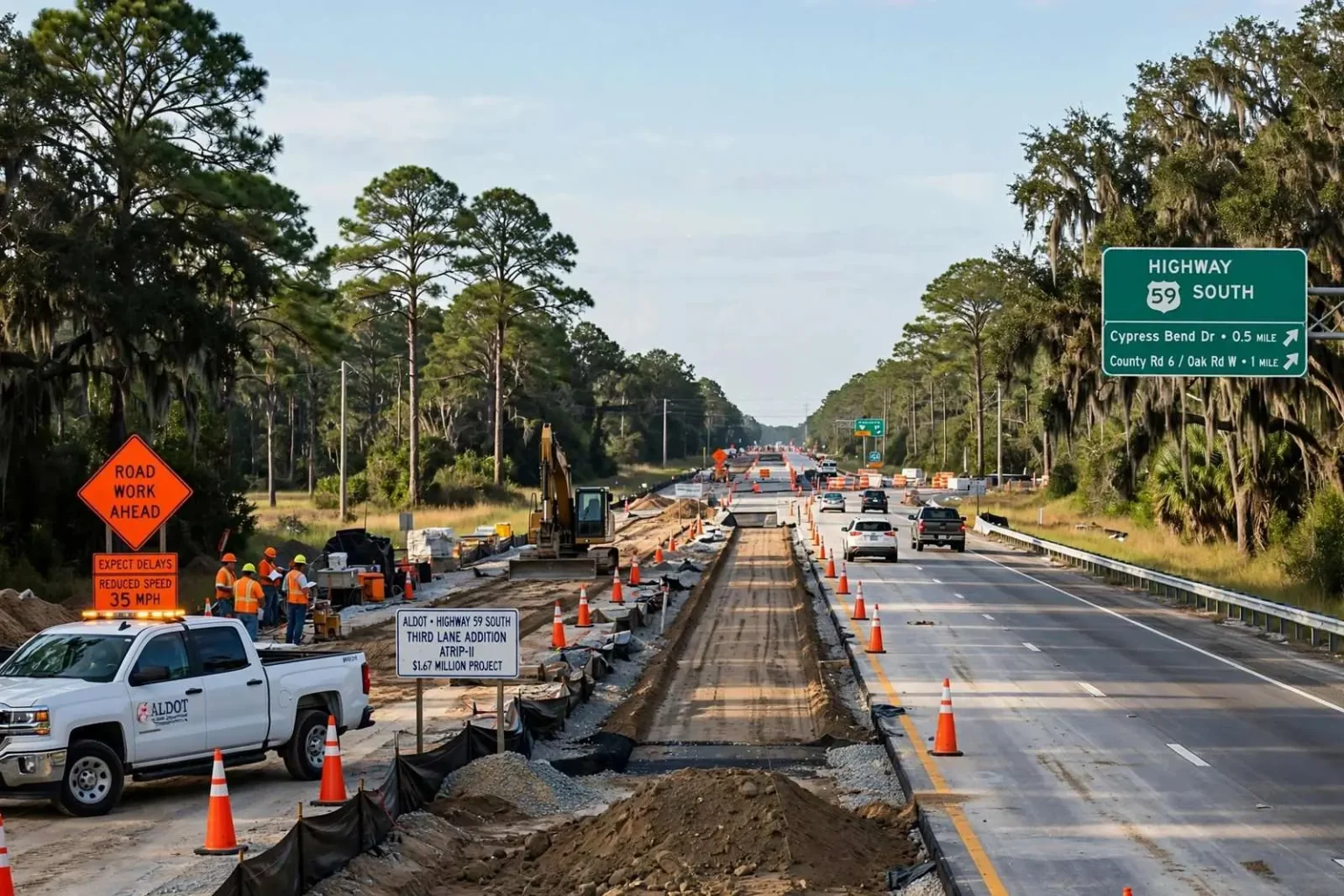
The Alabama Department of Transportation is adding a third southbound lane to Highway 59, a $1.67 million project intended to relieve congestion on one of Baldwin County’s most heavily traveled corridors. Construction is expected to begin in September.
The new lane will run from Cypress Bend Drive to just south of County Road 6, also known as Oak Road West. The work has been awarded to Wiregrass Construction and is funded through the Alabama Transportation Rehabilitation and Improvement Program.
During construction, motorists should anticipate periodic lane closures and reduced speeds within the work zone. ALDOT is asking drivers to stay alert and use caution traveling through the project area.
What ATRIP Funding Is
The Alabama Transportation Rehabilitation and Improvement Program-II, commonly called ATRIP-II, provides an annual minimum of $30 million from state gas tax revenues for local road and bridge projects on Alabama’s state highway system.
The program grew out of the Rebuild Alabama Act, the 2019 law that increased the state fuel tax and dedicated portions of the resulting revenue to specific purposes. ATRIP-II is the piece aimed at projects of local significance that sit on the state highway system — roads maintained by ALDOT but where the pressing need is generated by local growth rather than by statewide through traffic.
That distinction explains why a project like this one qualifies. Highway 59 is a state route, but the congestion driving the need for a third southbound lane is produced by development, tourism and local traffic patterns within Baldwin County.
Projects are selected through a competitive process in which local governments submit applications that are evaluated by a committee, rather than being distributed by formula. For counties and municipalities without the resources to fund major roadway improvements independently, ATRIP-II has become a principal avenue for getting work done.
Why Southbound
The decision to add capacity in one direction rather than both reflects how traffic actually behaves on this corridor.
Highway 59 is the primary north-south route through central Baldwin County, running from Bay Minette south through Loxley, Robertsdale, Summerdale and Foley to Gulf Shores. Southbound movement is the direction of the beaches, the outlet shopping, the seasonal rentals and the daily commercial traffic serving all of it.
Traffic on a corridor like this one is directionally imbalanced, and heavily so at predictable times. Weekend mornings during the warm season push volume south. Weekend afternoons and evenings reverse it. Layered on top is the weekday pattern of commuters and commercial vehicles.
Adding a lane in the direction with the greater sustained demand delivers most of the congestion benefit at a fraction of the cost of widening both directions. It also avoids the substantially larger right-of-way, drainage and utility relocation work that full widening entails.
A Short Segment With a Specific Job
The project limits — Cypress Bend Drive to just south of County Road 6 — define a relatively short stretch, and short projects of this kind are usually targeting a specific bottleneck rather than adding general capacity.
Corridor congestion is rarely uniform. It concentrates at points where lanes drop, where turning movements interrupt through traffic, or where signalized intersections meter flow. A queue that forms at one such point can extend backward for a considerable distance, making an entire corridor feel congested when the constraint is localized.
Adding a lane through the constrained segment allows traffic to clear it at a higher rate, which shortens the queue upstream. The benefit is frequently larger than the length of the new lane would suggest.
What Drivers Should Expect
Roadway widening within an existing corridor is disruptive in specific and predictable ways.
Lane closures will be periodic rather than constant. Crews close lanes when the work requires it — for shoulder excavation, base preparation, paving and striping — and reopen them between operations.
Reduced speed limits apply within the work zone. Alabama, like most states, enforces work zone speed limits with enhanced penalties. Fines in work zones are commonly doubled, and that applies whether or not workers are present unless the signage specifies otherwise.
The pattern will change over the project’s life. Widening projects shift traffic as construction moves across the roadway cross-section. Drivers who use the corridor daily should expect the configuration to change more than once.
Timing matters. Contractors performing lane closures on high-volume corridors typically schedule the most disruptive operations for off-peak hours and avoid peak weekend travel periods where possible.
Work Zone Safety
ALDOT’s request that drivers stay alert and use caution is standard language, and the reason behind it bears stating plainly.
Work zone crashes nationally are overwhelmingly rear-end collisions, and the people most often injured are drivers and passengers rather than construction workers. The mechanism is straightforward: traffic slows or stops unexpectedly at a lane closure, and a following driver who is not watching does not stop in time.
The practical countermeasures are equally straightforward. Increase following distance. Merge early rather than at the last moment. Put the phone down — Alabama’s hands-free law prohibits holding a device while driving, and a work zone is exactly the environment in which a few seconds of diverted attention produces a crash. Expect stopped traffic even where the road ahead appears clear.
The Corridor’s Broader Trajectory
This project joins a substantial list of transportation work underway across Baldwin County, driven by sustained growth in one of Alabama’s fastest-expanding counties.
The county’s population growth, the continued expansion of Gulf Shores and Orange Beach as destinations, the airport terminal expansion bringing new visitors by air, and steady residential development along the corridor all place demands on a road network that was built for a smaller and more seasonal population.
Highway 59 carries a disproportionate share of that load because of its geography. It is the direct route from Interstate 10 to the beaches, and there are limited parallel alternatives for through traffic.
Incremental capacity additions of the kind announced here are the practical response available within existing funding. They do not transform a corridor, but they address the specific points where flow breaks down.
Project Details
- Scope: Third southbound lane on Highway 59
- Limits: Cypress Bend Drive to just south of County Road 6 (Oak Road West)
- Contractor: Wiregrass Construction
- Contract value: $1.67 million
- Funding: ATRIP-II
- Start: September
South Alabama News will report on the project’s progress and completion.