ALDOT Agrees to Study Single-Phase Option for Mobile River Bridge After MPO Leaders Push Back
<p>ALDOT told Mobile and Eastern Shore planning leaders it will study a single-phase alternative to its phased Mobile River Bridge and Bayway plan, after MPO chairmen Sandy Stimpson and Jack Burrell raised safety and cost concerns with the multiphase approach.</p>
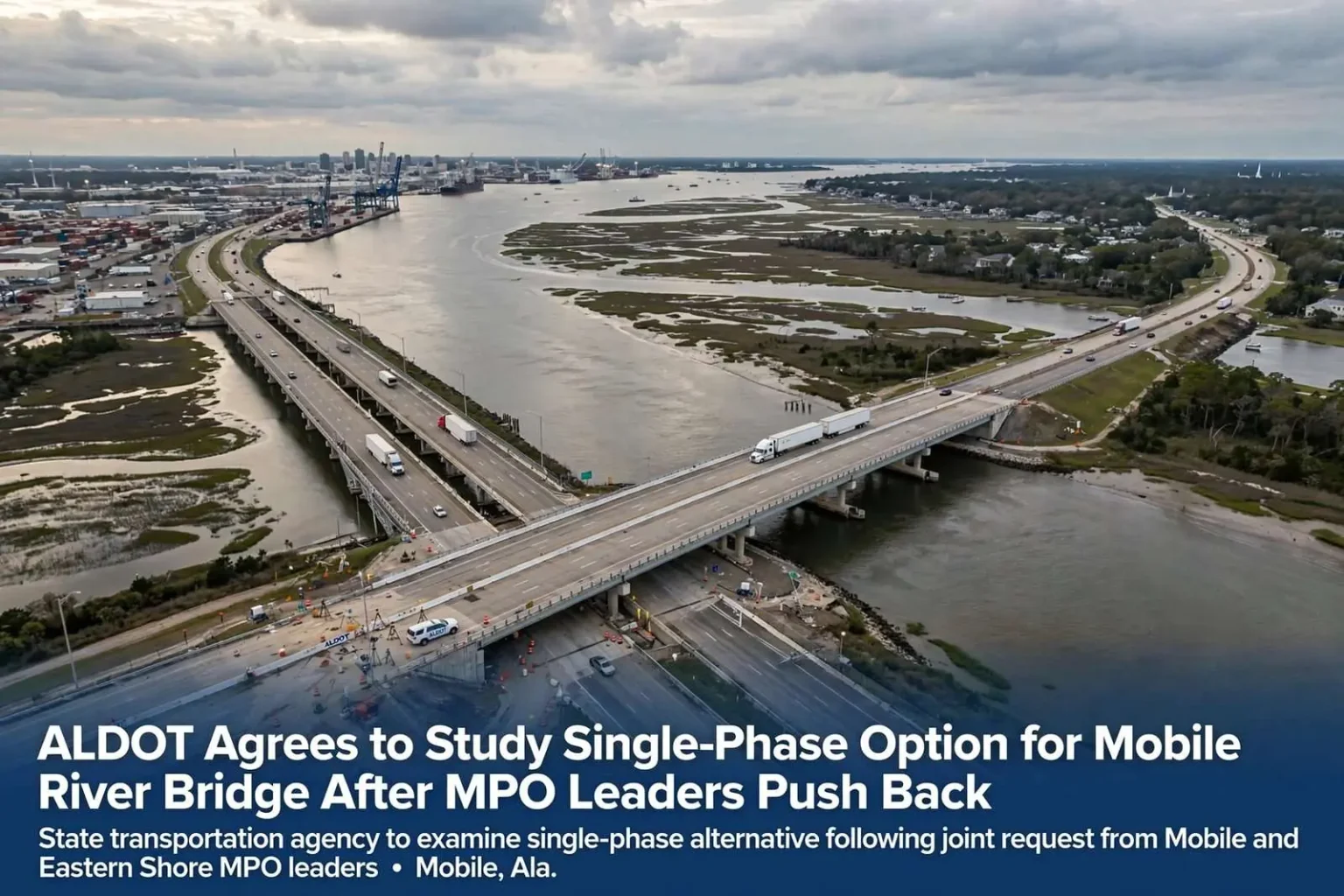
The Alabama Department of Transportation says it is open to studying a single-phase alternative to its long-debated Mobile River Bridge and Bayway project, a shift that came after local leaders on both sides of the bay pressed the agency to look beyond its current phased approach.
The commitment came during a joint meeting this week between the Mobile and Eastern Shore Metropolitan Planning Organizations and ALDOT, the latest in a series of near-monthly briefings the state has held with regional planners as the massive Interstate 10 crossing moves through preliminary engineering and financing work.
Both MPOs had already voted earlier this year to include ALDOT’s phased proposal in their official transportation planning documents. But on Sept. 1, Mobile MPO Chairman Sandy Stimpson and Eastern Shore MPO Chairman Jack Burrell sent a joint letter to ALDOT Director John Cooper asking the agency to examine the financial feasibility of building the project in a single phase rather than stretching it across multiple stages.
“We have been continuing to look at those options, and once we put those together, we will meet with both MPOs and have public meetings to share options and results,” ALDOT Project Manager Edwin Perry told the panel Monday. “But as of right now, it’s a phased project.”
Perry said the state has hired a contractor to collect new traffic data and run updated traffic modeling for the corridor, work that will help refine design specifications and financial projections and ultimately support a credit rating needed to secure the loans and bonds required to finance construction.
ALDOT is also continuing efforts to acquire rights of way and rights of entry along the project corridor, which will clear the way for archaeological surveys at 15 suspected cultural sites. That survey work alone is expected to take roughly a year and a half to complete. Separately, Perry said the agency is working to stand up a steering committee to guide planned mitigation efforts in the Africatown community, which sits near the project footprint.
“The next steps are to develop additional study options as requested by the MPOs,” Perry said. “The results will be submitted back to the MPOs, and if the options are supported and adopted, they will need to amend their [transportation planning documents]. ALDOT will then be able to update documentation and reports, make environmental updates and begin working on procurement to start building the project.”
Mobile MPO Coordinator Kevin Harrison told attendees that any changes to the project’s structure would still require additional rounds of public hearings before moving forward.
Under ALDOT’s current phased framework, the first phase would build a single bridge span and its western approach for an estimated $725 million, opening the improvements initially to truck traffic only under a $15 toll. A second phase would add a second bridge span along with improvements to the tunnel and downtown interchanges, while a third and final phase would rebuild the entire Bayway and add turn lane improvements on the Eastern Shore side.
In their letter to Cooper, Stimpson and Burrell raised concerns about the safety risks, extended timelines and added costs that could come with spreading construction across three separate phases. Perry acknowledged Monday that a single-phase build would likely come in cheaper overall.
“Nothing gets cheaper as you wait,” Perry said. “This project would be a lot of concrete work and steel work, and being able to keep those contractors and efficiencies would definitely make it cheaper.”
Harrison said the MPOs and ALDOT expect to reconvene for another project update in late November or early December, with additional details on the single-phase study options expected to emerge in the coming months.
Background on the Project
ALDOT’s earlier toll-funded version of the project collapsed in August 2019, after the Eastern Shore MPO voted to remove it from its transportation improvement plan and Gov. Kay Ivey declared it dead. The current crossing, the George Wallace Tunnel, opened in 1973.
Africatown, where the mitigation steering committee will focus, was founded by survivors of the Clotilda, the last known ship to bring enslaved Africans to the United States, which arrived in Mobile in 1860.