ALDOT Grooves Centerline of Highway 45 in Push to Curb Deadly Head-On Crashes
ALDOT is cutting warning grooves into Highway 45's centerline after 15 head-on deaths in five years, though the road still doesn't qualify for widening.
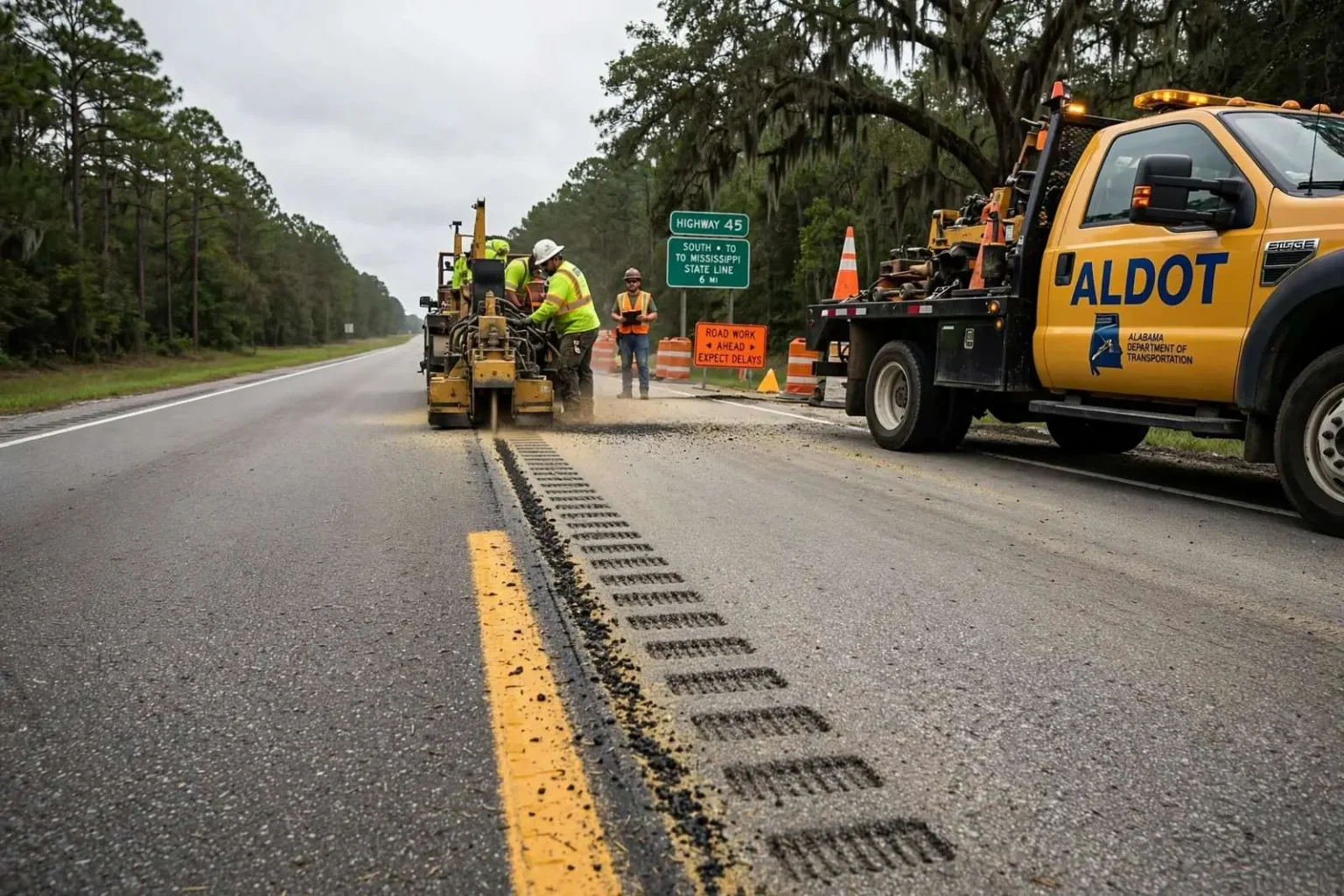
Crews with the Alabama Department of Transportation are cutting grooves into the centerline of Highway 45 this week, adding a low-cost safety feature aimed at one of southwest Alabama’s most crash-prone roads.
The treatment, known as scoring, places a band of small grooves along the center of the travel lane. Drivers who drift across the line feel and hear the vibration through their vehicle — a sensory warning that gives them time to correct before crossing into oncoming traffic. Shoulders along Highway 45 have already received the same treatment.
Highway 45’s Deadly Head-On Crash History
According to ALDOT, 15 people have died in head-on collisions on the highway over the past five years. Brian Aaron, assistant region engineer for ALDOT’s Southwest Region, called scoring a proven countermeasure used nationwide.
“We saw a lot of head-on collisions, fatalities occurring because of those head-ons — this is a proven countermeasure that’s used all across the country to combat that,” Aaron said. He cited research suggesting such treatments can cut head-on crashes by roughly 30 percent.
Push to Widen Highway 45 Continues
The work has not settled the larger debate over the two-lane highway, which carries heavy traffic between Mobile and Washington County, swelling during summer months as beach-bound travelers use it as a bypass.
State Rep. Shane Stringer, who has pushed for years to widen Highway 45 to four lanes, said smaller measures still help but argued the road’s capacity is fundamentally inadequate.
“I think everything we do is going to help. Even the small stuff as far as trimming trees, the scoring of the road, new entrance and exit points,” Stringer said, adding that officials have “kicked the can down the road long enough.”
Aaron acknowledged the seasonal traffic surge but said Highway 45 does not currently meet the state’s criteria for widening, noting that other two-lane roads across Alabama face similar needs. The grooving project is expected to take six to eight weeks, beginning near the Mississippi state line and working south along the corridor.
The Federal Highway Administration lists centerline rumble strips among its “Proven Safety Countermeasures,” a set of treatments with documented crash reductions, recommending them particularly for two-lane rural roads where head-on and opposite-direction crashes are a concern.