ALDOT, Mobile County and City of Mobile Launch Major Traffic Signal Upgrade Under RTOP
ALDOT, the City of Mobile and Mobile County are upgrading 174 traffic signals as part of the Regional Traffic Operations Program, with retiming work rolling out in four waves through October.
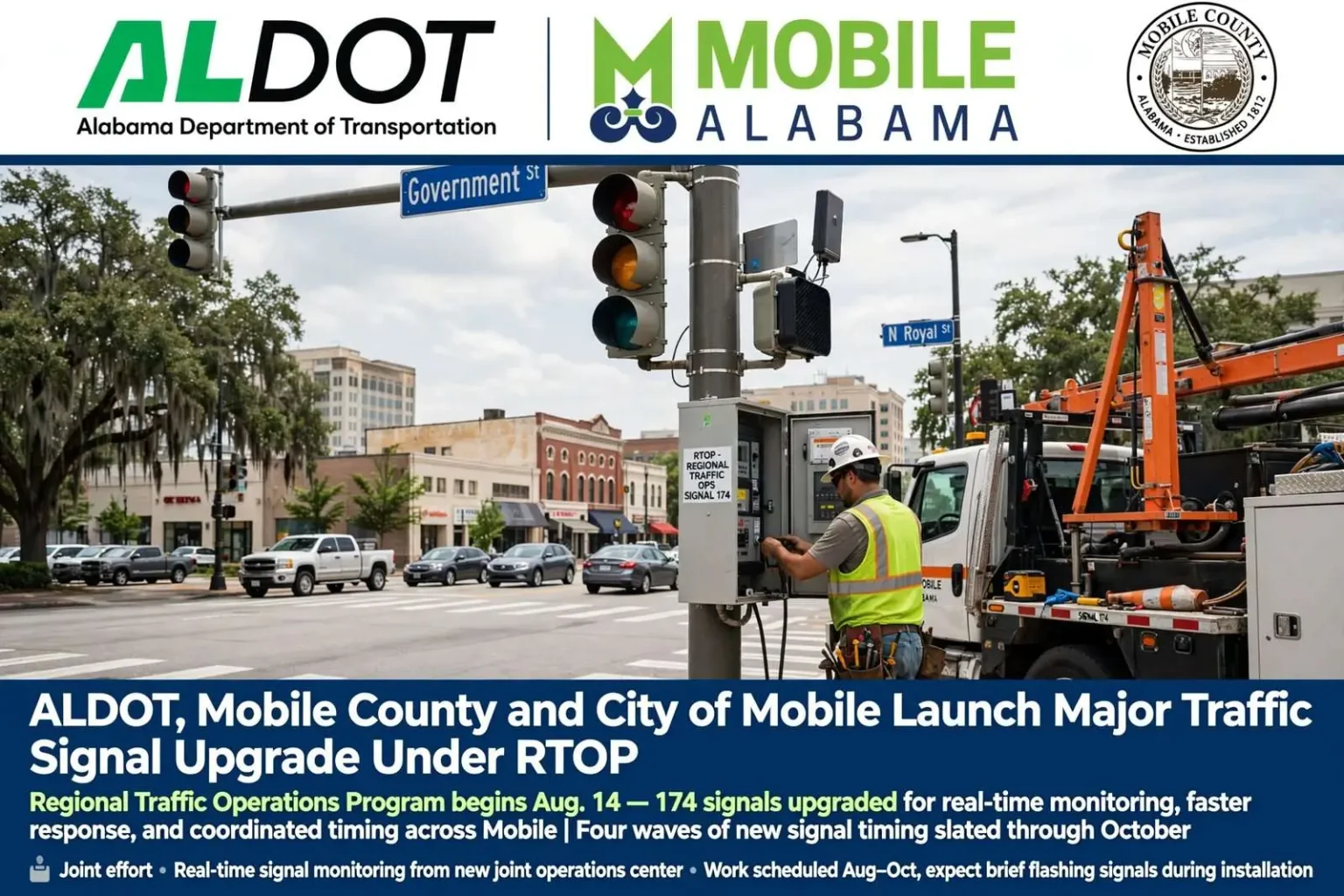
Alabama Department of Transportation, City of Mobile, and Mobile County are launching a major upgrade to traffic signal infrastructure across the Mobile area starting Aug. 14, as part of the Regional Traffic Operations Program (RTOP).
The project will bring new controllers and hardware to 174 traffic signals throughout the city and county.
Why the upgrade is needed
Under the current system, signal engineers often have no way of knowing when a signal malfunctions, which can create delays for drivers and, in some cases, safety hazards at intersections. A signal stuck in one phase or running on a default pattern can go unreported for hours unless a motorist takes the time to call it in, leaving crews to react to problems rather than anticipate them.
Once the new hardware is in place, engineers will be able to monitor and operate signals in coordination with one another from a joint operations center in real time, giving them the ability to spot and respond to problems as soon as they occur. Instead of waiting for a complaint, technicians will see fault reports the moment a signal goes down, and timing adjustments can be pushed to corridors without a truck roll to each cabinet.
The upgrade will also make it easier to manage traffic during major events that draw heavy crowds to the region, including University of South Alabama football games, Mardi Gras parades, concerts and conferences. Coordinated, real-time signal timing can help move traffic more efficiently through the city during these high-demand periods.
That capability matters most in a city whose event calendar can transform an ordinary weekday into a gridlocked one. During Carnival season, parade routes periodically close major corridors such as Government Street, forcing thousands of vehicles onto parallel roads all at once. A signal network that can be retimed on the fly — extending green time on the detour routes, holding traffic back upstream — gives engineers a tool they have never had across the full city.
What drivers can expect
Motorists in the Mobile area should be prepared for some temporary disruptions as crews install the new equipment. Signals undergoing installation may flash for one to two minutes at a time, and work on major corridors and other critical intersections will generally be scheduled during off-peak hours to minimize disruption.
Officials are asking drivers to use caution and obey all traffic laws at any intersection where a signal is flashing or dark, and to expect installation work to continue through September and October. A flashing red light should be treated as a stop sign, with drivers proceeding when clear, while a dark signal calls on each driver to yield as if the intersection were uncontrolled.
Residents who notice problems with a signal are encouraged to call 311 to report it.
Four waves of signal retiming
Beyond the hardware installation, the project includes new timing plans that will roll out in four waves between late August and late October, covering the vast majority of the signals in the upgraded network.
Retiming is as important as the equipment itself. A signal controller is only as good as the timing plan inside it, and plans that were built years ago stop matching traffic as development patterns change. New subdivisions, shopping centers and school zones all shift where and when vehicles move through an intersection, and a corridor that was balanced a decade ago can produce long, avoidable delays today.
Engineers will collect traffic counts and travel-time data along the major corridors before and after each wave, comparing the results to confirm that the new plans are actually shortening delays. Coordination — the practice of linking consecutive signals so that platoons of vehicles hit a series of green lights — depends on accurate timing offsets between intersections, and it degrades gradually as traffic patterns drift away from the assumptions in old plans.
The four-wave approach lets officials apply lessons from the first group of corridors to the ones that follow. If a particular cycle length or offset strategy works well on one arterial, it can be refined before the next wave is cut over, rather than imposing a single plan across the whole network at once.
What RTOP is and who runs it
The Regional Traffic Operations Program is a joint effort between the Alabama Department of Transportation, the City of Mobile and Mobile County to treat traffic signals as one regional system rather than a collection of assets owned and operated separately. Signals on state routes, city streets and county roads are all part of the same driving experience, and congestion does not respect jurisdictional lines.
Under the program, the three governments share a joint operations center, staffed by engineers and technicians, where the signal network can be monitored from a single room. The center gives the region a home for the cameras, vehicle detectors and communications links that modern signal management requires, and it puts the three agencies in a position to coordinate on incident response instead of transferring responsibility at the edge of a boundary line.
Funding for the program draws on the participating governments’ capital budgets, with the state contributing to improvements on the routes it controls. For Mobile drivers, the practical effect is a signal network that is managed day to day as a single connected system.
Where the work will happen
The 174 signals covered by the project are spread across the city and county, including the commercial corridors that carry the heaviest daily traffic. Arterials such as Airport Boulevard, Government Street, Cottage Hill Road and the roads radiating from the downtown grid are among the busiest signal corridors in the region, and they are precisely the routes where modern controllers and coordinated timing deliver the most visible benefit.
Crews working on the installation will typically close a single intersection’s cabinet for a short window rather than taking whole corridors down. The flashing periods that drivers may notice during a cutover are part of the transition between the old controller and the new one, and the work is timed to avoid the morning and evening peaks wherever possible.
The September and October finish means the upgraded network will be largely in place before the winter holiday shopping season and the Carnival season that follows, both of which put sustained pressure on the same corridors. Getting the hardware and the first retiming waves completed ahead of those periods gives engineers a real window to tune the system under normal traffic before the heaviest demands arrive.
What it means for daily drivers
For most residents, the changes will show up in small ways before large ones. Faults that once lingered for hours until someone called 311 will now surface on an engineer’s screen within minutes, shortening the time a malfunctioning signal snarls a morning commute. Corridor timing plans that once changed rarely will be reviewed and adjusted regularly as data comes in.
During the event calendar, the difference should be more visible. Football Saturdays at the University of South Alabama and Mardi Gras parades downtown produce surges that overwhelm fixed signal plans, and the ability to watch those surges develop and retime the network in response is the kind of capability larger cities have used for years to move crowds more efficiently.
Officials emphasize that the project will not eliminate congestion, and drivers will still see delays at the busiest intersections at peak hours. But the combination of new hardware, connected monitoring and four waves of fresh timing plans is expected to produce steady, measurable improvement across the network rather than a dramatic change at any one intersection.
How to report a problem signal
Throughout the installation period and after, residents who encounter a signal that appears to be malfunctioning can report it by calling 311, the city’s non-emergency service line. Callers should be prepared to describe the intersection — naming the two streets — and to say what the signal is doing, whether it is dark, flashing, or stuck on one direction.
Emergency situations, including a signal that creates an immediate danger, should still be reported to 911. Property damage from a crash that knocks a signal out of service should also be reported through emergency channels so that officers and crews can respond quickly.
Under the new system, a call to 311 will still work exactly as it did before, but the operations center will often already know about a fault by the time the phone rings. The redundancy between automated fault detection and resident reports is deliberate; both channels catch problems the other may miss, and the reports help technicians prioritize which of the network’s hundreds of cabinets needs attention first.
A changing signal landscape
The RTOP upgrade places Mobile among the mid-sized American cities that have moved signal management from a maintenance task into an ongoing operations discipline. The distinction matters: maintenance fixes what breaks, while operations continually adjusts how the network performs as traffic changes, much as a traffic engineer tunes a living system rather than a set of mechanical boxes.
As the four retiming waves conclude in late October, officials will have a clearer picture of how much the combined program has shortened travel times on the region’s principal corridors. The data collected before and after each wave will feed future decisions about which intersections need further attention, and whether additional signals should be brought into the coordinated network.
Drivers who want to track the rollout should expect to see crews and flashing signals through September and October, and are asked to stay patient and alert during the transition. The temporary inconvenience of installation, officials say, is the price of a signal system that can finally be managed as one connected, responsive network for the whole Mobile area.