ALDOT Reviewing More Than 700 Public Comments on Mobile River Bridge Toll Plan
ALDOT says it received more than 700 public comments on the Mobile River Bridge toll plan after the comment period closed, with residents pushing for a bigger frequent-user discount and additional funding to offset the cost.
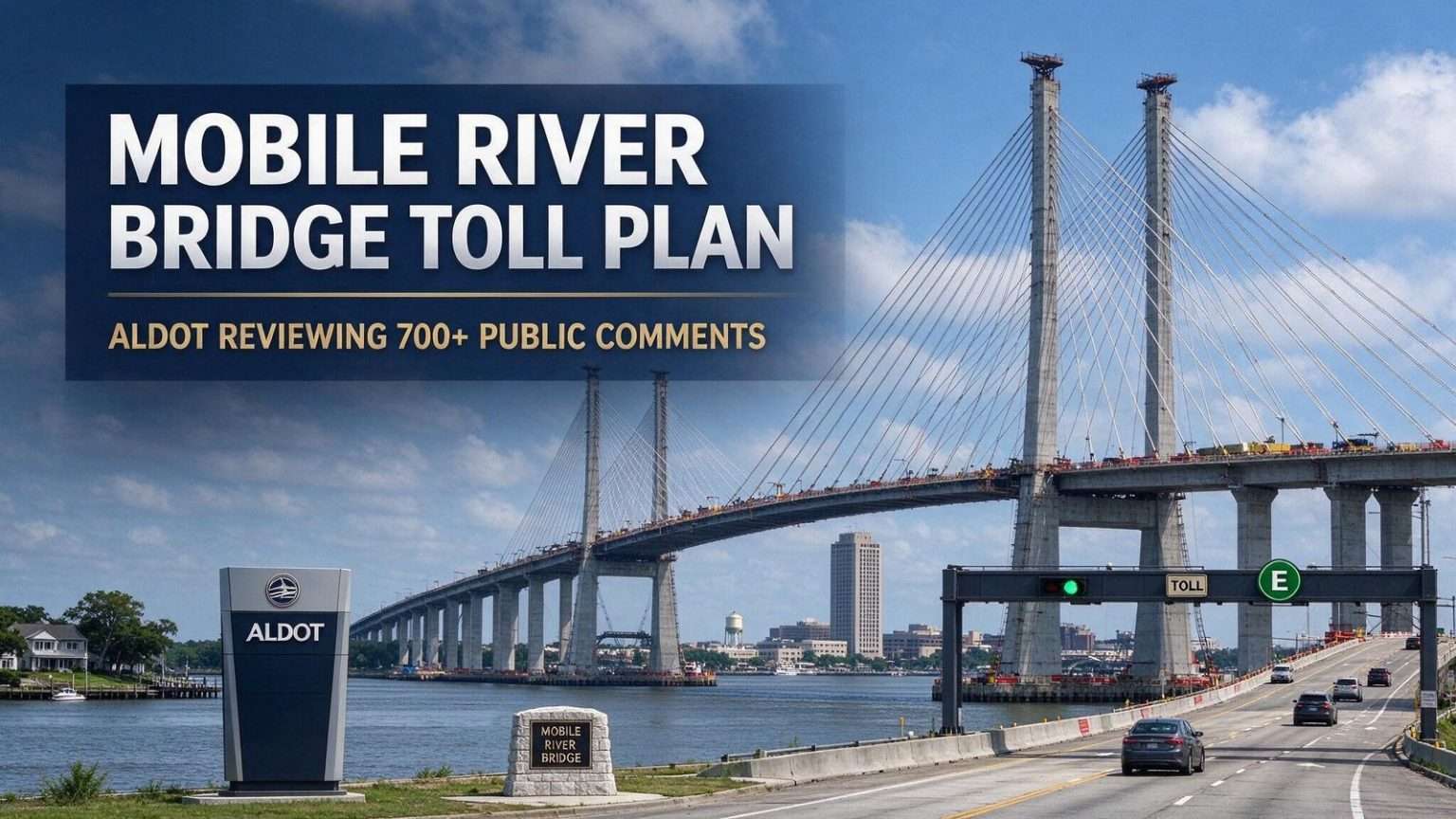
The Alabama Department of Transportation says it is sorting through more than 700 public comments submitted on the proposed Mobile River Bridge project, after a public comment period tied to the plan closed this week.
The comments came in ahead of the release of a supplemental draft environmental impact statement for the long-discussed project, which would add a new bridge across the Mobile River and additional lanes along the Bayway to relieve chronic congestion on Interstate 10 between Mobile and Baldwin counties. ALDOT opened the comment window to give residents, business owners and commuters a chance to weigh in on the latest version of the plan, including its tolling structure, before the agency moves toward a final environmental review.
In a statement released May 24, ALDOT Project Director Edwin Perry said the response confirmed broad support for expanding capacity on the corridor, even as commenters pushed back on how the project would be financed.
“The overwhelming majority of respondents agree that there is a need for additional capacity on I-10 between Mobile and Baldwin counties,” Perry said. “Locals want a higher frequent user discount and for ALDOT to continue to pursue additional funding to offset the toll.”
The Toll Fight at the Center
Tolling has been the most contentious piece of the project since planners first floated charging drivers to cross the new bridge and use improved sections of the Bayway. Many commenters used the public input period to press ALDOT for a more generous discount program for daily commuters who cross the bay regularly for work, arguing that a flat toll would fall hardest on residents who have no practical alternative route.
The geography of the objection is unavoidable. Interstate 10 crosses Mobile Bay on the Wallace Tunnel — twin bores beneath the river downtown — and the Bayway’s low bridge east of the city, and for most trips between the two counties there is no reasonable detour. A driver who objects to the toll cannot simply take another road; the alternatives add hours around the head of the Bay or a ferry ride, which is why commenters described the charge less as a choice than a tax on the commute. For residents of Baldwin County who work in Mobile, and for Mobilians whose jobs, doctors and schools sit across the bay, the toll would be collected every working day with no option to refuse it.
The frequently asked question in the comments — whether ALDOT could deepen the discount for those drivers — has become the hinge on which public acceptance turns. A commuter discount program, built on the electronic tolling transponders the project would use, can in theory keep the daily cost tolerable for regular users while charging occasional drivers, including the beach-bound summer traffic that contributes much of the congestion, the full rate. Commenters pushed for exactly that design: locals pay less, visitors pay more, and the revenue math still supports the bonds.
ALDOT says it is now reviewing every comment submitted during the period and will use that input to help shape the next phase of project development. The agency said it is simultaneously working with elected officials in both counties to identify additional funding sources that could help offset the cost of the toll for local drivers, a step officials have described as central to winning public buy-in for the project.
Those funding conversations — state appropriations, federal grants, potential contributions from local governments that would benefit from the construction — matter because every dollar found outside the toll reduces the charge that has generated the resistance. ALDOT’s statement that it will “continue to pursue additional funding to offset the toll,” quoted from Perry’s May 24 release, turned the demand of the commenters into an official commitment, one that both counties’ delegations have pressed the agency to honor in meetings since the comment period closed.
From Comments to Record of Decision
The agency said it will keep refining the toll plan and will release further details before issuing the Final Environmental Impact Statement, the document that will formally respond to the public comments and set the direction for the project moving forward. All comments gathered during the recently closed period will be included in that final statement when it is published.
That response requirement is not ceremonial. Under the National Environmental Policy Act, which governs the environmental review, a federal lead agency must give written responses to substantive comments before a final statement issues — meaning each of the 700-plus submissions becomes part of the project’s legal record, and the toll questions raised in them must be answered, not merely acknowledged. The document also carries the refined analysis of traffic, air quality, wetlands and neighborhood impacts that the supplemental draft had revised, and it becomes the baseline that courts and federal reviewers will consult if the project is challenged later.
Beyond finalizing the environmental statement, ALDOT laid out a lengthy list of remaining steps before construction can begin. Those include securing sign-off on the environmental statement from the Federal Highway Administration, receiving a formal Record of Decision, and issuing a final Request for Proposals to the three teams that have already been shortlisted to design, build and finance the project. From there, ALDOT would select a winning proposal, reach financial and commercial close on the deal, and move into construction.
The delivery model explains the unusual sequence. Rather than award separate design and construction contracts, ALDOT has shortlisted private teams that would design and build the bridge and Bayway improvements and help arrange the financing, paid back over years through the toll revenue. Financial close — the moment the team’s lenders and investors commit their money against the projected toll stream — is therefore the true point of no return, and it requires the toll structure to be settled enough to support a bankable revenue forecast. That is why the discount debate in the comments is not just politics; the answer will be priced into the bids.
Once those milestones are cleared, ALDOT has said it expects construction on the bridge and Bayway improvements to take roughly five years to complete. The project has been discussed for years as a way to ease some of the worst bottleneck traffic in south Alabama, particularly during peak commuting hours and summer weekends when beach traffic backs up for miles along the current span.
The congestion’s cost is measured daily. The Wallace Tunnel carries far more traffic than its design anticipated, a single wreck in the bore can strand both counties’ commuters for hours, and on summer weekends the queue through the tunnel and onto the Bayway can stretch for miles as beach-bound traffic funnels through the chokepoint, slowing emergency response and bleeding tourist dollars from drivers who give up on the trip.
What Comes Next
ALDOT has not announced a timeline for when the Final Environmental Impact Statement will be released, but officials indicated the agency intends to keep the public informed as the toll structure and funding picture become clearer in the months ahead.
The promise of continued transparency will be tested against the project’s history. The Mobile River Bridge has been studied, revised and deferred across two decades, surviving changes in governors, funding formulas and federal rules, and each round of study has produced its own round of public comment. The 700-plus submissions now under review are the latest installment of a conversation the region has been having with itself since the idea was first drawn: how to fix a bottleneck everyone agrees on, in a way whose cost the two counties can accept.
What has changed is the machinery now in motion. Shortlisted design-build-finance teams, a supplemental environmental statement drafted, a Record of Decision ahead — the project is further along the federal pipeline than at any point in its history, and the toll question commenters pressed will have to be answered in writing, in public, before the next document issues. For the commuters, business owners and coastal residents who wrote in, the review ALDOT has promised is the point at which their input either shapes the plan or becomes the record of why it stayed the same.
Reading the Comments
The 700-plus submissions themselves say something about how the region engages with the project. Public comment periods on transportation studies often close with a few dozen letters; the volume here reflects the unusual reach of the toll into daily life, touching virtually every household in the two counties and a large share of the businesses. The responses came from commuters with exact toll-cost arithmetic, small business owners calculating the delivery charges that would pass through to customers, and residents of neighborhoods near the bridge footprint raising construction and access questions alongside the financing ones.
That mix matters for the environmental document. NEPA comments are not a referendum, and agencies are not obliged to adopt the majority view, but the written record will show whether the toll analysis addressed the distribution of costs — who pays, how often, and what discount they receive — as carefully as it addressed the concrete and wetlands. Commenters who asked ALDOT to model lower local rates or greater non-toll funding created a paper trail that advocacy groups and local officials can and do cite in later hearings, and several of the region’s municipal councils have already requested formal responses on behalf of their residents.
The frequent-user discount also interacts with another familiar coastal variable: seasonality. Traffic on the Bayway swings from heavy commuting weekdays to extraordinary summer weekend loads, and a toll design that charges visitors the full rate while discounting locals maps neatly onto that pattern. Commenters repeatedly made the point that the bridge should be paid for in proportion to use — by the millions of beach visitors as much as by the nurse driving to Providence Hospital every morning — and ALDOT’s engineers, whose revenue models must survive contact with actual traffic counts, have every incentive to agree.
Where the project goes from here depends on how those threads tie together: a final environmental statement that answers the comments, a toll schedule that respects them, and a funding package that reduces what the toll must raise in the first place. Each is a public decision, and each will be made with the 700-plus submissions ALDOT is now reading sitting in the record — the region’s most complete statement yet of what it wants from the bridge, and what it is prepared to pay.