
ALDOT Shifts Traffic on US-43 as Crews Build New Southbound Bridge Over Steele Creek
ALDOT shifts traffic on US-43 northbound as crews build a new southbound bridge over Steele Creek in Mobile County. Expect delays in the work zone.
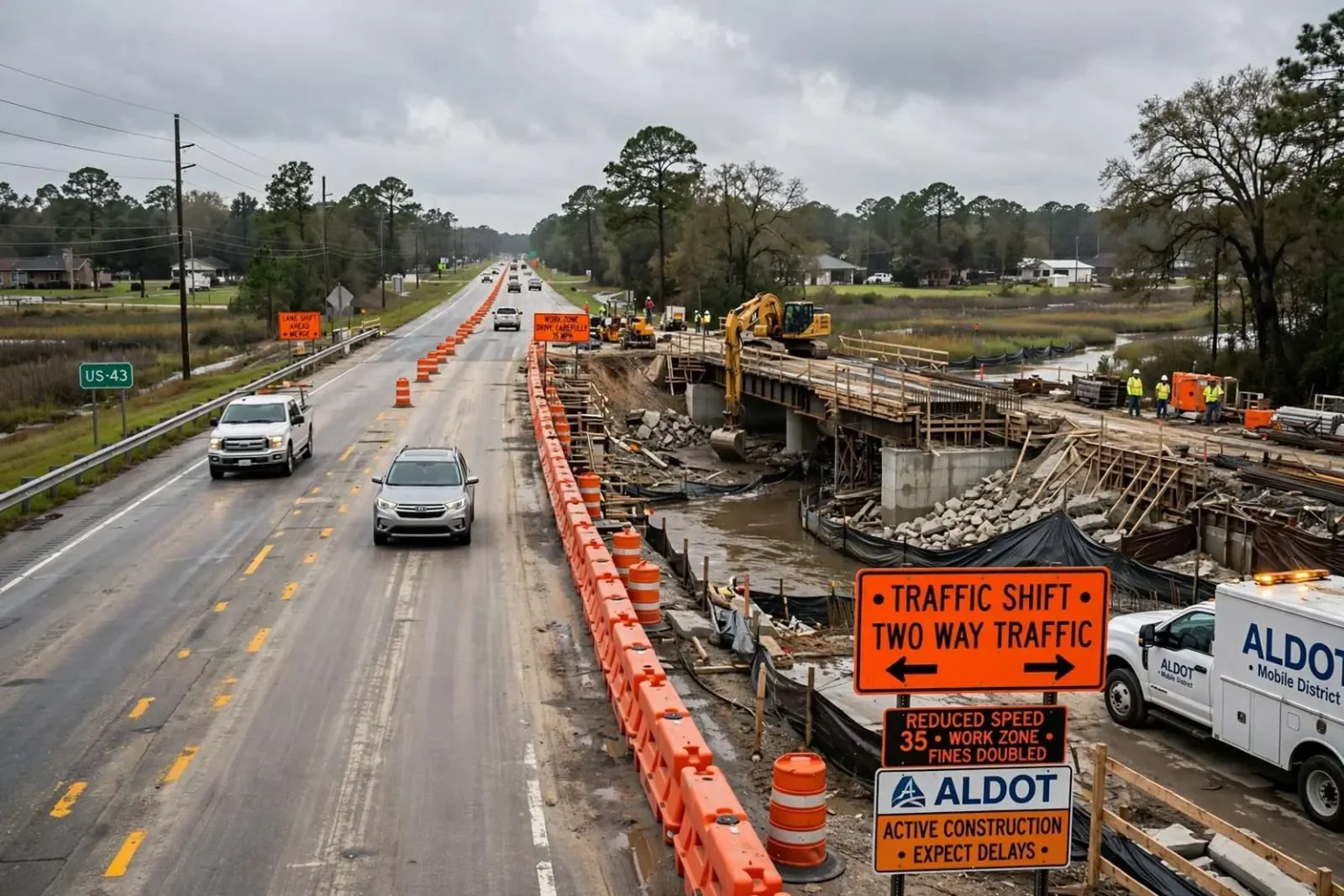
Drivers along US-43 in Mobile County should expect traffic changes as the Alabama Department of Transportation moves forward with construction of a new southbound bridge over Steele Creek. The work marks another step in the state’s continuing effort to modernize the aging highway corridor that carries commuters, freight, and local traffic through the communities north of Mobile.
Crews have begun shifting traffic onto US-43 northbound between East and West Plateau Avenue and Dogwood Drive/Juniper Avenue, converting the northbound side to carry vehicles in both directions while the southbound span comes out and the new bridge goes in. Two-way traffic on a roadway built for two full directions demands the most from drivers, and ALDOT is treating the transition zone as the project’s most sensitive stretch.
The shift allows workers to continue culvert removal operations and construct the new southbound bridge over Steele Creek. Removing the old culvert and building the replacement span requires open excavation along the creek and heavy equipment operating immediately beside live traffic — conditions that leave no room for drivers who ignore the new traffic pattern.
What drivers need to know
ALDOT is urging motorists to obey all traffic signage and use extra caution while traveling through the work zone. The signage — lane-shift arrows, reduced speed limits, and barrier drums marking the narrowed lanes — is the only thing separating drivers from an active construction site over a creek, and officials stress that the posted limits in work zones are not suggestions.
The construction is part of ongoing infrastructure improvements along the US-43 corridor in the Mobile area. The highway, which runs from downtown Mobile north through Prichard, Chickasaw, Saraland, Satsuma, and Creola before continuing toward Washington County, serves as the backbone for the communities along Mobile Bay’s northern reaches — an alternative to Interstate 65 that carries local commerce, school traffic, and drivers avoiding interstate congestion every day.
For the cities along the corridor, the state of US-43 is a daily quality-of-life issue. Flooding and aging drainage structures like the Steele Creek crossing have long been points of concern, and replacing undersized culverts with modern bridges reduces both the flood risk that closes the road in heavy rain and the maintenance costs that come with infrastructure at the end of its design life.
Why the work matters
Steele Creek drains a watershed that collects runoff across the surrounding area before it reaches the waterway, and its crossing of US-43 has been a choke point both for stormwater and for the roadway itself. When a culvert can no longer pass the volume of a heavy rain, water backs up onto the highway, closing lanes and sometimes the entire road while it recedes. A new bridge built to modern standards raises that capacity, keeping the corridor open during the storms that regularly test Mobile County’s drainage.
The project also brings the crossing up to the load standards required by today’s freight traffic. US-43 carries a steady stream of trucks serving the industrial and commercial businesses along the corridor, and bridges designed decades ago require increasingly frequent — and disruptive — repairs to stay in service. The new southbound span is built for the loads the road actually carries now and for decades to come.
Drivers who regularly use this stretch of US-43 should plan for potential delays and consider alternate routes during peak travel times. The morning and afternoon commuter pushes, when northbound and southbound volumes are heaviest and unbalanced, are when a two-way traffic pattern shows its strain most clearly; midday trips through the work zone move considerably better.
Living with a two-way traffic shift
A lane shift of this kind changes the driving experience in ways that catch even familiar commuters off guard on the first pass. Head-on traffic now sits immediately across a narrow center line; turning movements onto and off of East and West Plateau Avenue and Dogwood Drive/Juniper Avenue become more complicated; and the margins that used to exist for distraction simply disappear. ALDOT’s request for caution is aimed at exactly those first weeks of adjustment.
The department’s standard guidance for work zones applies in full: slow to the posted limit, merge early where lanes close, leave following distance, and eliminate phone use in the zone. Alabama law doubles fines for speeding violations in work zones when workers are present, and law enforcement patrols the corridor during active construction. The greater penalty, though, is the one that can’t be assessed in court — most work zone injuries strike drivers and their passengers, not the crews behind the barrels.
Local drivers have alternates worth knowing. The parallel street grid around the Steele Creek crossing gives nearby residents options for short trips, and for longer north-south runs the interstate stands ready for those willing to trade a few minutes of distance for a predictable drive. School arrival and dismissal times complicate the local streets near the work zone, so through-traffic is best served by staying on the highway at the reduced speed rather than cutting through neighborhoods.
ALDOT’s role on the Gulf Coast
The Alabama Department of Transportation maintains the state’s highways through district offices, and the Mobile district manages a program that spans everything from interstate widening to the bridge and culvert replacements now under way on US-43. Projects of this scale move through years of study, design, environmental review, and letting before crews ever arrive, which is why the sight of barrel-lined lanes represents the final stage of a long process.
Work schedules on bridge projects depend heavily on weather. Rain raises the creek’s flow and halts excavation; concrete pours and curing follow their own timetables. The department adjusts the traffic pattern as the work progresses, and drivers should expect the configuration between East and West Plateau Avenue and Dogwood Drive/Juniper Avenue to remain in place until the southbound bridge structure is far enough along to carry traffic again.
ALDOT publishes project updates and advises drivers to check conditions before traveling through active work zones. For the communities along US-43 — commuters heading to Mobile, shoppers moving between Prichard, Chickasaw, and Saraland, and freight serving the corridor’s businesses — the short-term inconvenience of the shift is the price of a crossing that will no longer flood the highway or throttle the road’s capacity every time Steele Creek rises.
What happens next on the project
With traffic shifted and the work zone established, crews proceed through the sequence that bridge replacement follows: demolition and removal of the old culvert, excavation and stabilization of the creek banks, construction of the new southbound span’s foundations and structure, and finally the roadway work that reconnects the highway to its full width. Each stage brings its own equipment and its own temporary disruptions, and the traffic pattern will be adjusted as the project advances.
Drivers passing the site will see the project’s progress in real time — the old culvert coming out, the new structure taking shape over the creek, and the gradual return of lanes as the work closes out. The department’s practice is to complete one phase fully before restoring the traffic pattern it displaced, so the two-way arrangement on the northbound side remains until the new southbound bridge is ready to shoulder its share of the load.
In the meantime, the department repeats the essentials: obey the signage, slow down, stay alert for workers and equipment, and build a few extra minutes into trips through the corridor during peak hours. The US-43 corridor has served Mobile County’s northern communities for generations, and the investments now under construction — including the new bridge over Steele Creek — are what keep it serving them for generations more.
Residents and commuters with questions about the project, its schedule, or the traffic pattern can find information through ALDOT’s Mobile district office and the department’s public information channels. For now, the advice for anyone driving US-43 between East and West Plateau Avenue and Dogwood Drive/Juniper Avenue is simple: plan ahead, drive the posted speeds, and remember that the crew working feet from your lane is building the crossing that your commute will depend on when the barrels come down.
The work zone also serves as a reminder of what corridor improvement requires in a built-up area. Unlike projects on open highway, work along US-43 happens inches from driveways, side streets, and businesses whose customers need continuous access. The traffic shift between East and West Plateau Avenue and Dogwood Drive/Juniper Avenue is engineered to keep that access open throughout construction, and drivers’ patience with the narrowed lanes is part of what makes the staging possible.
Beyond the immediate project, the improvements along US-43 fit the broader pattern of investment in Mobile County’s transportation network as growth pushes north from the city. The communities along the corridor have added residents and commercial development steadily, and the highway — never designed for the volume it now carries — is being brought up to the task piece by piece. Bridge and culvert replacements like the one at Steele Creek are the least glamorous part of that effort and among the most consequential, since a single failed crossing can cut a corridor in two.
For now, the measure of the project’s success is the everyday one: drivers getting through the work zone safely, the creek flowing under a structure built to handle the storms to come, and the corridor’s communities connected without interruption. The department’s message to the drivers who use US-43 daily is to treat the reduced speeds and shifted lanes as the new normal until the southbound bridge opens — and to remember that every safe passage through the zone is a crew member’s workplace made safer by the caution of the drivers passing through it.


