ALDOT Starts Overnight Resurfacing Work on US-90/98 Causeway Stretch, Lane Closures Planned
ALDOT began a $1.5 million resurfacing project on US-90/98 near the Mobile Bay causeway, with nightly lane closures Sunday through Thursday expected into.
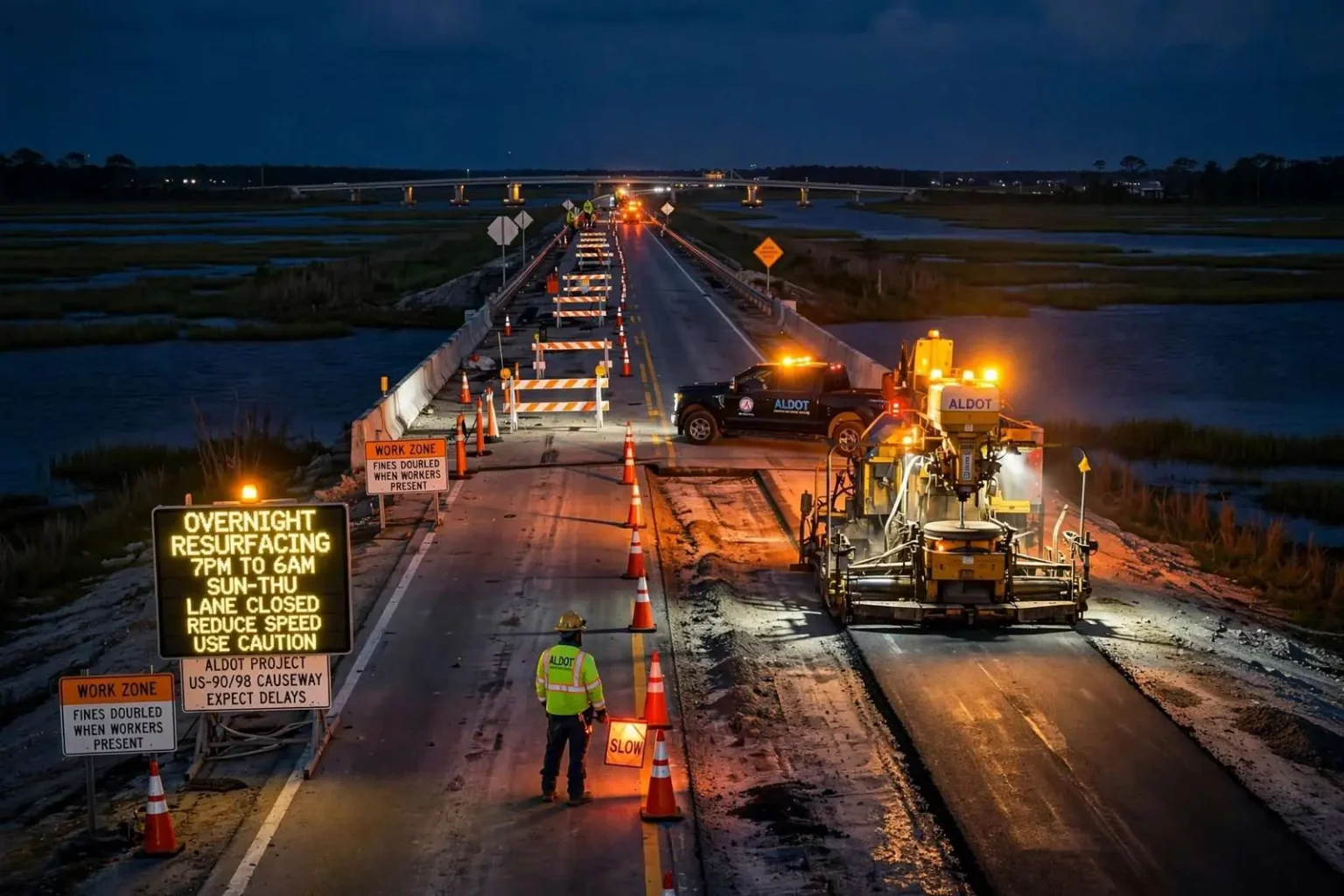
Drivers traveling between Mobile and the Eastern Shore should plan for overnight delays along part of the US-90/98 corridor. The Alabama Department of Transportation has begun a resurfacing project covering nearly three miles of roadway, and motorists can expect alternating lane closures during nighttime hours while the work proceeds.
The project stretches along US-90 from the Cochrane-Africatown USA Bridge to a point just west of the Tensaw River Bridge near Battleship Park, following the causeway route that carries traffic across the southern edge of the Mobile-Tensaw Delta. It is one of the region’s most scenic drives — and one of its most heavily relied-upon — linking the Mobile Bay causeway communities with the industrial corridors on either side of the bay.
According to ALDOT, lane closures run Sunday nights through Thursday nights, from 7 p.m. until 6 a.m. Crews will close lanes one at a time rather than shutting the road completely, so traffic will continue to move through the work zone, though at reduced speeds and with flagging operations where the surface is being milled or repaved.
Project cost and timeline
The resurfacing effort is valued at about $1.5 million, with completion targeted for June if weather cooperates. Pavement work is highly sensitive to rain and humidity — asphalt cannot be laid on a wet surface, and overnight temperatures in late winter and early spring occasionally dip below the range where a proper bond forms — so the schedule carries a built-in allowance for weather days.
Motorists are urged to follow all traffic control signage, slow down and stay alert while driving through the zone. Workers on foot, milling machines and paving equipment will be operating just feet from live traffic, and the causeway’s narrow shoulders leave little room for error. Fines for speeding in Alabama work zones double when workers are present.
Resurfacing projects like this one renew the driving surface on heavily traveled corridors, extending pavement life and improving ride quality. Milling removes the cracked and rutted top layer of asphalt, and a fresh lift is then laid and compacted, restoring skid resistance and smoothing out the bumps that accumulate from years of heavy truck traffic.
The US-90/98 causeway is a key commuter and freight link connecting downtown Mobile with Spanish Fort, Daphne and Baldwin County. While Interstate 10 carries most of the region’s through traffic on the parallel Bayway, the causeway serves local commuters, commercial vehicles avoiding the interstate’s tunnels, and the string of businesses, marinas and fishing camps that line the route along the delta’s southern edge.
Why the causeway needs attention
The stretch between the Cochrane-Africatown USA Bridge and the Tensaw River Bridge carries a steady mix of commuter cars, tour buses bound for delta attractions, and heavy trucks serving the industries along the Mobile River. That combination wears pavement faster than lighter traffic would, and the low-lying causeway environment — with its high water table and frequent tidal influence on the underlying soils — adds stresses that interior highways rarely face.
ALDOT maintains the causeway as part of its larger stewardship of the US-90/98 corridor across the Mobile-Tensaw Delta, one of the largest river deltas and wetland ecosystems in the United States. The route predates the interstates: the original Bankhead-era bridges and the causeway fill made Mobile Bay’s upper reaches passable by car in the 1920s and 1930s, long before the modern Bayway was built alongside it.
Today the two routes serve different purposes. I-10’s Bayway handles high-speed through traffic, while the older causeway provides the slower, closer-to-the-water route that connects the communities and businesses along the shoreline. Keeping it in good condition preserves that alternative for the tens of thousands of drivers who cross between Mobile and Baldwin County each day, particularly when incidents close the interstate.
What drivers will experience
During the closure windows, drivers should expect a single lane of traffic in alternating directions where work is underway, controlled by temporary signals, flaggers or both. Delays are typically measured in minutes rather than hours, but the queue can stretch during peak overnight periods such as Sunday evenings when weekend travelers return, or around 5 a.m. as the first commuters cross toward the Eastern Shore.
The work zone sits between two bridge crossings, meaning there are few practical alternatives once a driver is on the causeway. Motorists who want to avoid the zone entirely can shift to I-10 across the Bayway, though that adds distance and, for trips during peak hours, risks the tunnel congestion the causeway route is often used to escape.
ALDOT’s traffic-control plan keeps the causeway open to local traffic at all times — no full closures are planned. Businesses along the route, including the restaurants and bait shops that depend on drive-by customers, remain accessible throughout the project, and the agency has asked the public to continue patronizing them despite the orange cones.
The bigger maintenance picture
Resurfacing is the visible piece of a broader maintenance cycle. ALDOT engineers inspect pavement condition across the state’s system on a rolling schedule and rank segments for rehabilitation based on ride quality, cracking, rutting and underlying structural condition. A mill-and-resurface job like this one resets the clock on the top layers; full-depth reconstruction, which is far more expensive and disruptive, is reserved for segments where the foundation itself has failed.
The nearly three-mile scope suggests the project is a surface renewal rather than a structural rebuild, which is good news for the causeway’s long-term outlook. Combined with routine drainage cleaning and mowing under ALDOT’s roadside programs, the new surface should keep the corridor serviceable for years under its current traffic loads.
Officials said the June target gives crews a cushion for weather delays, and that any significant change to the schedule will be announced publicly. In the meantime, drivers crossing the delta after dark should treat the work zone as they would any active construction area: reduced speed, full attention and patience with the alternating lanes.
Landmarks along the route
The project’s endpoints are themselves waypoints in the region’s history. The Cochrane-Africatown USA Bridge, which carries US-90/98 across the Mobile River from the Africatown community, honors the descendants of the Clotilda — the last known ship to bring enslaved Africans to the United States — whose survivors founded Africatown north of downtown Mobile after the Civil War.
At the project’s eastern end, the Tensaw River Bridge rises near Battleship Memorial Park, home of the USS Alabama battleship, the submarine USS Drum and one of the largest collections of military aircraft on the Gulf Coast. The park draws hundreds of thousands of visitors a year, many of whom cross the causeway en route to and from downtown Mobile.
Between the two bridges, the roadway skirts the edge of the Mobile-Tensaw Delta, passing boat launches, campgrounds, seafood restaurants and the historic Delta communities whose access to Mobile has always run along this corridor. The causeway is also a favored route for cyclists on organized rides and for sightseers drawn to the delta’s sunsets, which adds a recreational dimension to its daily traffic counts.
Advice for commuters and freight
Commuters who cross the bay on a regular schedule should plan around the 7 p.m. to 6 a.m. closure windows. Friday and Saturday nights are exempt, which means weekend social traffic between Spanish Fort, Daphne and Mobile flows normally, but Sunday-through-Thursday overnight trips should budget extra time or shift to I-10.
Commercial carriers with overnight schedules through the Port of Mobile area will find the alternating-lane pattern workable but slow, particularly where milling equipment occupies the travel lane. Dispatchers serving the region have been advised of the schedule so loads moving between the port, the causeway industries and Baldwin County distribution centers can be timed around the work.
Emergency services have also been looped in. Alternating-lane work zones on a route with no parallel access require coordination so that ambulances and fire apparatus crossing the delta are either escorted through or routed to I-10 when minutes matter. That planning is standard on ALDOT projects of this type.
Looking ahead
When the project wraps in June, drivers will find a smoother, quieter ride across the southern edge of the delta, with fresh markings and restored shoulders visible along the entire work area. The improvements will not change the causeway’s fundamental character — a two-lane-per-direction, water-hugging route that moves traffic at modest speeds through one of the most distinctive landscapes on the Gulf Coast.
ALDOT asks the public to report any issues observed in the work zone, from damaged signage to standing water in the new pavement, so crews can correct problems promptly. Drivers with questions about the schedule can use the agency’s public information resources, which carry project updates for the Mobile region’s active work zones.
Until then, the advice from the agency is unchanged: follow the signage, slow down, stay alert, and remember that the workers just beyond the cones are rebuilding the road everyone in the region depends on. A few minutes of patience on a weeknight crossing is the price of a causeway that will serve the next decade of commuters, freight and delta travelers alike.