ALDOT to Close Sections of I-10 in Mobile for Overnight Sign Replacements
ALDOT will close sections of I-10 in Mobile overnight starting Aug. 7 to replace overhead signs with temporary ones ahead of the Mobile River Bridge.
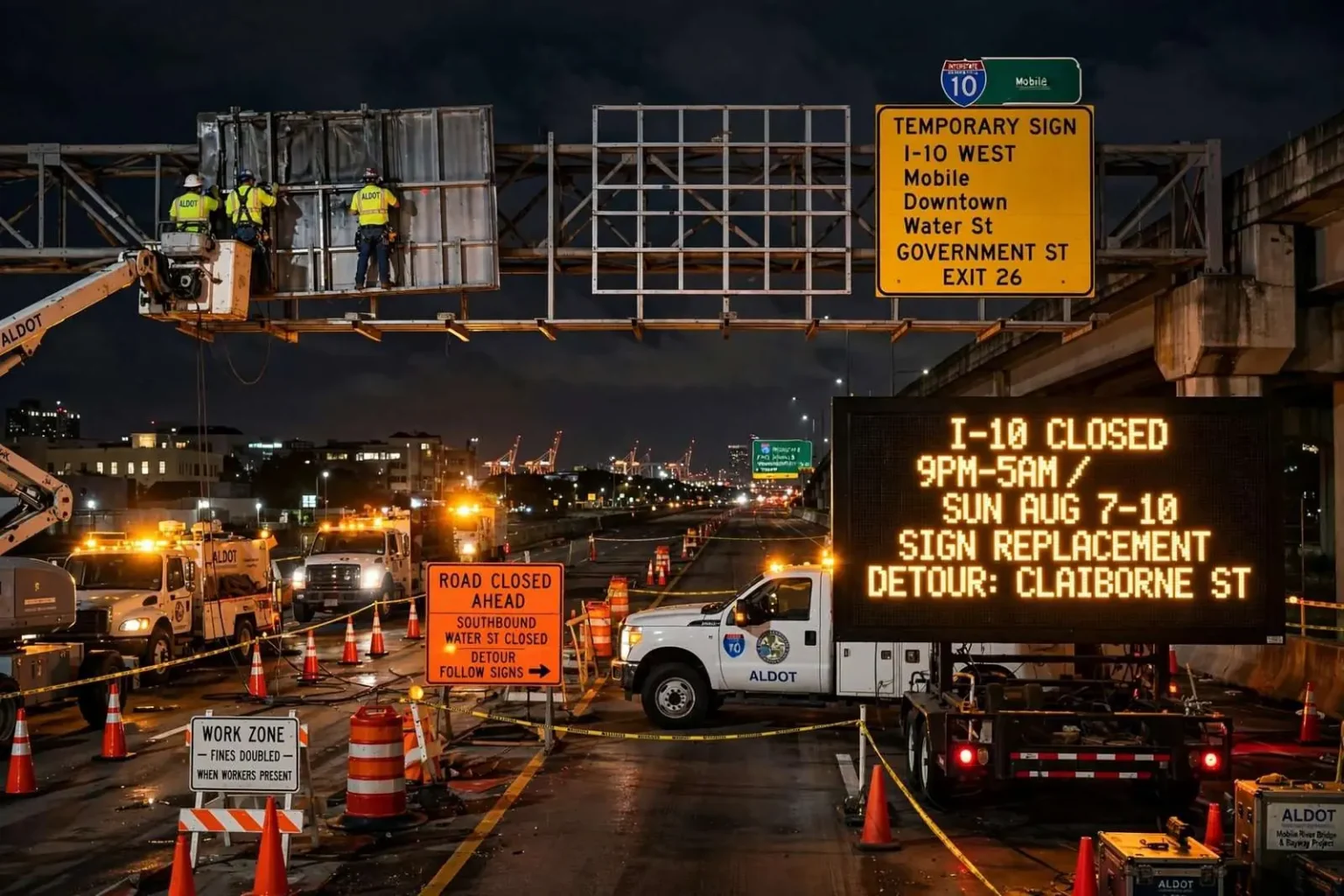
The Alabama Department of Transportation will close portions of Interstate 10 in Mobile starting Sunday, Aug. 7, to replace several overhead signs as part of preparations for the Mobile River Bridge and Bayway Project. The overnight closures, scheduled from 9 p.m. to 5 a.m., will allow crews to swap out existing signs with temporary replacements before the corridor’s long-anticipated redesign moves forward.
ALDOT says the signs needed to be replaced regardless of the bridge project, but because the future design of the span is still being finalized, using temporary signs now will save significant money. The arithmetic is stark: replacing the three signs with new permanent ones would cost an estimated $1 million, while the temporary replacements cost approximately $100,000. Should the final design later require different signage, the state avoids spending heavily on structures that would come down anyway.
The work is among the first visible infrastructure changes tied to the Mobile River Bridge and Bayway Project, a multibillion-dollar effort that will add a new cable-stayed crossing over the Mobile River along the I-10 corridor and rebuild the Wallace Tunnel approach. For years the project existed mostly in planning documents and public meetings; drivers will now begin seeing its fingerprints on the roadways they use every day.
Scheduled closures
On Monday, Aug. 8, southbound Water Street will be closed south of Government Street, with drivers detoured to Claiborne Street. Water Street runs directly beneath the elevated I-10 viaduct through downtown, so overnight work above the roadway requires closing the surface street to protect motorists from falling debris and equipment. The closure may extend into Tuesday, Aug. 9, depending on how quickly crews can complete the sign work and remobilize.
On Tuesday, Aug. 9, southbound Dauphin Island Parkway will be closed from the I-10 ramp area. Motorists needing to access I-10 will be detoured to northbound DIP, a reversal of the usual pattern that ALDOT engineers use when ramp work makes the standard movement unavailable. This closure may also extend into Wednesday, Aug. 10.
Transportation officials note that overnight windows are standard practice for work of this kind. Closing lanes between 9 p.m. and 5 a.m. keeps crews clear of the daytime peak, when I-10 through downtown Mobile carries commuters, port traffic and freight moving between the Gulf Coast and the Southeast. Night work also reduces the crash risk that comes with narrowing lanes past a work zone.
Why the signs matter to the bigger project
Overhead guide signs on an interstate are more than directions; they define lane assignments, exit numbering and the decisions drivers make at highway speed. The Mobile River Bridge and Bayway Project will reshape both of those elements across a wide stretch of the corridor, adding new exits, realigning ramps and shifting traffic patterns between downtown Mobile and the Eastern Shore. Permanent signage can only be fabricated and installed once those design decisions are locked in.
Until then, temporary replacements give ALDOT flexibility. If the final configuration changes an exit’s function or shifts a movement from one ramp to another, crews can simply repanel the temporary structures rather than demolition and rebuild of permanent sign bridges. Officials said the savings from that approach — roughly $900,000 on these three signs alone — compound across a project of this scale.
The sign replacements also serve a safety purpose in the interim. Aging overhead structures along the downtown viaduct and the approaches to the Wallace and Bankhead tunnels have long been slated for renewal, and drivers familiar with the corridor will notice the refreshed panels even before any bridge construction begins.
Context for the Mobile River Bridge and Bayway Project
The broader project has been discussed in Mobile for more than two decades. It centers on a new crossing of the Mobile River designed to relieve the George Wallace Tunnel, whose single tubes in each direction create chronic bottlenecks at rush hour and during port operations. The plan also rebuilds the Bayway — the elevated causeway section of I-10 that spans the Mobile-Tensaw Delta between the Bankhead Tunnel approaches and Baldwin County — with a higher, more modern structure.
Funding for the project was approved through a tolling framework adopted after years of public debate, with revenue dedicated to construction and long-term maintenance. ALDOT has emphasized that early utility relocations, right-of-way work and interim improvements like sign replacements will continue to appear along the corridor as design work advances, giving residents a rolling preview of the changes ahead.
For commuters between Mobile and the Eastern Shore, the near-term effect of the project will be a steady drumbeat of nighttime lane closures and ramp detours. ALDOT routinely publishes weekly schedules for such work and asks drivers to check conditions before trips through the work zone.
What drivers should expect
During each closure window, marked detours will route traffic around the affected segment, and law enforcement details will be stationed at key intersections to keep movements orderly. ALDOT’s guidance is consistent: slow down in the work zone, expect the unexpected, and build a few extra minutes into trips that cross downtown Mobile late at night or in the pre-dawn hours.
Drivers who regularly use Water Street south of Government Street or the DIP interchange with I-10 should pay particular attention to the Monday and Tuesday night windows, since both closures could stretch an extra day if weather or equipment problems intervene. Mobile’s summer thunderstorms are a routine source of overnight work delays.
Motorists can monitor progress through ALDOT’s public information channels, which post closure notices and detour maps ahead of each night’s work. The agency has committed to announcing any changes to the schedule in advance so that freight carriers, shift workers and overnight travelers can adjust their routes.
A corridor under transformation
Interstate 10 is the spine of the Gulf Coast economy, and its passage through Mobile is one of the most congested segments between Jacksonville and Houston. The downtown viaduct and tunnel system was built in the 1970s for a fraction of today’s traffic volume, and the mismatch shows daily: backups routinely stretch from the tunnels back to the I-65 interchange and beyond during morning and evening peaks.
The Mobile River Bridge and Bayway Project grew out of that reality. Study after study concluded that simply widening the existing alignment was impractical through downtown, leaving a new river crossing as the preferred long-term answer. The design will ultimately change how traffic moves from the viaduct to the new bridge, which is precisely why the current guide signs must give way — first to temporary panels, and eventually to signage matched to the finished roadway.
Residents should expect the pace of visible work to accelerate as the project advances. Utility relocations, drainage improvements and bridge foundation work will each bring their own closure schedules, most of them confined to overnight hours for the same safety and traffic reasons that govern this week’s sign replacements.
Planning around the closures
Local businesses along Water Street and Dauphin Island Parkway were notified of the work in advance, as were the school systems and freight operators that depend on predictable overnight routes. ALDOT coordinates with the City of Mobile on detour signage so that street-level wayfinding matches the interstate guidance drivers see on the mainline.
For most drivers, the practical advice is simple. If a trip through downtown Mobile can wait until after 5 a.m., it will avoid the closures entirely. If not, the detours to Claiborne Street and northbound Dauphin Island Parkway are straightforward, and law enforcement officers will be present to direct traffic where the detour routes meet the closed segments.
ALDOT officials have repeatedly thanked the public for its patience during early-phase work, noting that the short-term inconveniences of sign swaps and ramp closures are the visible down payment on a corridor redesign that will define travel between Mobile and the Eastern Shore for the next half-century. The overnight windows beginning Aug. 7 are, in that sense, the project’s first concrete step from blueprint to roadway.
As always in active work zones, penalties for speeding are heightened and enforcement is stepped up. Drivers passing the sign crews — working above the roadway on lift equipment through the night — are asked to give the work zone full attention and to report any damaged signage or debris in the roadway so crews can respond before the morning rush begins.
ALDOT has not announced a firm completion date for the overall bridge and Bayway rebuild, but officials have said early-phase work of this kind will continue in stages across the corridor. Each overnight job is coordinated with the project office so that temporary installations do not conflict with permanent construction scheduled for the same segments.
The agency also reminded drivers that construction zones along I-10 are enforced around the clock, and that fines are doubled when workers are present, including during the overnight sign replacements. Motorists who observe unsafe driving or debris in the closed segments are encouraged to report it to state troopers or through ALDOT public reporting channels so crews can respond before the next morning commute.