ALEA identifies 18-year-old Theodore High School senior killed in Schillinger Road crash
An 18-year-old Theodore High School senior was killed Friday in a four-vehicle crash on Schillinger Road in western Mobile County, according to ALEA.
Western Mobile County crash
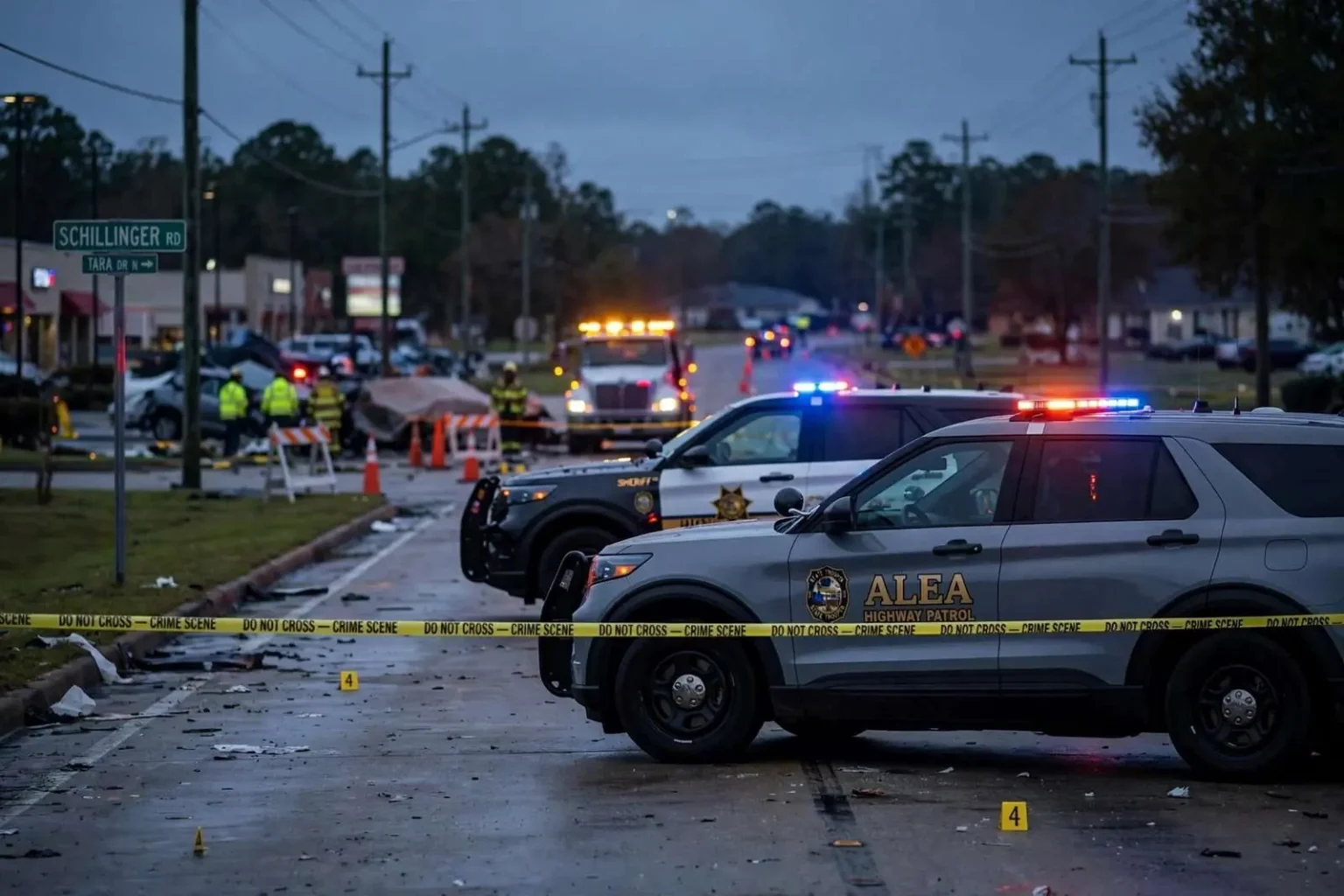
An 18-year-old Theodore High School senior was killed Friday evening in a four-vehicle crash on Schillinger Road in western Mobile County, according to the Alabama Law Enforcement Agency. ALEA troopers responded around 5:40 p.m. to the crash near Tara Drive North, a stretch of Schillinger Road that carries steady commuter and school traffic through one of the county’s fastest-growing corridors.
Investigators said Yaderik J. Morales Madera, 21, of Mobile, was traveling north on Schillinger Road in a 2012 Honda Accord when he collided with a 2003 Honda Accord driven by Devinee Saige Rooney, 18, of Mobile. Rooney, a senior at Theodore High School, was wearing a seat belt, but the injuries she sustained were fatal, and she was pronounced dead at the scene.
Two more vehicles were drawn into the collision. A 2013 Ford F-150 driven by Logan Woodruff, 22, of Mobile, and a 2004 Chevrolet Suburban driven by David Odom, 41, of Saraland, were also involved in the crash. Woodruff and Morales Madera were taken to University Hospital for treatment of injuries that were not considered life-threatening, ALEA said. Odom’s condition was not included in the agency’s initial statement. Troopers continue to investigate the crash, and no charges had been announced as of the agency’s most recent public update.
Four-vehicle crashes on a two-lane corridor like Schillinger Road unfold in seconds and leave investigators with a complex reconstruction to complete. Troopers will document the final resting positions of all four vehicles, examine roadway evidence, interview witnesses and download any available vehicle data before determining how the initial collision cascaded into the others. Those findings, when complete, become part of the investigative record that determines whether any traffic citations or criminal charges follow.
The crash site: Schillinger Road near Tara Drive North
Schillinger Road is one of western Mobile County’s principal north-south arterials, linking the communities around Theodore and Tillmans Corner with the residential subdivisions that have spread west of the city over the past three decades. Near Tara Drive North, the road passes through a dense mix of neighborhoods, churches and small commercial strips, and its traffic load swells sharply during weekday commutes and school arrival and dismissal hours.
A 5:40 p.m. Friday crash lands at one of the week’s busiest moments: end-of-workday traffic layered on top of high school football season travel, when drivers across Mobile County are on the move to games and Friday-night gatherings. Corridors like Schillinger Road absorb that volume with limited capacity, and the intersection areas near minor streets such as Tara Drive North are recurring points of conflict where turning traffic, following distances and speed differentials converge.
Local officials have long identified western Mobile County’s arterial network — Schillinger among them — as a pressure point for growth. As subdivisions push farther from the city core, commuter volumes climb on roads that were built for a quieter era, and the county has pursued widening and signal projects piecemeal as funding allows. Until those projects arrive, the daily reality is heavy traffic on a road with tight margins for driver error.
Who responds when a crash turns fatal
Fatal crashes in unincorporated Mobile County fall under the jurisdiction of ALEA’s Highway Patrol Division, whose troopers handle scene management, evidence collection and the formal investigation. The response draws on a large support network: county sheriff’s deputies secure the perimeter, fire and rescue units extract anyone trapped and treat the injured, and coroner’s personnel manage the deceased. Each agency’s work feeds the troopers’ final reconstruction.
University Hospital — formally USA Health University Hospital, the region’s only Level 1 trauma center — is the designated destination for the most seriously injured patients across southwest Alabama. Its trauma teams stand ready around the clock for exactly the kind of transports Friday’s crash produced, and survival outcomes on Mobile County highways depend in real terms on how quickly patients reach its doors. That Woodruff and Morales Madera arrived with non-life-threatening injuries reflects both the responders’ speed and the variable ways a multi-vehicle impact distributes its violence.
For the neighborhood around the crash scene, a fatal wreck brings hours of disruption: the road closes while troopers photograph and measure, traffic backs up onto connecting streets, and residents watch investigators work under lights into the evening. The closures are not bureaucratic theater — the measured evidence disappears the moment traffic resumes, so the roadway itself becomes the investigation’s primary document.
The loss of a student ripples outward from the scene in ways the accident report cannot capture. Theodore High School, one of the largest schools in the Mobile County Public School System, serves a wide swath of the county’s western communities, and its senior class shares classrooms, teams, work shifts and friend groups with the victim. When a classmate dies on a road students drive every day, grief counseling and school support services typically swing into action in the days that follow.
Seat belts help, but they cannot do everything
ALEA’s statement that Rooney was wearing a seat belt carries a grim significance for readers accustomed to hearing that unrestrained occupants fare worst in crashes. Restraints dramatically reduce the risk of death — they remain the single most effective protection in a collision — but they are engineered to manage a specific envelope of impact forces. In multi-vehicle crashes involving vehicles of different sizes and masses, the forces can exceed what any restraint system can survivably distribute.
The mix of vehicles in Friday’s crash illustrates that physics. The collision involved two passenger sedans, a full-size pickup truck and a large SUV. When a sedan is struck in a chain-reaction crash that includes heavier vehicles, the occupant compartment can be overwhelmed regardless of restraint use. Investigators will consider each vehicle’s damage profile and orientation as they reconstruct the sequence — details that will matter to the families seeking answers about how a Friday commute turned fatal.
That message — belts still save lives, but belts are not immunity — is a staple of Alabama’s traffic safety outreach, and it is worth repeating in a state whose fatality rates have historically run above the national average. Rural and suburban two-lane arterials account for a disproportionate share of Alabama’s deaths, and Mobile County’s growing western corridor fits the pattern: high speeds, heavy commuter volume, and limited room for error.
The investigation: what happens next
An ALEA fatal crash investigation proceeds in stages, and it can take weeks before the agency’s public account is complete. Troopers begin with the scene: mapping skid marks and gouges, measuring final vehicle positions, photographing debris fields and documenting the roadway itself. Vehicles are examined for mechanical condition, and where available, onboard event data recorders are downloaded to establish speeds, braking and throttle inputs in the seconds before impact.
Witness statements fill in the gaps the physical evidence cannot. Drivers behind the collision, residents along Schillinger Road and the surviving participants each provide accounts that troopers test against the evidence. Toxicology testing is routine in fatal crashes, and its results factor into the final determination of contributing factors.
The end product is a reconstruction that assigns the sequence of events and identifies contributing factors — speed, following distance, lane position, distraction, mechanical failure or roadway conditions. Depending on those findings, the case may result in traffic citations, or in rare circumstances referral for criminal review. Until that work concludes, the agency’s interim statement — the facts of time, place, vehicles and people — is the public’s complete picture.
For the families involved, the investigation’s pace is a hard reality. Rooney’s family is left planning a funeral for an 18-year-old who was days into her senior year’s rhythm of classes, friends and Friday nights; the other families await word on the injured. Troopers continue to investigate the crash, and the corridor reopened to traffic as the county absorbed another loss on one of its busiest roads.
A corridor’s recurring risk
Schillinger Road has appeared in Mobile County’s crash statistics before, as have its sister arterials in the western county. Growth has a signature on every one of them: more driveways, more turning conflicts, more vehicles staging onto a road designed decades ago. County and state engineers track crash patterns to prioritize improvements — turn lanes, signal timing, lighting and, where warrants justify them, medians — and fatal crashes accelerate those conversations.
In the meantime, the practical lessons are the ones troopers repeat after every multi-vehicle fatality: leave following distance, slow for congestion, watch turning traffic at minor intersections and buckle up every trip. None of those habits would have guaranteed a different outcome Friday evening — but each one moves the odds on a corridor where thousands of Mobile County commuters will drive again Monday morning.
Anyone with information about the crash is encouraged to contact ALEA’s Highway Patrol Division, as witness accounts remain valuable to investigators even after a scene has been cleared. The agency’s continuing investigation will, in time, provide the formal answers the families and the community are waiting for.