MOBILE COUNTY, Ala. — State troopers have identified the 18-year-old Mobile man who was struck and killed by an 18-wheeler on Interstate 10 after fleeing the scene of a crash that followed a brief law enforcement pursuit. The death closed a chain of split-second decisions on one of the Gulf Coast’s busiest highways, and it opened two parallel investigations — one by the Alabama Law Enforcement Agency into the fatal collision, and another by the sheriff’s office into the pursuit that preceded it.
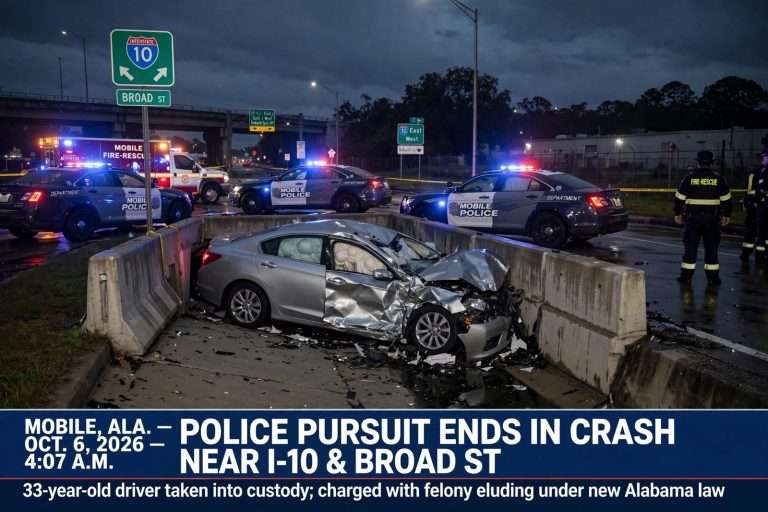
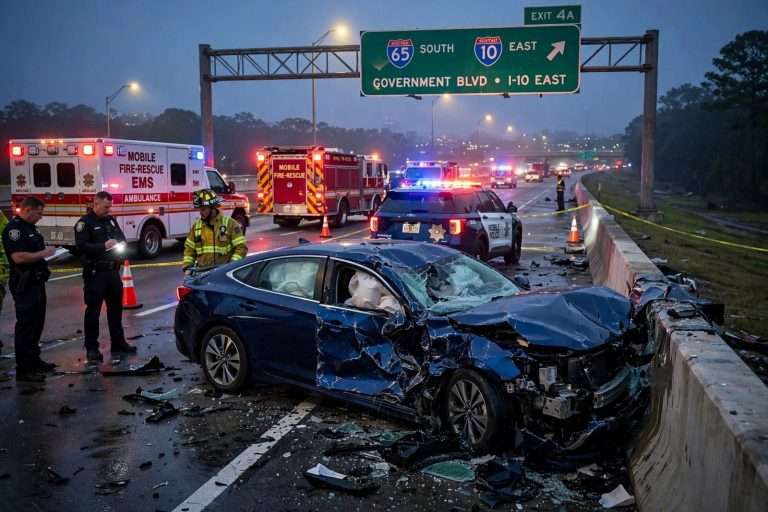
How the crash unfolded: According to the Alabama Law Enforcement Agency, the chain of events began around 5:30 p.m. on Sunday, January 12, when a Mobile County Sheriff’s Office deputy tried to pull over a vehicle for speeding and driving without headlights on I-10 westbound. Authorities said the driver refused to stop, lost control of the car, and ran off the westbound roadway into a ditch. The attempted traffic stop — the kind made thousands of times a year across the county — turned into a short pursuit and ended within minutes in a ditch beside the interstate.
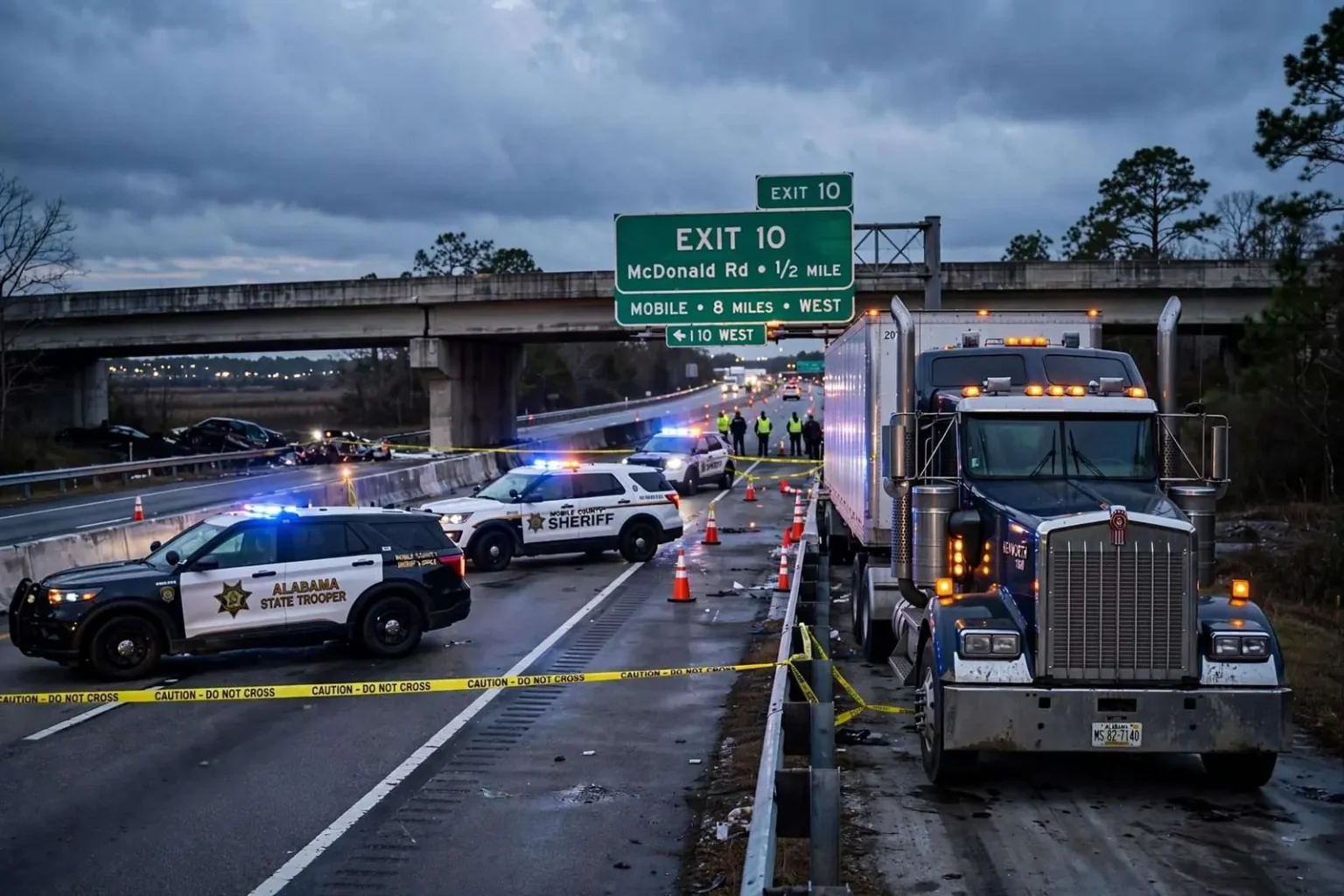
After the crash, the driver — identified by ALEA as Cameron Shamir Gamble, 18, of Mobile — got out of the vehicle and attempted to cross the eastbound lanes of the interstate near the McDonald Road overpass at Exit 10. He was struck by a 2020 Kenworth commercial truck shortly before 5:45 p.m. and was pronounced dead at the scene. The stretch of interstate near Exit 10 sits amid the cluster of interchanges that serve western Mobile County, where traffic from the minor local roads merges onto a highway already moving at highway speed.
Truck driver uninjured, investigation continues: ALEA identified the driver of the truck as Curley Gardener of Osyka, Mississippi. Troopers said Gardener was not hurt in the collision. For commercial drivers, a collision like this one unfolds in seconds that no amount of experience can fully prepare for — a person on foot in travel lanes at dusk, no time to brake, no room to swerve into adjacent traffic at seventy miles an hour.
Family members, reached by phone, described Gamble’s death as devastating and expressed sympathy for the truck driver caught up in the incident. Their words acknowledged what investigators will spend weeks untangling: a crash with two sets of victims — the family of the young man who ran, and a truck driver who was simply in the lane where a fleeing driver chose to cross.
Troopers said no further information would be released while the investigation remains active. ALEA’s Highway Patrol Division handles crash reconstruction on fatalities across the region, and inquiries of this kind typically examine vehicle speeds, sightlines, lighting conditions and the sequence of the pursuit before any findings are made public.
The Interstate That Carries the Coast
Interstate 10 is the main east–west corridor through Mobile County, and crashes that shut down its lanes routinely ripple across the metro area’s evening commute. The highway funnels beach traffic, port freight and daily commuters through the same lanes, and an incident on either side of the Bayway or the tunnel crossings can back up traffic for miles in every direction. Sunday evening’s fatal sequence, occurring west of the city, slowed the western approaches just as weekend travelers were returning home.
The crash also illustrates the danger that interstates pose to anyone on foot. Pedestrian strikes on limited-access highways are almost universally fatal — there are no intersections, no crosswalks and no expectation on the part of drivers that a human being could appear in the roadway. Safety officials repeat the same guidance whenever a vehicle becomes disabled or a driver exits a wreck: stay behind the guardrail, walk along the shoulder away from traffic, and never attempt to cross the travel lanes of an interstate on foot.
When a Traffic Stop Becomes a Pursuit
The sequence that began with a deputy’s radar and headlights raises familiar questions for law enforcement agencies everywhere. Pursuits are governed by strict internal policies that weigh the seriousness of the suspected offense against the risk created by a chase — and fleeing a stop for speeding and no headlights puts a fleeing driver, pursuing officers and the motoring public all in motion at once. Agencies generally review every pursuit that ends in a crash to determine whether policy was followed and where decisions could have been made differently.
The Mobile County Sheriff’s Office, which patrols the county’s unincorporated areas and the corridors around the interstate’s western exits, has handled dozens of similar pursuits over the years, and each one that ends badly renews the debate over how long a chase should continue for a minor traffic offense. In this case, authorities said the pursuit itself was brief: the deputy attempted the stop, the driver refused, and the car was in a ditch within minutes — before troopers were even called to the scene.
What happened after the crash — the decision to leave a wrecked vehicle in a ditch and cross eight lanes of interstate traffic — is the portion of the sequence that investigators and family members alike keep returning to. Whether Gamble was disoriented, fleeing or simply unaware of how much traffic was approaching at highway speed may never be fully known. What is certain is how little margin the eastbound lanes leave: at 65 miles an hour, a truck covers nearly a hundred feet every second it travels, and its stopping distance stretches longer than a football field.
The Toll on Those Left Behind
For the truck driver, the aftermath of such a collision brings its own ordeal. Commercial drivers involved in fatal pedestrian strikes face investigations of their own — company reviews, federal compliance checks and the weight of knowing that a routine run through Mobile ended in a death that no defensive driving could have prevented. The family’s public expression of sympathy for Gardener, offered while their own grief was fresh, was the kind of grace rarely seen in the hours after a fatal crash.
The scene itself closed portions of the interstate while troopers documented evidence, surveyed the roadway and worked the reconstruction — a methodical process that keeps a highway closed in the middle of an evening and tests the patience of thousands of drivers. On a corridor like I-10, though, the shutdown is a routine the region knows well: drivers reroute through the surface streets of western Mobile County while the work of documenting a fatality is done correctly the first time.
Interstate 10’s western reaches near the McDonald Road overpass carry a mix of through-freight and local traffic that makes the corridor unforgiving at any hour. Truck traffic is constant — the interstate is a primary route between the Port of Mobile, the logistics warehouses of the I-10 corridor and destinations across the Gulf South — and Sunday evening traffic on a January night means a steady stream of commercial vehicles moving through the very lanes where Gamble attempted his crossing.
Exit 10 itself serves one of the county’s busiest suburban intersections, where the interstate meets the commercial spine of west Mobile. Drivers exiting there know the routine risks of the merge; what happened Sunday was the rarer, grimmer category — a crash that began on the highway and ended with a young man on foot in the eastbound lanes with night falling and headlights streaming toward him.
What Investigators Will Examine
In the weeks ahead, ALEA’s investigation will sort the sequence into its component parts: the circumstances of the initial traffic stop, the duration and decisions of the pursuit, the mechanics of the single-vehicle crash into the ditch, and the fatal pedestrian strike that followed. Findings in cases like this one typically take weeks to finalize, and any determination about whether the deputy’s actions complied with sheriff’s office policy would come through the agency’s own review process rather than the crash report.
The case is also a reminder of a pattern troopers see repeatedly: crashes that become fatal only because of what happens in the minutes after the initial collision. Vehicles disabled in travel lanes, drivers who exit into live traffic and pedestrians crossing interstates turn survivable incidents into tragedies — which is why ALEA and highway safety advocates repeat the same advice after every storm, every blowout and every fender-bender on the interstate: move to safety first, stay off the roadway, and never cross the travel lanes on foot.
For now, the file remains open. Troopers said no further information would be released while the investigation remains active, and the final report — when it comes — will stand as the official account of a January evening when a routine traffic stop on the interstate ended, fifteen minutes later, in a death that touched two families and a highway’s worth of bystanders.