Allegiant Air Takes Delivery of First Mobile-Built Airbus A320
Allegiant Air has received its first Airbus A320 assembled at the company's Mobile manufacturing plant, a delivery that coincided with the debut of a new $1.4 million dock built by the Mobile Airport Authority.
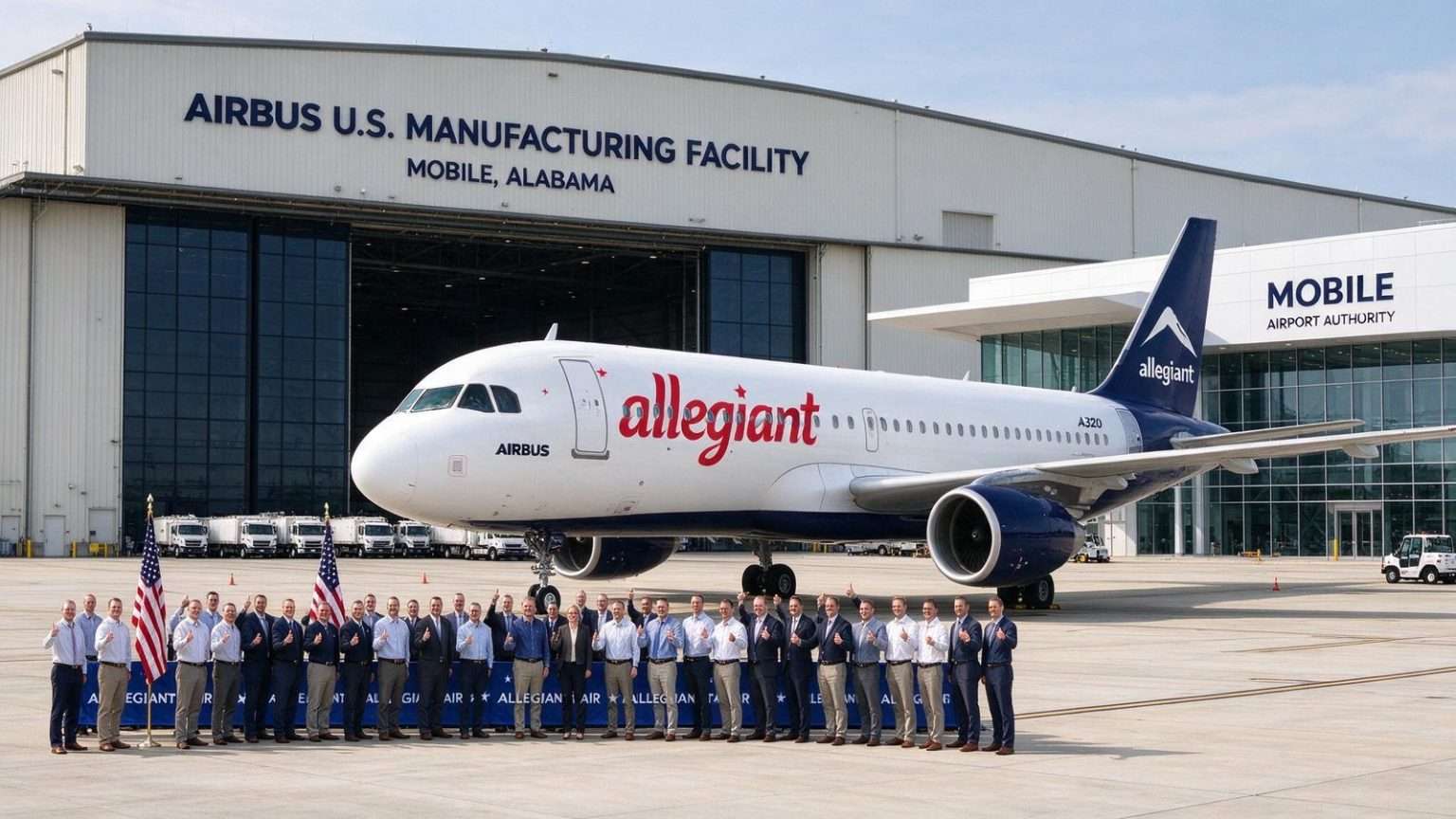
Allegiant Air has taken delivery of its first Airbus A320 built at the Airbus U.S. Manufacturing Facility in Mobile, marking a milestone both for the airline’s expanding fleet and for the local aerospace plant’s growing production record. Executives from Airbus and Allegiant gathered at the Mobile facility alongside a team of Allegiant employees and representatives of the more than 380 workers employed at the plant to mark the handoff. The ceremony was the kind the Brookley field site has seen before, but this one carried a first: the finished aircraft bore both the Allegiant name and the distinction of being assembled on Mobile’s assembly line.
The aircraft is the first of what Allegiant expects will be a steady stream of Mobile-built jets as the Las Vegas-based carrier continues shifting its entire fleet to Airbus aircraft. For an airline that built its name on bargain fares to vacation destinations, the transition is less about branding than economics — a single fleet type means lower maintenance costs, simpler pilot training and better scheduling flexibility across the operation.
“Airbus is committed to developing and producing fuel-efficient, passenger-friendly aircraft that are leaders in the evolving airline marketplace,” Bob Lekites, executive vice president of customers for Airbus Americas, said in a statement announcing the delivery. “Our partnership with Allegiant Air, coupled with our commitment to producing innovative aircraft, has allowed Allegiant to expand their ultra-low-cost consumer flight options. We are proud to deliver Allegiant their first Airbus aircraft manufactured in Mobile, and we look forward to providing them more aircraft that exceed customer expectations.”
Allegiant Chairman and CEO Maury Gallagher called the delivery an “exciting milestone” for the company in a statement of his own. “This delivery is also an important step in our transition to an all-Airbus fleet, increasing efficiencies across our entire operation and bringing economic advantages in fuel savings, higher seat capacity and more,” Gallagher said. The A320 family has become the workhorse of low-cost carriers around the world for exactly those reasons: newer engines burn less fuel per seat, and the cabin layout gives airlines room to pack in the seat counts their business model depends on.
A plant hitting its stride
The Mobile plant is now turning out A320 Family aircraft at a rate of roughly four per month. The Allegiant jet was the 69th aircraft delivered from the facility since it began operations in 2015, a pace that underscores how quickly the Brookley-based plant has scaled up since Airbus first broke ground on the site. In its early years the facility delivered a handful of aircraft annually while it worked through the long process of training a workforce from scratch; reaching the steady four-per-month rhythm has made Mobile a meaningful share of Airbus’s worldwide output.
Reaching that pace required more than a building. Final assembly of a commercial jet is a rolling procession: fuselage sections arrive by ship and by road, wings cross the ocean by sea, and the aircraft takes shape section by section before being wheeled to the paint hangar and, finally, to delivery. Each of those steps depends on workers hired locally and trained in the specialty trades of aircraft assembly — skills that did not exist at scale in Mobile before Airbus arrived and that now represent one of the region’s most valuable concentrations of industrial talent.
The plant’s output matters well beyond the delivery line, too. Every jet that rolls out is a claim on Gulf Coast craftsmanship that Airbus carries into its sales conversations with airlines worldwide, and every new customer added to the delivery book extends the runway of work ahead for the facility and its suppliers.
A new dock for the handoffs
The delivery also coincided with the debut of a new dock built specifically to speed up the handoff of finished aircraft to airline customers. The Mobile Airport Authority, along with the city and county, funded and installed the new dock at Arlington Point at a cost of roughly $1.4 million. Before the new facility, the logistics of moving finished jets, ferrying customer crews and staging the paperwork of a delivery strained against the available apron space at the plant.
Airbus took its first deliveries from the new dock on May 16 and May 17, according to Executive Director Chris Curry, who briefed the Airport Authority’s board on the project earlier this week. The first two handoffs at the dock came before the Allegiant event, and the facility is now the working front door for every delivery that follows.
Authority Chairman Elliot Maisel touted both the new dock and an ongoing runway improvement project during the board meeting, framing the investments as part of the Authority’s broader mission to support the businesses operating at its industrial park. “Both investments are capital investments for the benefit of a client or a number of clients,” Maisel said. “It should be noted that despite the fact we have limited resources, we manage to find a way to support the businesses at our park. They are economic drivers and it’s part of our mission.”
“It’s not the main part of our mission,” he added. “We’re not in the economic development business, but we’re glad to help when we can.” The distinction Maisel drew is a practical one. The Authority’s core job is running an airport and its property, but the businesses that have clustered around Brookley generate the activity — and the jobs — that make the investment self-sustaining.
The workforce behind the line
Keeping the Mobile plant running requires a large, specialized workforce. More than 80 percent of the facility’s employees come from the Gulf Coast region, and nearly a third are U.S. military veterans, according to Airbus. The veteran share reflects the region’s deep ties to the armed forces — the area’s bases and shipyards have produced generations of workers trained in precision trades, and aircraft assembly has proven a natural second career for many of them.
The plant’s presence has also drawn a network of suppliers to open new facilities in the area, adding further jobs and economic activity beyond the assembly line itself. Seats, interior fittings, composites and support services that once had to be shipped in are increasingly produced nearby, and each new supplier operation deepens the industrial ecosystem that took root when Airbus chose Mobile over competing sites. For local officials, the supply chain build-out is the quiet dividend on top of the plant’s own headcount: work that stays in the region even as the aerospace market rises and falls.
The facility has also changed the way the region thinks about its own economy. A city long anchored by the Port of Mobile, the shipyards and the chemical plants now sits inside a global aerospace supply chain, and the mobility of that industry — aircraft orders are booked years ahead and production schedules shift with demand — has given economic developers a different kind of prospect list than the region’s traditional industries ever offered.
Part of a global network
Airbus has promoted the Mobile plant as part of a global production network that keeps aircraft moving off assembly lines around the clock. Along with Mobile, the company operates A320 Family final assembly lines in Hamburg, Germany; Toulouse, France; and Tianjin, China, allowing the company to say that the sun never sets on its manufacturing operations. When demand surges in one market, the network lets Airbus shift the flow of deliveries to match, and Mobile’s four-per-month rate is the newest and fastest-growing spoke in that system.
For Allegiant, the arrival of its first Mobile-built jet closes a chapter and opens another. The carrier spent years operating a mixed fleet of secondhand aircraft, and its conversion to the A320 family is the backbone of its growth plan — new airplanes with lower operating costs that make thinner routes profitable. That the planes feeding that plan now come off a line in Mobile gives the arrangement a local face: each Allegiant jet that follows will be one more aircraft assembled minutes from Mobile Bay and delivered to a customer whose route map covers the Gulf Coast itself.
The delivery also gives the region a visible marker of how far Brookley has come since the air station closed decades ago. The field that once employed thousands in military aviation sat largely empty through the 1970s and 1980s before the Airport Authority rebuilt it into an industrial park, one tenant and one hangar at a time. Airbus’s decision to put its first U.S. assembly line there in 2013 was the turning point, and a delivery ceremony attended by a customer’s executives is now the routine proof that the gamble paid off.
What comes next for the plant is growth of the same kind that produced the 69th delivery. The A320 family remains the most in-demand single-aisle jet family in the world, with order books stretching years into the future, and Airbus has said the Mobile line is central to meeting demand from North American carriers. Allegiant is unlikely to be the last airline whose first Mobile-built jet comes with a ceremony and a set of local photographs; each additional customer added to the delivery book extends the hiring plans of the plant and its suppliers well beyond the current workforce.