Alma Bryant Setter Parris Collier Powers Hurricanes Into Volleyball Postseason
Alma Bryant senior setter Parris Collier has powered the Hurricanes to an 11-8 record and a spot in area tournament play, capping a volleyball journey that began under coach Cassandra Stewart nearly seven years ago.
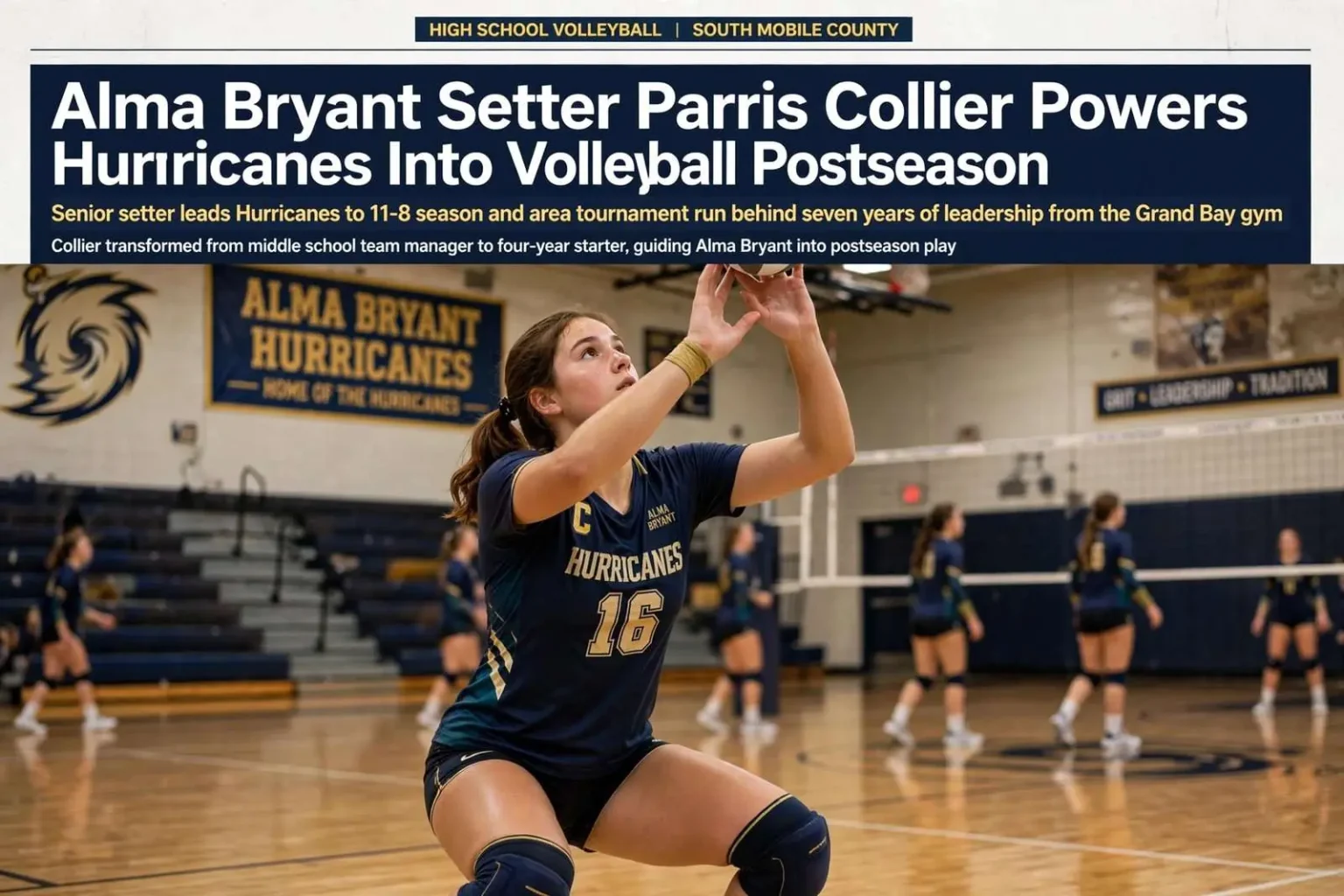
Alma Bryant High School’s volleyball team is heading into postseason play behind the steady hands of senior setter Parris Collier, whose rise through the program traces back nearly seven years to a middle school gym in Grand Bay.
The Hurricanes improved to 11-8 on the season with a win over Theodore, a victory that helped set the stage for the start of area tournament play.
Alma Bryant coach Cassandra Stewart said the team’s postseason push has been fueled in large part by the leadership Collier has shown on and off the court in recent weeks.
Stewart’s history with Collier dates back to when Collier was a sixth-grader working as a team manager for Grand Bay Middle School’s volleyball squad, which Stewart coached at the time. Collier’s older sister, Liberty, played on that team, and Parris often tagged along, soaking up the game from the sideline before eventually picking up a jersey of her own.
“I’ve been into volleyball since I was in the fifth grade because my sister played and she played under Coach Stewart as well,” Collier said. “I saw that it was a really fun game and Coach Stewart was really involved with her players, and it just made me want to start playing. So I talked to my parents about it and they put me into club ball, so when I was old enough to be on the team I would already have the knowledge of it.”
Collier said watching her sister play in their yard sealed her love for the sport after other athletic pursuits failed to hold her interest.
“As soon as I saw my sister playing, I would play in the yard with her, and I instantly fell in love with it,” Collier said. “I had tried other sports and I just couldn’t get into anything. But as soon as I started playing volleyball I knew it was the sport for me.”
From Outside Hitter to the Setter’s Spot
Collier began her playing career as an outside hitter, but it did not take long for Stewart to recognize a different kind of potential in her game. Stewart moved Collier to setter, a position that requires court awareness, quick decision-making and the temperament to run an offense possession after possession — the closest thing volleyball has to a point guard, where every good swing depends on the ball arriving at the right spot at the right moment.
The move is not a demotion; it is where a coach sends the player she trusts most. Setters touch the ball more than anyone else on the floor, and a team’s ceiling is set by how reliably its setter turns an imperfect pass into an attack. For a program like Alma Bryant’s, preparing for the area tournament against the other schools in its Mobile County region, having a four-year-tested senior running the offense changes what the postseason looks like.
The statistic that frames the season — 11-8, with a win over Theodore in the stretch run — tells the story of a program that has grown steadily through the fall. The Hurricanes’ record puts them in the conversation as area play begins, and the matchups that follow will be decided by exactly the kind of ball-control volleyball that a veteran setter provides: serving pressure, first-ball sideouts, and the discipline to run the offense even when a match tightens.
The Grand Bay Pipeline
Collier’s path — fifth-grade interest sparked by an older sister, a manager’s spot on Stewart’s Grand Bay Middle School team, club ball before she was old enough for school competition — is the quiet pipeline on which South Alabama volleyball is built. The feeder programs around Mobile County, from Grand Bay to Irvington, are where the sport’s habits are instilled: the footwork, the ball-handling, the willingness to watch a game closely enough to understand it before playing it at all.
That her route began as a manager matters more than it might seem. Managers see a program from the inside — the drills, the rotations, the coach’s demands — without the pressure of the scoreboard, and the ones who love it make players who arrive already fluent in the game’s rhythm. By the time Collier took the floor for Alma Bryant, she had years of gym hours behind her that her teammates were still acquiring.
Alma Bryant High School, serving the communities of south Mobile County around Irvington, Bayou La Batre and Grand Bay, competes in one of the state’s most geographically spread-out athletic regions, where rivalry games carry the flavor of small-town matchups. Stewart, who coached Collier’s sister and then Collier herself, has now watched the family’s investment in the sport pay off across a decade — a longevity that is rare at the high school level, where coaches and players usually overlap for only four years.
What the Setter Means in the Postseason
Area tournament volleyball compresses everything a season has built into a handful of matches, and the position Collier plays becomes decisive in exactly that environment. The setter’s hands determine whether a team’s offense runs at full speed or half; her communication holds a defense together in serve-receive; and her composure — seven years in the making, from the Grand Bay sideline to the court — is what a younger roster leans on when a tournament match swings.
Coaches talk about setters as extensions of the coaching staff on the floor, and Stewart’s evaluation of Collier has that quality: the leadership she cited has been visible on and off the court in recent weeks, in practices as much as matches. A senior setter’s final postseason is also a handing-off point for a program; the players who will carry next year’s team are watching how this one competes, and the standards Collier sets now become the ones the program inherits.
The win over Theodore carried its own significance in the region’s map. Theodore has long been a fixture in the area’s volleyball pecking order, and beating a program of that standing in the closing stretch of the regular season is both a standings event and a confidence one — proof, for a team with postseason ambitions, that it can handle the opponents it will face again when the bracket is drawn.
Club ball and the modern high school season
The club ball Collier’s parents enrolled her in is now the standard route for serious high school volleyball across Alabama. Club seasons run through the winter and spring, put developing players against better competition than their school schedules offer, and expose them to collegiate recruiting pipelines that high school coaches alone cannot open. Players who commit to club early — as Collier did, before she was even old enough for her school team — arrive at the high school level with skills their school’s opponents may never match.
The investment reflects the sport’s growth in the state. Volleyball’s participation numbers in Alabama high schools have climbed steadily over the past two decades, driven by the club infrastructure around the state’s metro areas and by the sport’s visibility at SEC schools, where Alabama, Auburn and South Alabama run established programs. For a player in south Mobile County, the pathway from a middle school manager’s chair to a postseason area tournament now runs through year-round commitment, and Collier’s career is a textbook version of it.
What remains this fall is the tournament itself, and the Hurricanes’ fortunes will track the setter’s hands. The 11-8 record, the senior leadership, the seven-year relationship between a coach and the player she managed before she coached her — all of it converges on the next few weeks, when area tournament play begins and Alma Bryant’s season becomes either a story about the one that got away or the one that a veteran setter carried where it needed to go.
Either way, the program’s foundation is visible in the story. A sister’s yard game, a middle school gym in Grand Bay, a coach who noticed a sixth-grader watching from the sideline — that is how a postseason volleyball team gets built in south Alabama, one player at a time, long before anyone counts wins.
The setter’s craft deserves its own explanation for readers new to the sport, because it is the least understood of volleyball’s positions and the one the Hurricanes’ season rests on. The setter receives the second contact on nearly every play and must judge, in less than a second, which of her hitters can score against the block in front of her, whether the pass she has been given allows a quick set or demands a high ball to the outside, and where the opposing defense is weakest. The best setters are described as quarterbacks, and the comparison holds: they call the plays, they absorb the blame when execution fails, and their distribution is the difference between an offense that is predictable and one that cannot be defended.
Collier’s conversion from outside hitter to setter gave her the position’s most valuable instinct — she knows what a hitter wants, because she has stood where the hitters stand. Setters who played attack read their hitters’ timing naturally and set balls their teammates can actually swing at, rather than balls that merely meet a diagram. Stewart’s decision to move her was the kind of judgment that shapes a program for years, since a good senior setter is typically the product of a decision made when she was a freshman.
The leadership Stewart has pointed to operates in less visible ways as well. Setters are the floor’s communicators — calling plays, redirecting teammates, managing the emotional temperature of a match. A senior in that role sets practice standards that younger players absorb without being taught: how a team warms up, how it responds to a lost set, how it treats a match it is favored to win. Those habits are what remain after the seniors graduate, which is why a coach’s public praise of a setter’s leadership usually doubles as a statement about the program’s future.
The area tournament format amplifies all of it. In Alabama’s classification system, area tournament play is a single-elimination gateway to regional and state competition — one off night ends a season, regardless of the record a team carried in. Teams therefore build their whole year around peaking for that week: managing rotations, resting injuries, and refining the serve-receive and transition games that decide tight tournament sets. A senior setter who has played club volleyball since middle school is the asset that survives the pressure; her experience is the roster’s cumulative advantage.
The Hurricanes’ schedule to this point has been the preparation for that test. Every match against the Theodore team they beat, and the other area opponents awaiting them in the bracket, was a rehearsal for conditions they will see again in the tournament — same gyms, same travel, same rivalries. The 11-8 record reflects an honest season of that work, and the win over Theodore in the stretch run demonstrated the execution the postseason will demand.
Collier’s own account of her beginnings — the fifth-grade start, the parents who put her in club ball so she would “already have the knowledge of it,” the sister whose yard games made the sport hers — is also a portrait of how athletic careers actually form in small Gulf Coast communities. Nobody scouts a sixth-grade manager. What happens instead is slower and more durable: a coach notices a child who watches carefully, a family commits to a year-round schedule, and seven years later the program’s postseason hopes run through a senior’s hands in an Irvington gym.
The final weeks of the season will be judged by the bracket, but the season itself has already produced what high school athletics exists to produce: a player who grew from a sideline observer into the person her team trusts, and a coach whose decade-long relationship with two sisters from Grand Bay shows in every set the Hurricanes run.