Aloe Vera Care Tips Ahead of Mobile Botanical Gardens’ Fall Plant Sale
A guide to growing and caring for aloe vera at home coincides with Mobile Botanical Gardens' upcoming Fall Plant Sale, plus a roundup of other South Alabama garden events this fall.
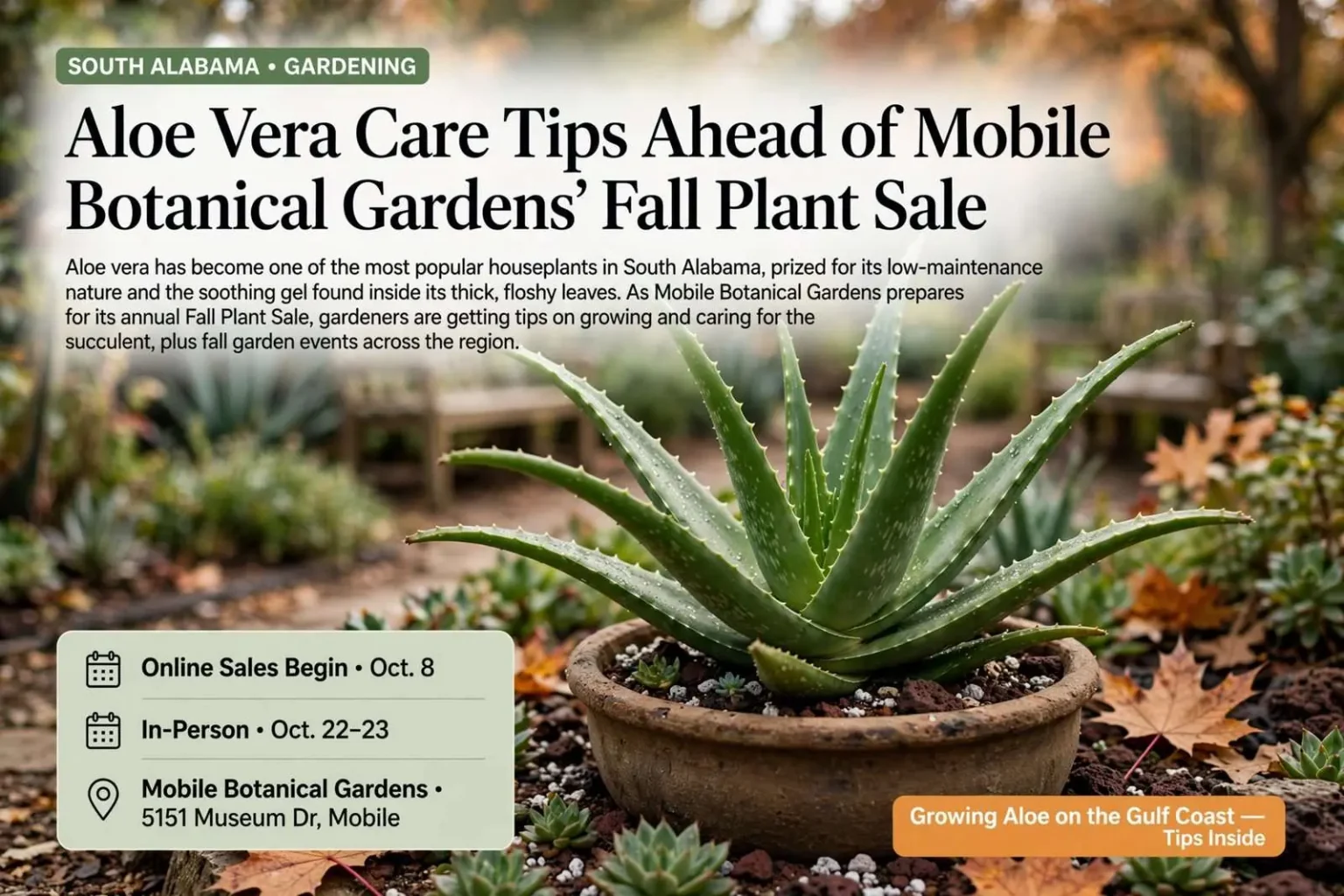
Aloe vera has become one of the most popular houseplants in South Alabama, prized for its low-maintenance nature and the soothing gel found inside its thick, fleshy leaves. As Mobile Botanical Gardens prepares for its annual Fall Plant Sale, area gardeners are getting a timely reminder of how to grow and care for the succulent, along with a rundown of other garden events happening around the region this fall.
Also known as medicinal aloe or Barbados aloe, aloe vera is a stemless or short-stemmed succulent with greenish, fleshy leaves that fan out from a central point. Its leaf margins carry small, serrated teeth, and the clear gel inside the leaves has long been used to soothe minor burns and scrapes, making it a favorite for windowsills, kitchens and porches across the region.
Aloe vera belongs to a much larger family of succulents that includes some striking relatives. Aloe arborescens, sometimes called tree aloe, can grow as tall as 18 feet, with branching stems topped by clumps of gray-green, spiny-edged leaves and winter blooms ranging from bright vermillion to clear yellow. It tolerates salt spray well, making it a hardy choice for coastal landscapes. Aloe saponaria, or soapwort, is a shorter, broad clumping variety with thick, white-spotted leaves and orange-red to shrimp-pink flowers that tends to spread into large colonies over time. Aloe variegata, which includes the partridge-breast and tiger aloe varieties, tops out around 12 inches and features triangular rosettes of dark-green leaves banded and edged in white, with loose clusters of pink to dull-red flowers appearing intermittently throughout the year.
For gardeners looking to bring aloe vera indoors, location matters most. The plant thrives in bright, indirect sunlight, and artificial light works well too. Direct, sustained sun exposure can dry the plant out and turn its leaves yellow, which diminishes the gel’s soothing properties. A porous container, such as a terra cotta pot, is recommended, with at least one drainage hole in the bottom to prevent root rot. The pot should be roughly as wide as it is deep, and the soil should be a mix formulated for succulents, containing perlite, lava rock and bark chunks to keep water from pooling around the roots.
When transplanting, gardeners should gently brush excess dirt away from the roots without damaging them, then fill the new container about a third of the way with potting mix before setting the plant in place. Soil should be added around the base, leaving about three-quarters of an inch of space between the soil line and the pot’s rim, with the plant’s bottom leaves resting just above the soil surface. Newly potted aloe should not be watered right away; it can go about a week without water while it settles into its new indirect-light spot.
Aloe vera is considered a low-maintenance plant that does best in temperatures between 55 and 80 degrees. It can spend warm months outdoors but should be brought inside before temperatures drop in winter, since it cannot tolerate cold. Fertilizer should be applied sparingly, no more than once a month, only during spring and summer, using a balanced houseplant formula diluted to half strength. Watering should be deep but infrequent, allowing the top third of the soil to dry out between waterings. A general rule of thumb is watering every two to three weeks during spring and summer and every four to six weeks in fall and winter.
Aloe kept indoors rarely blooms, but under ideal conditions it may send up a flower spike of tubular yellow or red blossoms. Mature plants may also produce “pups,” small clones of the parent plant that can be separated and repotted to start new plants. Gardeners should watch for mealybugs and scale, the most common pests, as well as root rot, soft rot, fungal stem rot and leaf rot, which tend to develop when the soil stays too wet.
To use the plant’s healing gel, gardeners can cut a mature leaf lengthwise and squeeze out the gel to apply directly to a burn or scrape, or place the opened leaf against the skin. The gel should not be ingested, since it can cause nausea or indigestion and may be toxic in large amounts, and it should be kept away from pets.
Aloe vera and its succulent relatives will be among the offerings at Mobile Botanical Gardens’ Fall Plant Sale this year. Online sales begin Oct. 8, with in-person shopping open Oct. 22 and 23 at the gardens, located at 5151 Museum Drive in Mobile.
The plant sale is one of several garden-related events on the calendar for South Alabama residents this fall. Bellingrath Gardens, at 12401 Bellingrath Gardens Road in Theodore, remains open for visitors year-round, with details available at www.bellingrath.org. Mobile Botanical Gardens itself is open Wednesday through Sunday, with hours and admission fees posted on its website, www.MobileBotanicalGardens.org, and lunch reservations available Wednesdays and Fridays. The Mobile Japanese Garden, at 700 Forest Hill Drive, is open daily during daylight hours and is free to visit, though donations are welcomed; more information is available at www.MobileJapaneseGarden.com.
Beekeeping enthusiasts can join the At Home Beekeeping Series by Zoom on Aug. 31 and Sept. 28 from 6:30 to 7:30 p.m., with questions directed to [email protected]. A Chainsaw Safety Workshop is scheduled for Sept. 13 from 8 a.m. to 3 p.m. at the Jon Archer Agricultural Center, 1070 Schillinger Road N. in Mobile; registration and details are available through the Alabama Cooperative Extension System at aces.edu, or by contacting [email protected] or 251-259-6507. Gardeners with general questions can also reach the Master Gardener Helpline at 1-877-252-4769.
Growing Aloe on the Gulf Coast
Aloe vera can’t handle frost, so on the central Gulf Coast it is usually grown in containers that can be moved indoors when a freeze is in the forecast.
Mobile Botanical Gardens is in Langan Park in west Mobile. Bellingrath Gardens, another stop on the fall calendar, opened to the public in 1932.