AltaPointe CEO Urges Congress to Overhaul Mental Health System After String of Mass Shootings
The head of AltaPointe Health Systems, which serves Mobile, Baldwin and Washington counties, is calling on Congress to pass mental health reform legislation, arguing chronic underfunding and stigma -- not gun policy alone -- are at the heart of the nation's response to mass violence.
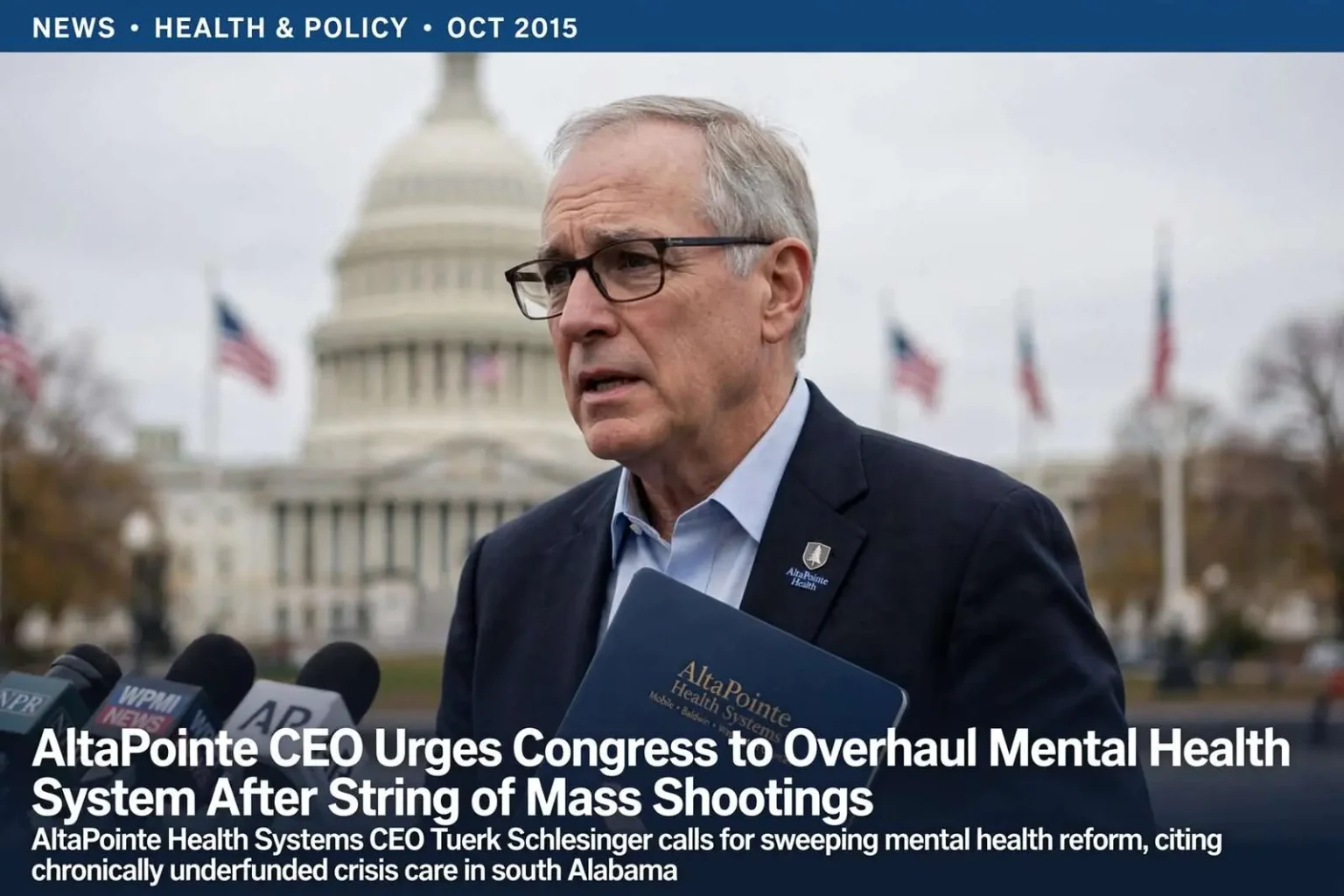
The chief executive of AltaPointe Health Systems, the behavioral health care provider serving Mobile, Baldwin and Washington counties, is calling for sweeping reform of the nation’s mental health system in the wake of a series of mass shootings that have again put a spotlight on the intersection of gun violence and mental illness.
AltaPointe CEO Tuerk Schlesinger said in comments this week that after each mass shooting — from Columbine to Aurora, Newtown, Charleston and most recently the shooting at Umpqua Community College in Oregon — the public reflexively asks whether the shooter was mentally ill, often assuming the answer before the facts are known.
Schlesinger said that instinct, while understandable, obscures a more urgent and solvable problem: a mental health treatment system that is chronically underfunded and difficult for families to navigate.
The pattern he described will be familiar to anyone who has tried to find care in south Alabama. A family in crisis typically encounters a patchwork of crisis lines, emergency rooms, courts and community providers, each with its own eligibility rules, waiting lists and funding limits — and no single door that leads to the right service on the first try.
What AltaPointe is, and what it carries
AltaPointe serves more than 23,000 people a year across the three-county area, according to Schlesinger, and the organization has had to find creative ways to stretch limited resources to meet that demand.
As the community mental health center for the region, AltaPointe is the safety-net provider for Mobile, Baldwin and Washington counties: it takes the patients other systems turn away, the uninsured, the Medicaid population, and people in the middle of a psychiatric emergency whose first stop is often a hospital emergency room ill-equipped to hold them.
The demand arrives from every direction — schools referring children, jails referring people with untreated illness, hospitals needing somewhere to discharge patients who still need care, and families who have exhausted private options. A safety-net provider’s budget, however, is built from the same public dollars that every state has tightened for decades.
Schlesinger said the complexity of severe mental illness, combined with the stigma surrounding both the diagnosis and the treatment, makes it difficult to build public support for the funding and policy changes needed to fix the system.
What the research actually says
Schlesinger pushed back on the assumption that mental illness is a leading driver of gun violence.
Citing a study by two Vanderbilt University researchers published in the American Journal of Public Health, Schlesinger noted that people diagnosed with a mental illness were responsible for fewer than 5 percent of the roughly 120,000 gun-related killings in the United States between 2001 and 2010.
The same research found that people with mental illness are 60 to 120 percent more likely than the general population to be victims of violent crime rather than perpetrators.
That second finding — the one that rarely makes it into the public conversation after a mass shooting — is the one clinicians emphasize. People living with schizophrenia, bipolar disorder and other serious diagnoses are far more likely to be robbed, assaulted or otherwise harmed than to harm anyone else, and every reflexive round of fear after a shooting makes their lives harder: harder to disclose a diagnosis to an employer, harder to get a landlord to rent to them, harder to walk into a clinic without shame.
Even so, Schlesinger argued that the stigma attached to mental illness keeps many people from seeking treatment in the first place, and that better public education about mental illness could reduce that stigma.
With an accurate diagnosis, consistent treatment and adherence to prescribed medication, Schlesinger said, most people living with mental illness can achieve meaningful recovery — but only if they are able to access care.
What access costs
That access, Schlesinger said, depends on money.
A greater investment of federal, state and local funding is needed to support mental health services and psychiatric medical education, along with more equitable and reasonable civil commitment laws that could help thousands of people get treatment rather than cycling through courts and jails.
The structural history behind his point is long and well documented. The large state hospitals that once housed most of America’s psychiatric patients were emptied over decades — first by new medications, then by legal and policy changes — but the community-based system that was supposed to replace them was never funded at the promised scale. The consequence, visible in every county jail and emergency room, is a population of people with untreated serious mental illness whose first sustained contact with public institutions is now more likely to be with law enforcement than with a psychiatrist.
Alabama is no exception. Community mental health centers carry large caseloads on lean budgets, and the supply of inpatient psychiatric beds in the state has not kept pace with demand, leaving emergency rooms and county jails to absorb the overflow. Civil commitment laws sit in the middle of that problem: written to protect individual liberty, they can also leave families without any lawful way to compel treatment for a loved one in obvious decline.
Three bills Congress was weighing
Schlesinger pointed to three pieces of federal legislation pending in Congress in the fall of 2015 that AltaPointe and other behavioral health providers were watching closely.
The Helping Families in Mental Health Crisis Act (H.R. 2646) was designed to overhaul the federal government’s approach to mental illness, making it easier for family members to help a loved one without relying on involuntary commitment, forcing more coordination among federal agencies, funding evidence-based programs such as the jail diversion program AltaPointe operates locally, requiring additional psychiatric beds, expanding telehealth psychiatry, and training pediatricians to know when to consult child psychiatrists.
Each provision spoke to a gap providers see daily. Family caregivers in Alabama describe the catch-22 of watching a relative deteriorate while the law requires the person to be an immediate danger before any intervention is possible. Jail diversion programs — which AltaPointe already runs locally — intercept people whose real problem is untreated illness, steering them into treatment instead of a booking. Telehealth psychiatry addresses the state’s geographic reality: psychiatric specialists are concentrated in a few cities, while patients are everywhere.
A companion measure, the Mental Health Reform Act of 2015 (S. 1945), sought to address gaps in resources and coordination by encouraging integration of physical and mental health care, creating a new Assistant Secretary for Mental Health and Substance Use, establishing an Interagency Serious Mental Illness Coordinating Committee and a National Mental Health Policy Laboratory, reauthorizing mental health research, strengthening enforcement of mental health parity laws, and improving mental health services within Medicare and Medicaid.
The parity provisions carry particular weight for working families. Federal parity law requires insurers to cover mental health care on terms equal to physical health care, but enforcement has lagged — denials, restrictive networks and confusing authorization requirements remain routine complaints. Patients who cannot get their insurance to pay for outpatient psychiatry end up, again, in the safety-net system.
Schlesinger also highlighted the Improving Access to Emergency Psychiatric Care Act (S. 599), which had passed the Senate and was awaiting action in the House at the time.
The bill would extend a Medicaid emergency psychiatric care demonstration project that had been limited to three years.
AltaPointe’s EastPointe Hospital in Daphne took part in the original demonstration project for roughly two and a half years before it ended unexpectedly earlier in the year; passage of the bill could allow the hospital and others like it to resume participation through fiscal year 2016.
The demonstration mattered in a concrete way: it allowed Medicaid to pay for emergency psychiatric stays in a freestanding psychiatric hospital — the kind of facility EastPointe is — rather than forcing those patients into general emergency rooms that are rarely equipped for them. When the demonstration lapsed, the financing for a working model of emergency psychiatric care simply stopped, and providers had to absorb the loss.
The local ask
Schlesinger urged residents of south Alabama to contact their members of Congress in support of the legislation, saying the debate over gun violence too often fades once the immediate news cycle passes, and that sustained pressure on lawmakers is needed to keep mental health funding and reform on the agenda.
His argument about attention spans is, in effect, an argument about budgets. The public conversation after a mass shooting is intense but brief; the funding decisions that determine whether a clinic can hire a psychiatrist, whether a crisis bed exists, and whether a jail diversion program keeps its staff are made slowly, over fiscal years, and rarely make headlines.
Beyond the federal proposals, Schlesinger said local investment in behavioral health education, treatment capacity and diversion programs remains critical to helping people in Mobile, Baldwin and Washington counties get care before a crisis occurs.
The local dimension includes the institutions residents touch directly: school counselors trained to recognize warning signs, first responders trained in crisis intervention, judges and sheriff’s offices connected to the diversion program, and primary care doctors who know when to refer rather than treat alone. Every dollar spent upstream on those connections, providers argue, is a dollar not spent downstream on emergency commitment, incarceration or an emergency room hold.
For the more than 23,000 people AltaPointe serves each year, the debate in Washington is not an abstraction. It is the difference between a system with enough beds, enough clinicians and enough coordination to catch a crisis early — and a system that meets them for the first time in its worst moment.