Amazon Confirms Multiple COVID-19 Cases at Mobile Sortation Facility
Amazon has confirmed multiple COVID-19 cases among employees at its sortation center in Mobile, with workers saying they aren't always told how many cases have occurred or whether they've been exposed.
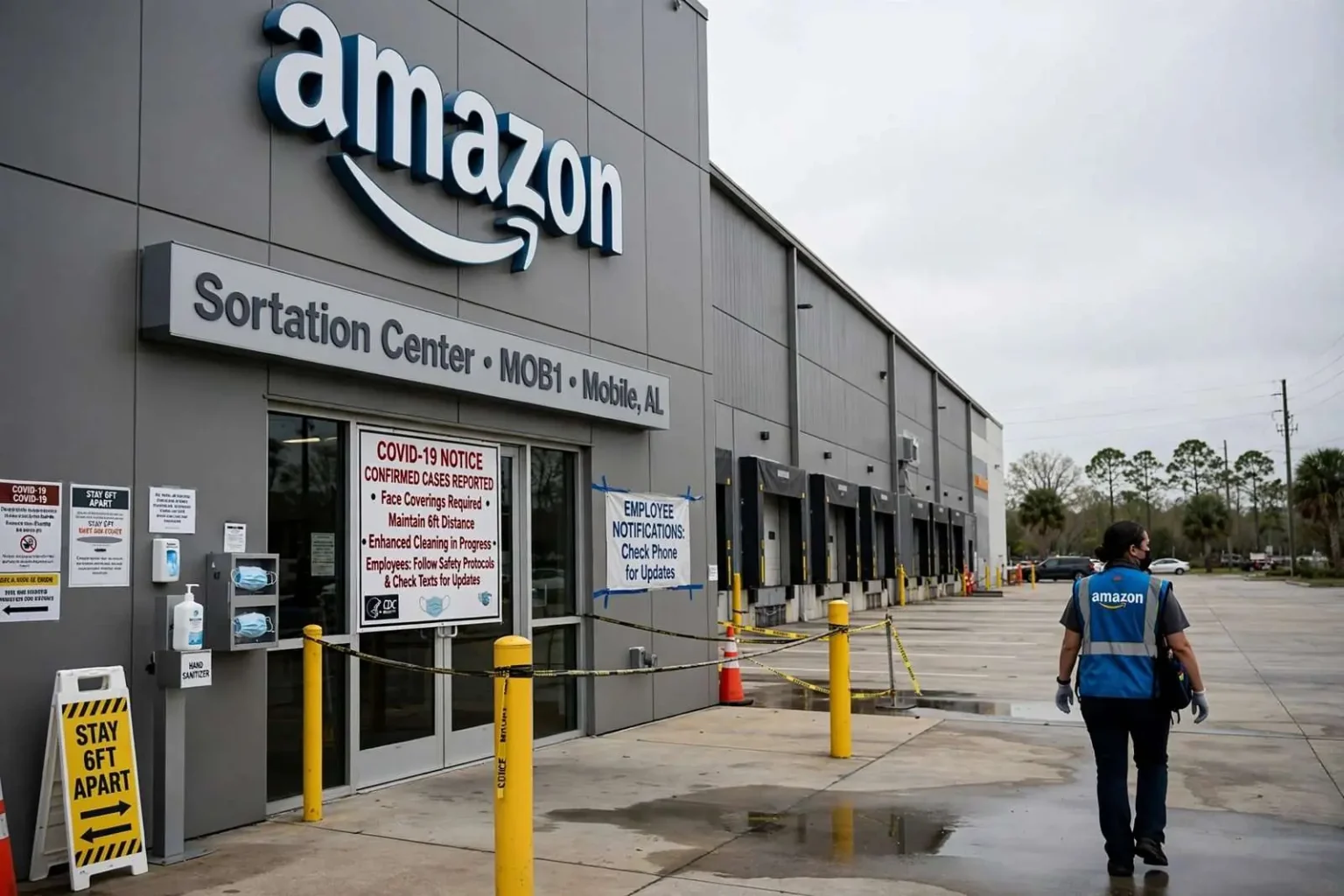
Amazon has confirmed that several employees at its sortation center in Mobile have tested positive for COVID-19, even as the company maintains it is taking steps to protect workers on site. A company spokesperson acknowledged this week that cases have occurred at the Mobile facility, though he declined to provide a specific total. That refusal to publish a running count has become a familiar pattern across Amazon’s national network, and it has left workers, their families and local officials to piece together the scale of the outbreak from fragments — company statements, text alerts and word of mouth.
The spokesperson said Amazon has worked to slow the spread of the virus inside the facility, notify affected employees and support workers who become sick. The company noted it is supporting employees who are recovering and that ensuring the health and safety of its workforce remains its top priority. Sortation centers occupy a critical middle position in Amazon’s logistics chain: packages arriving from fulfillment centers are sorted there by ZIP code and handed off to local delivery operations. When a sortation center stalls, the effects ripple across an entire delivery region.
The stakes were amplified by the moment. The pandemic pushed a historic share of household shopping online, and Amazon — the country’s dominant online retailer — scaled up hiring and operations just as public health officials were urging residents of Mobile County and Baldwin County to stay home. That put the company’s warehouse workforce, the people who could not work from home, on the front line of the outbreak in a way few other large employers in the region experienced.
Amazon has said it expects to spend roughly $4 billion companywide between April and June on COVID-19 related initiatives aimed at getting products to customers while keeping employees safe. According to the company, about $800 million of that spending is earmarked specifically for safety measures inside its facilities. Those measures include additional personal protective equipment, enhanced cleaning protocols, redesigned process paths that allow for greater social distancing between workers, and the eventual rollout of in-house COVID-19 testing capabilities. The quarterly figure, unprecedented for workplace safety spending, was meant in part to answer the accusation — pressed by warehouse workers and their advocates across the country — that the company was treating its employees as expendable in the rush to keep packages moving.
How word of cases reaches the floor
Amazon has said company policy calls for notifying employees at a facility whenever a case is confirmed there, and that practice has played out at the Mobile site in a series of text alerts sent to workers in recent weeks. One employee, who asked that her name not be used, shared copies of several of those messages. The first notification went out to employees on April 11, informing them of a confirmed case of COVID-19 at the facility. That message outlined safety measures already in place and explained that any workers who might have been exposed to the infected employee would be contacted individually.
Weeks later, on May 5, the same employee received another alert confirming two additional cases. At least four more cases were confirmed through follow-up texts sent since May 8. Taken together, the messages trace a slow accumulation of infections across more than a month — long enough for the initial alarm of the first announcement to give way to something closer to resignation among the workforce.
Word of additional cases has also spread through informal channels. Last week, the family of another employee at the sortation center posted on social media that a relative connected to the facility had tested positive for COVID-19, urging fellow Amazon workers to get tested as well. Based on the timeline of the company’s prior notifications, that case would represent roughly the sixth or seventh confirmed infection tied to the facility, though the employee who shared the text messages said she believes the true number could be higher.
For workers deciding whether to show up for a shift, the difference between an official count of seven and a real number that is higher is not an abstraction. It is the difference between a workplace they judge manageable and one they judge a risk to bring home to their families. And without a public total, there is no way to know which it is.
“We have gotten several texts now saying that there has been positive cases, but we are not told an exact number,” she said. “They used to put a new case or two cases. Now they just say ‘additional cases’… not implying how many there are at this point. We don’t know who they are or what shift they work, and I find it very unlikely that they can tell who exactly they would have come in contact with.”
Her account describes a notification system that has grown more opaque as the outbreak has grown larger. The early alerts, she said, were specific enough to count; the later ones use language that folds several possible infections into a single vague announcement. For a worker trying to calculate her own risk, the change matters. If a confirmed case walked the same pick line or shared the same break room on the same shift, a count of two means something very different from a count of five. Vagueness collapses that distinction.
That employee said she has not personally been notified of any possible exposure to a co-worker who tested positive, but said the uncertainty has left her and other workers uneasy despite the safety measures Amazon has put in place. The company’s changes on the floor — the distancing markers, the additional cleaning, the masks — are visible every shift, she said, but they do not answer the question each worker carries through the door: whether the person who stood at the adjacent station yesterday was sick.
Leave requests and paid time off
The worry is sharpest for workers with vulnerable relatives. She said she sought time off over concerns that a close family member could face serious complications from COVID-19, but was told she would need to test positive for the virus herself before qualifying for that leave. The policy, as she described it, effectively required her to wait until she was sick — and possibly to work while infectious — before she could step away to protect a family member whose age or health made the virus dangerous.
Another employee said she experienced a similar situation before ultimately testing positive herself. She is currently on paid leave and recovering at home. Her case follows the trajectory public health officials have described all along the Gulf Coast this spring: a worker with concerns, no accommodation, and then a positive test that removed the question of whether to stay home.
In a statement, Amazon said the company provides additional paid time off for any employee diagnosed with COVID-19. The company also said workers who come into close contact with a confirmed case are asked to self-quarantine at home for 14 days and are compensated during that period as well. Taken at face value, those benefits are more generous than what many hourly workers in Mobile County can expect from their employers during this pandemic, where paid sick leave is not guaranteed by federal law for most workers. The dispute at the Mobile facility is therefore not about whether support exists on paper, but about who qualifies for it and when — with employees describing a system in which the support arrives only after a positive test, and the company describing a system built to catch exposures before that point.
The gap between those two descriptions is exactly what a specific case count and a clear accounting of contacts would resolve. Neither has been provided publicly for the Mobile site.
One site in a national pattern
The Mobile facility is one of many Amazon sites nationwide that have reported employee COVID-19 cases as the company has scaled up operations to meet a surge in online orders during the pandemic. From New Jersey to California, fulfillment and sortation centers have logged infections among workers who spend their shifts in close quarters — sharing conveyor lines, break rooms, parking lots and clock-in queues that no amount of floor tape can fully space out. The company’s sheer size makes the arithmetic stark: with hundreds of thousands of employees in its operations network, even a modest infection rate produces hundreds of cases, and even a well-run notification system produces a steady stream of alerts.
Workers at fulfillment and sortation centers across the country have raised similar concerns about transparency and the pace of safety improvements, even as Amazon has pointed to its broader investment in protective measures as evidence it is taking the outbreak seriously. Employee groups have kept informal tallies of cases, organized walkouts at some sites, and pressed for the same things the Mobile worker described: specific numbers, specific locations within the building and specific shift information. Company executives have responded by emphasizing aggregate figures — the billions in safety spending, the millions of masks purchased, the testing program being built out — rather than site-by-site counts.
That national argument has a local register in Mobile. The sortation center is a significant hourly employer in the region, drawing workers from across Mobile County, and its cases are counted among the county’s totals reported by the Alabama Department of Public Health. Every uncounted infection at the facility is, from the county’s perspective, still an infection circulating in the community — reaching households in Toulminville, Crichton, west Mobile and beyond, regardless of what appears in a company statement.
For now, the picture at the Mobile sortation center remains what the text messages describe: a first confirmed case announced on April 11, two more on May 5, at least four more since May 8, and a workforce that no longer expects to be told exactly how many of its colleagues have been sick. The company says it is doing everything it can; the employees sharing their phones and their stories say they still cannot see the whole picture. Between those two statements sits the question every warehouse worker in Mobile is left to answer alone each morning: is today the day the risk walks in with the shift?