Amazon Delivers $15,000 in Holiday Donations to Boys and Girls Club of South Alabama
Amazon delivered about $15,000 in toys, rain jackets, hygiene products and other essentials to the Boys and Girls Club of South Alabama in Mobile, part of a national holiday tour benefiting local families.
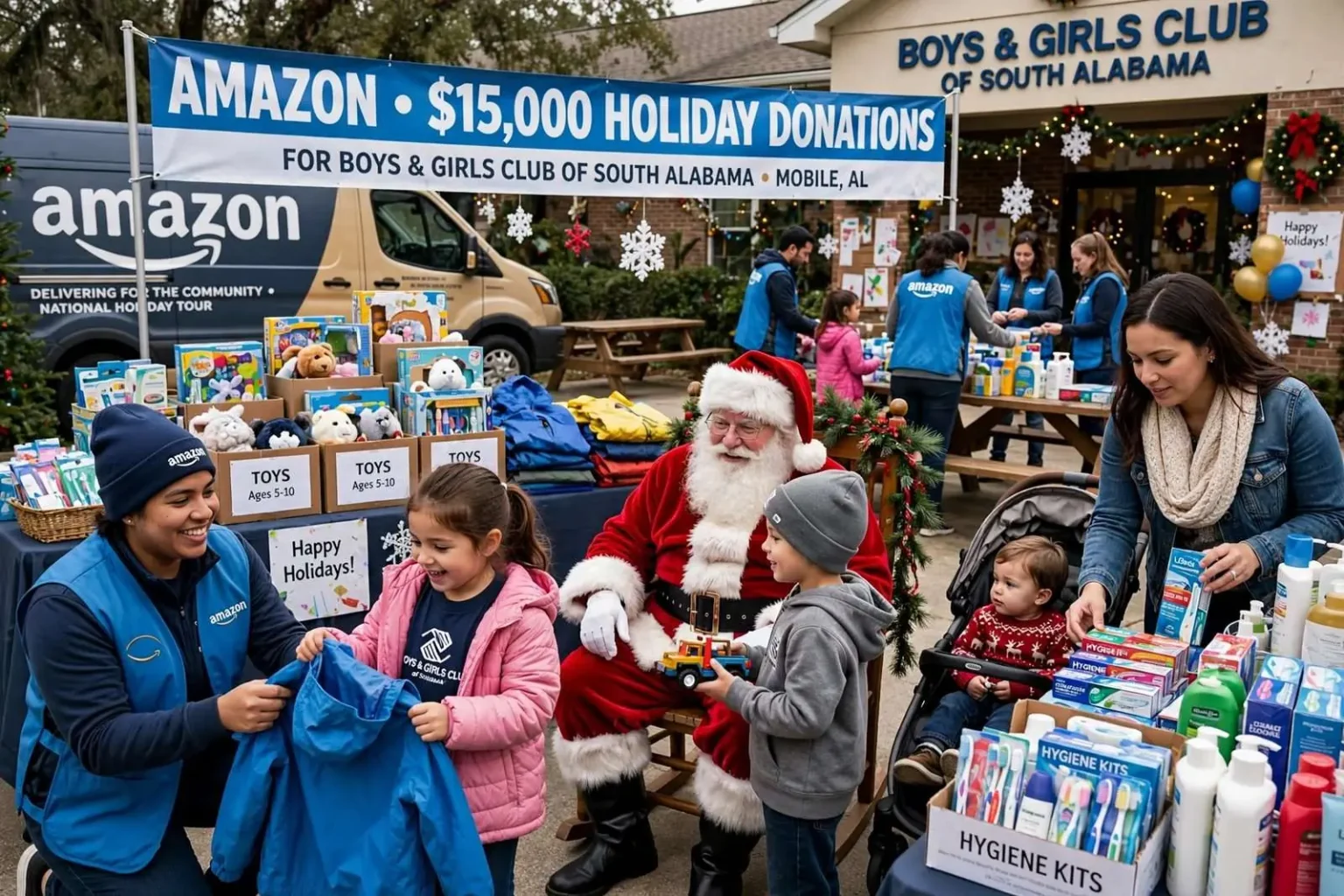
Children and families connected to the Boys and Girls Club of South Alabama received an early holiday surprise this month when Amazon delivered roughly $15,000 worth of donated goods to the organization in Mobile. The delivery, made in person by Amazon representatives, included toys, rain jackets, hygiene products and other essential items intended to help local families heading into the winter season.
After the donated items were unveiled, children and their families were invited to select toys and supplies for themselves, take part in holiday-themed activities and meet with Santa Claus. Club staff said the event was designed to feel festive and celebratory rather than transactional, giving families a chance to enjoy the holiday spirit while also receiving items many of them genuinely needed.
That distinction shaped the whole afternoon. Rather than a handout line, organizers built the giveaway as an event — children moving through holiday stations, parents choosing practical items, and a visit with Santa anchoring the celebration. Staff said the goal was for families to leave with both the supplies they needed and a memory of the season that had nothing to do with hardship.
One Stop on a National Tour
The Mobile stop was one leg of a broader national campaign by Amazon to distribute wish list items and holiday gifts to community organizations across the country. As part of the tour, the company has pledged to donate $1 to the National Alliance to End Homelessness for every mile its delivery trucks travel during the multi-city effort, tying the toy and supply giveaways to a broader push to support people experiencing homelessness.
The mileage pledge turns the tour’s logistics into a fundraising mechanism of its own: the more ground the donation trucks cover between cities, the more the company contributes to the national homelessness nonprofit. For the organizations along the route, the arrangement layers two benefits — the goods delivered at their door and the national contribution their stop helps generate.
Amazon representatives made the Mobile delivery in person, joining the event rather than simply dropping pallets. Corporate donors increasingly build presence into their giving, and for the club, having company staff on hand turned the delivery into a celebration the children could associate with the people who brought it.
What the Club Does With It
The Boys and Girls Club of South Alabama serves thousands of children and teenagers across the region each year, offering after-school programming, mentoring and enrichment activities aimed at young people from working families. The organization’s sites provide what its national model calls a safe place to learn and grow — homework help, athletics, arts and character programs — during the hours when school is out and supervision is scarce.
Local nonprofit leaders say corporate donations like Amazon’s help stretch limited budgets during a time of year when demand for basic necessities and holiday cheer both tend to rise. A $15,000 delivery of goods that the club would otherwise have to purchase — jackets, hygiene products, program supplies — frees an equivalent amount for staff, utilities and programming that no in-kind donation can cover.
The timing matters as much as the value. Community organizations across Mobile County often see an uptick in requests for assistance during the holiday season, as families balance seasonal expenses with everyday costs like clothing, hygiene items and school supplies. Donations of practical goods, in addition to toys, are frequently cited by local charities as some of the most useful gifts they receive, since they address needs that persist well beyond the holidays.
Why Practical Goods Matter Most
Rain jackets and hygiene products rarely make headlines in gift-giving stories, but for organizations serving working families they are the donations that get used first. A child who receives a toy in December keeps it at home; a child who receives a rain jacket wears it to the bus stop all winter. Charities across the Gulf Coast consistently report that everyday essentials — coats, socks, toiletries, school supplies — leave their shelves faster than seasonal items and must be restocked year-round.
The structure of the Mobile giveaway reflected that understanding. By letting families select their own items rather than receiving pre-packed bags, organizers respected the reality that needs differ household to household: one family may need jackets in children’s sizes, another hygiene products, another a birthday-worthy toy. Choice also preserves a measure of dignity that mass distributions can erode.
The holiday emphasis was still central. Meeting Santa, holiday activities and the atmosphere of celebration are what staff said the event was built around, and those elements are not decoration — for families under financial strain, the seasonal experiences other households take for granted are often the first casualties of a tight December. An event that pairs need with celebration delivers both without asking families to choose.
Corporate Giving in the Mobile Community
Large corporate donations play a distinctive role in Mobile’s nonprofit economy. The region’s major employers — port and logistics companies, manufacturers, health systems and national retailers with a local footprint — channel seasonal giving through organizations like the Boys and Girls Club that already have the staff and facilities to distribute goods where they are needed.
The club’s regional footprint makes it a natural distribution point. With sites serving neighborhoods across the city and beyond, it reaches families its corporate partners would struggle to identify individually, and its staff know which households need which kinds of help. That infrastructure is why national campaigns route through local affiliates rather than attempting direct distribution.
The mileage-pledge model also reflects how corporate philanthropy has evolved. Rather than a flat check, campaigns increasingly tie contributions to visible activity — trucks on highways, customers in stores, miles logged — which generates publicity as it raises funds. The National Alliance to End Homelessness, the beneficiary of the pledge, is a national policy and advocacy organization focused on ending homelessness through housing-first approaches, giving the campaign a mission thread that runs from a delivery truck on a Mobile street to a national cause.
For the families at the club this month, though, the accounting happened on a smaller scale: jackets for the winter, hygiene items for the weeks ahead, toys for the tree — and an afternoon when the season came to them. Club leaders said that combination is what the event was designed to be, and by the time the last child sat with Santa, the $15,000 delivery had done its work twice over, meeting immediate needs and providing the kind of holiday memory the organization tries to build into everything it does.
The Club’s Role Across the Region
The Boys and Girls Club of South Alabama operates as part of a national movement of youth development organizations, but its daily work is intensely local. Its programs run on the school-year calendar — after-school hours, summer break and school holidays — filling exactly the gaps when children in working families are most likely to be unsupervised. Mentoring relationships formed at the club often last years, carrying students from elementary grades through high school graduation.
The organization’s reach across the region means a single donation can touch dozens of neighborhoods. Staff distribute supplies through their sites, fold them into program incentives and reserve them for families in crisis, so a December delivery keeps producing benefits well into the spring. Nonprofit administrators say that kind of durability is what separates useful in-kind gifts from photo-op donations that look generous and sit in storage.
The club also functions as a community hub in the neighborhoods it serves. Parents come to events like the holiday giveaway not only for the goods but for the connection — to staff they trust, to other families, to information about programs and services. Events that bring families through the door reinforce the relationships that make the club’s year-round work possible.
The Season of Rising Need
Every December, Mobile County’s charitable infrastructure faces the same convergence: higher demand, higher costs and shorter supplies. Families balancing holiday expectations against rent and utility bills cut discretionary spending first, and the charities that fill the gap see it immediately. Food banks report busier pantries, clothing ministries see longer lines, and youth organizations field more requests for help with basics than at any other time of year.
In-kind donations respond to that pattern in a way cash sometimes cannot. A corporate partner can deliver jackets and hygiene products directly from its supply chain at a moment’s notice, meeting needs that a fundraising drive would take weeks to convert into goods. That speed is part of why local charities consistently rank practical-goods donations among the most valuable they receive.
The visibility of events like the Amazon delivery also serves a quieter purpose: it signals to other families that help exists without stigma. Children who see classmates receive jackets and toys at the club learn that asking for help is normal, and parents who might hesitate at a social services office will attend a holiday party. Nonprofit leaders say those introductions often lead to the deeper engagements — tutoring, mentoring, scholarships — that outlast the season.
The $15,000 delivery this month fit that model from start to finish: goods chosen for real needs, distributed with celebration, delivered by people who showed up in person, and tied to a national campaign that kept giving after the trucks left Mobile. For the organization that received it, the hardest math of the holiday season got a little easier — and for the children who met Santa while their parents picked out winter coats, the month looked more like the one their classmates were having.