
Amazon Scraps New York HQ Plans, Mobile Mayor Invites Company South
Amazon canceled its New York headquarters plans and Mobile Mayor Sandy Stimpson invited the company to consider the Port City on Twitter.
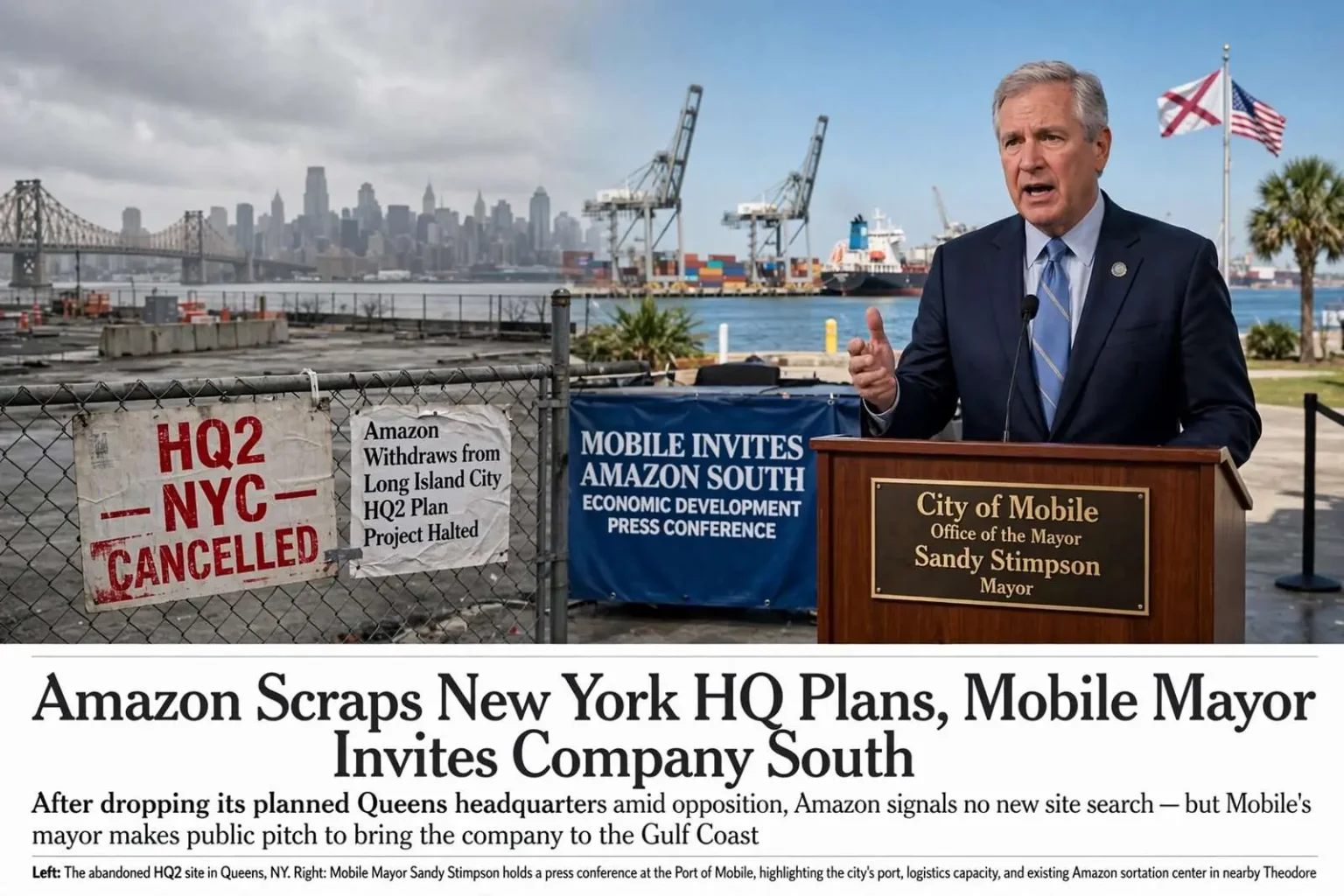
Amazon has dropped its plans for a major new headquarters in New York City, and Mobile Mayor Sandy Stimpson quickly used the announcement to pitch his city as an alternative home for the online retail giant. The company said Thursday it would not move forward with the New York site after facing opposition from politicians there who objected to the tax incentives Amazon had been promised. In its announcement, Amazon indicated it does not plan to search for another location.
Stimpson responded on Twitter by inviting the company to contact his office directly, signaling that Mobile would be ready to talk about bringing the headquarters south. The message was brief but pointed — the kind of overture economic development officials across the country made in the hours after Amazon’s announcement, and one that put the Port City’s name into a national conversation it rarely joins.
The New York decision capped a rocky few months for the project. Amazon’s plan to split its second headquarters between the Long Island City neighborhood of Queens and Virginia’s Crystal City had drawn criticism from the moment it was announced, with local politicians arguing that the billions of dollars in state and city incentives promised to one of the world’s most valuable companies would be better spent on transit, housing and schools. Opposition hardened through the winter, and Amazon — facing public hearings and wavering support among state lawmakers — walked away from the New York half, leaving the Virginia site to proceed on its own.
For cities that lost out in the original HQ2 bidding contest — a process that drew more than two hundred proposals from across North America — the cancellation reopened a door most had considered closed. Amazon had said it would not search for a replacement, but mayors like Stimpson calculated that a company rethinking its New York plans might, someday, reconsider everything else.
Mobile’s place in Amazon’s network
The Port City already has a place in Amazon’s fulfillment network. A 350,000-square-foot sortation center opened in Theodore in 2017, which was the first customer fulfillment facility of its kind in Alabama. The Theodore site sits along the industrial corridor of south Mobile County, close to the port, the rail lines and the interstate system that make the region attractive to logistics operators of every size.
Sortation centers occupy a specific niche in Amazon’s machine. They sit between the massive fulfillment centers, where orders are picked and packed, and the final delivery stations that stage routes for drivers — sorting packages by destination ZIP code and feeding them into the last-mile system. A facility of that kind in Theodore tied south Alabama directly into the network that delivers Amazon packages across the Gulf Coast, and it put hundreds of local workers inside one of the country’s most scrutinized employers.
The Theodore opening also established a track record. Economic developers know that a company’s second facility in a region follows the first one’s experience — labor availability, turnover, the practical details of operating in a specific market. Mobile’s pitch to Amazon, in other words, was not hypothetical: the company already operated locally and knew what the region’s workforce and infrastructure could do.
A growing regional pitch
The mayor’s overture is the latest in a long-running effort by Mobile-area leaders to position the Gulf Coast as a destination for corporate investment, citing the Port of Mobile, available industrial property and a growing logistics sector. The pitch has substance behind it. The Port of Mobile is one of the busiest deepwater ports on the Gulf, with container terminals, bulk facilities and an expanding intermodal rail connection that moves freight directly between the docks and the national rail network.
Around the port sits a logistics cluster built over the past two decades: aircraft manufacturing and its suppliers, shipbuilding, chemical and forest product exports, and the distribution centers that serve the growing Southeast. Mobile’s industrial property — large tracts with rail access and deepwater proximity — remains priced well below what companies would pay in coastal metros, and the region’s labor market has grown with each major employer that arrives.
Stimpson’s Twitter invitation fit the playbook that modern economic development has settled into: speed and visibility. When a company’s plans change publicly, the mayors who respond within hours — publicly, specifically, with an offer on the record — earn the attention that formal proposals wait months for. The message was aimed at Amazon, but it was also aimed at every site-selection consultant watching how quickly Mobile moves.
Realism about the odds
No one in Mobile economic development circles pretended the city was about to land a headquarters of Amazon’s scale. The original HQ2 search ended with the world’s largest metro areas — New York and Washington — and a headquarters hunt rewards exactly what Mobile lacks: an enormous pool of specialized tech labor, an international airport with global connections, and the density of amenities that executives and engineers weigh.
But a headquarters is only the most glamorous prize in Amazon’s empire, and the pieces Mobile can realistically attract — fulfillment centers, sortation operations, distribution hubs — keep multiplying as the company grows. Every new region Amazon enters needs the buildings that sort and ship what its customers order, and the Gulf Coast’s population growth makes it a natural candidate for more of them. A mayor who puts his city’s name in front of the company is fishing, but he is fishing in stocked water.
Mobile’s economic story in recent years has been one of steady, unglamorous accumulation — and each piece of it strengthens the pitch Stimpson made with a single tweet.
The Theodore sortation center demonstrated the multiplier effect those facilities carry. Beyond its own payroll, an Amazon building pulls third-party delivery contractors, staffing agencies, trucking companies and the small service businesses that grow up around any large industrial employer. Road improvements and utility expansions follow. Economic development officials call it the ecosystem effect, and it is why regions court even the unglamorous parts of a company’s network.
The incentives debate
The New York fight that killed HQ2’s northern half centered on the incentives themselves — and the debate has echoes in every Southern state that courts big employers, Alabama included. Critics of large incentive packages argue that public money promised to profitable companies rarely pays back on schedule, that the jobs promised often go to transferred executives rather than local hires, and that the bargaining itself rewards companies for playing regions against each other. Defenders counter that the incentives are performance-based — paid only as jobs and investment materialize — and that regions which refuse to compete simply lose the projects to regions that do.
Mobile’s position in that debate is practical. As a mid-sized city competing against larger metros, it cannot win a bidding war on incentives alone, and its leaders have generally argued instead for the region’s structural advantages: port access, rail, land and cost of living. The pitch to Amazon leaned on those same strengths — and on the company’s own experience operating in Theodore, which no tax abatement schedule can replicate.
The national attention the episode brought carried value of its own. When a Port City mayor tweets at one of the world’s largest companies and gets written up for it, the audience is broader than Amazon: it includes the site consultants and corporate real-estate executives who keep short lists of cities that are hungry, responsive and realistic. Economic development is a long game played in those small moments of visibility.
What comes next for the Port City
The realistic follow-up to Stimpson’s invitation is not a headquarters but continued cultivation: keeping Mobile in Amazon’s expansion conversations, supporting the Theodore operation, and marketing the region’s logistics credentials at every opportunity. The city’s economic development machinery — the port authority, the chamber, the industrial development board — works those channels continuously, and a moment of national attention is fuel for the machine rather than a replacement for it.
Amazon, for its part, gave no indication of renewed site hunting, and its statement made clear the Virginia project would carry the HQ2 name forward alone. But companies of its size make location decisions constantly — data centers, delivery stations, robotics facilities — and each one is a fresh opportunity for a region that has made the short list before. Mobile’s leaders have spent years positioning for exactly those decisions, and the mayor’s public pitch was a reminder that the Port City intends to keep making them.
Whether Amazon ever calls the mayor’s office or not, the episode made the region’s argument on a national stage: the port is deep, the land is ready, the logistics sector is growing, and Mobile is listening. In economic development, that message — repeated often enough, in front of enough audiences — is how regions eventually win the projects nobody predicted.


