Ambulance joyride results in moderate-to-major damage in Midtown Mobile
A man took a Mobile Fire-Rescue ambulance on a joyride through Midtown Mobile on Friday, causing moderate-to-major damage before police stopped the vehicle.
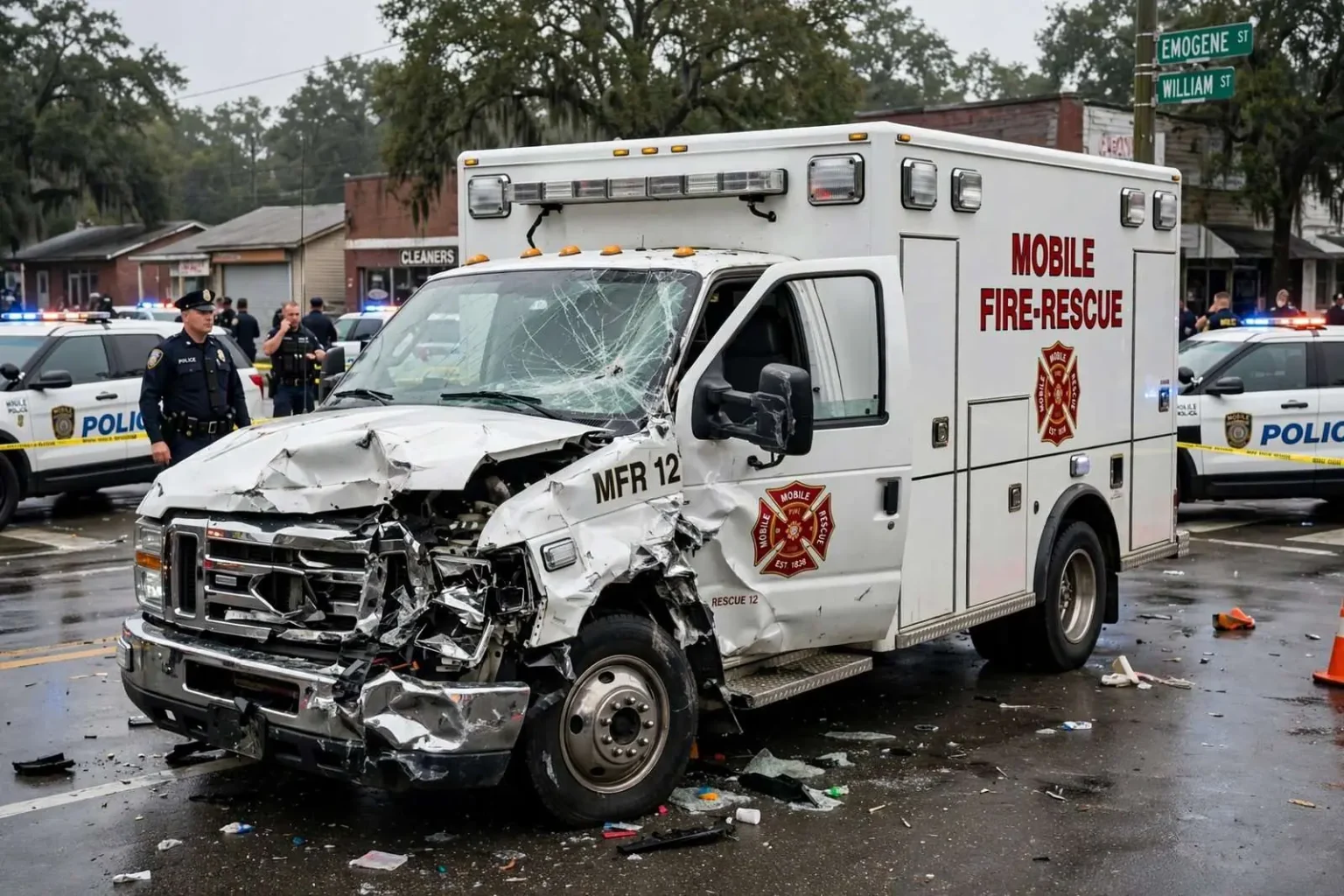
A suspect took a Mobile Fire-Rescue ambulance on a joyride through Midtown Mobile on Friday morning, causing moderate-to-major damage to the vehicle, according to fire department officials. Mobile Fire-Rescue Department Public Information Officer Steven Millhouse said the rescue unit was being taken to the city’s impound lot for further damage evaluation. “It could’ve been a lot worse,” Millhouse said. “He could’ve flipped it or hit a building or something.”
The incident began, according to the Mobile Police Department, when a suspect who was being transported by Lifeguard Ambulance Service to Mobile Infirmary from a city police precinct jumped out of one rescue vehicle and into another before driving it away. No one else was in the ambulance at the time, police said. The sequence — a prisoner in medical custody switching vehicles mid-transport — left officers and firefighters dealing with two intertwined problems at once: a stolen emergency vehicle moving through city streets, and a suspect who needed medical attention even as he fled.
In a statement, MPD wrote that the suspect had been questioned about an attempted burglary at a Subway restaurant on Springhill Avenue. Investigators determined the offense was a misdemeanor, and the suspect was being transported to the hospital by a private ambulance service — a routine step when a person in custody needs medical evaluation before being booked into jail. It was during that transport that the escape attempt unfolded.
The Chase and the Capture
Police said the suspect fled in the Mobile Fire-Rescue vehicle and officers gave chase. During the pursuit, MPD said officers fired at least one shot before the vehicle was stopped. The ambulance was brought to a halt near Emogene Street and William Street, in the Midtown area north of Government Street where residential blocks and commercial corridors meet, and the suspect was taken into custody at the scene.
The suspect was then transported to the hospital for treatment and will be guarded until he can be arrested and taken to jail, according to the department. Hospital guard details are standard procedure when a prisoner requires care before booking: an officer stays with the patient continuously, both to maintain custody and to protect hospital staff, until physicians release the person and officers can complete the arrest. The investigation is ongoing, and charges were expected to be formalized once the suspect is released from medical care and processed into the Metro Jail.
The forced choices police make during a pursuit — whether to continue chasing a stolen vehicle through city streets or break off to avoid endangering bystanders — are governed by departmental pursuit policies that weigh the seriousness of the underlying offense against the risk created by high speeds in traffic. The morning hour worked in the city’s favor here; had the pursuit unfolded at midday on Government Street or Airport Boulevard, the calculus for everyone involved would have been far more dangerous.
How an Ambulance Ends Up in a Police Chase
The theft of an emergency vehicle is rare but not unheard of, and it exposes an operational gap that departments nationwide have studied: ambulances run unsecured between calls, sit parked at hospital emergency rooms with keys in or near the ignition during patient transfers, and move through high-traffic areas where the public approaches crews constantly. A medic unit can carry thousands of dollars of equipment, controlled medications and communications gear, which makes its theft both a property crime and a public safety concern.
Mobile Fire-Rescue operates a fleet of rescue units and medic squads from stations across the city, responding to roughly tens of thousands of emergency calls each year in a department that is among the largest fire-based EMS providers on the Gulf Coast. When a unit is damaged — whether by fire, crash or, in this case, theft — the department has to pull a reserve apparatus into service or operate short-handed until repairs are complete, a strain that lands on the same crews still running their daily call volume.
The “moderate-to-major” damage assessment puts the vehicle out of service pending repair or replacement decisions. An ambulance is not an ordinary fleet vehicle: its patient compartment contains mounted equipment, a stretcher system, oxygen plumbing and radios configured for the department’s protocols, so a badly damaged unit cannot simply be swapped from a dealership lot. Damage evaluation at the impound lot will determine whether the unit goes to a specialized upfitter for repair or whether the department instead accelerates replacement through its equipment budget.
The Custody Transport Question
The episode also shines light on how people in custody move through the medical system. When someone arrested or detained complains of illness or injury, officers cannot simply book them and hope for the best; courts and jail standards require medical evaluation when it is warranted. That often means a private ambulance service — Lifeguard, in this case — transports the patient from a police facility to a hospital, with officers following or riding along depending on the department’s policy and the risk assessment for the individual.
Those transports involve a delicate balance. Restraining a patient too aggressively can complicate medical care; restraining too loosely invites exactly the kind of escape that occurred Friday morning. Departments review each incident like this to see whether procedures were followed and whether changes are needed — in officer positioning during transports, in vehicle security, or in how suspects are moved between vehicles at a scene.
For residents of Midtown, the episode ended without reported injuries to bystanders, though the sight of a stolen ambulance leading police through the neighborhood Friday morning was, by any measure, an unusual start to the day. The suspect faces the original misdemeanor accusation along with whatever additional charges investigators present — likely including theft of the emergency vehicle — as the ongoing investigation runs its course through the court system.
The Aftermath of an Officer-Involved Shooting
Because officers fired at least one shot during the pursuit, the incident will be examined under the review procedures that apply whenever a Mobile officer discharges a weapon. Such reviews typically run on parallel tracks: an internal review of whether departmental policy was followed, and an examination by investigators of the facts surrounding the shooting itself. These processes are routine after any shots-fired incident, regardless of whether anyone is struck, and their findings determine whether the officers’ actions fall within policy and state law.
The Alabama Law Enforcement Agency has historically assisted or led investigations of officer-involved shootings in jurisdictions around the state, a practice designed to add an outside layer of review to decisions made by local officers. Details about who is conducting the review of Friday’s shooting, and whether the person being guarded at the hospital suffered any gunshot injury, had not been released as the investigation continued.
For the officers involved, administrative leave or reassignment pending review is common practice in departments across the country, giving investigators time to gather physical evidence, canvass for camera footage from homes and businesses along the pursuit route, and interview the officers while memories are fresh. The corridor between the precinct, the original rescue vehicle and the point near Emogene and William where the chase ended offers multiple potential sources of surveillance video, which has become a central form of evidence in modern pursuit cases.
A Broader Look at the System Under Strain
Incidents like this one land on agencies already operating under significant demands. Mobile Fire-Rescue answers a call volume dominated by medical emergencies, and every hour a medic unit is out of service or tied up in a police matter is an hour it is not available for the next cardiac arrest or wreck on I-65. Police departments similarly expend enormous resources on pursuits — in vehicle hours, dispatch coordination and aftermath paperwork that can dwarf the original misdemeanor that set things in motion.
The case also illustrates how the pieces of the criminal justice system interlock in ways the public rarely sees. An attempted burglary report brings police; a medical complaint during custody requires an ambulance; a hospital evaluation delays booking; a guard detail occupies an officer for hours; and the eventual criminal case will involve evidence from three separate agencies plus a private ambulance company. Each handoff is a point where procedure matters, and each is now part of a single case file.
What happens next is largely out of the public eye: damage assessment continues at the impound lot, the suspect’s medical treatment concludes, formal charges are presented, and the internal and external reviews of the pursuit and shooting run their course. Mobile residents can expect the departments involved to release further details as those processes allow — and to see the stolen unit’s replacement, in one form or another, back in service among the city’s rescue fleet before long.