American Cancer Society Brings 34th Annual Chili Cook-Off Back to Downtown Mobile’s Canal Street
The American Cancer Society's 34th annual Chili Cook-Off hits Canal Street in downtown Mobile March 11 with live music, kids' activities and $10 tickets.
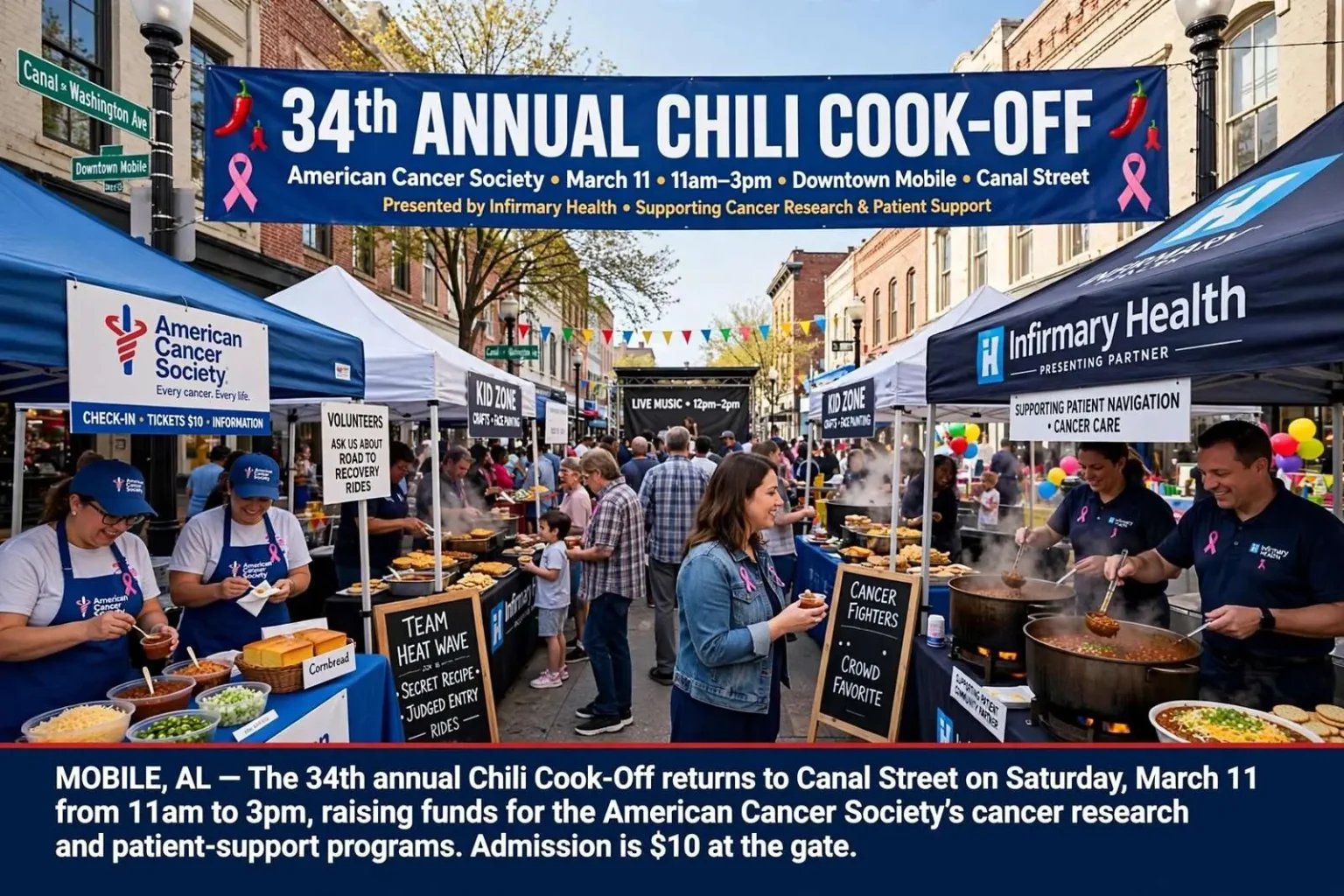
MOBILE, Ala. — Downtown Mobile is about to smell like a chili parlor. The American Cancer Society’s Chili Cook-Off returns for its 34th year on Saturday, March 11, taking over Canal Street from 11 a.m. to 3 p.m., and organizers say the long-running fundraiser remains one of the Gulf Coast’s tastiest ways to support the fight against cancer.
Presented by the American Cancer Society in partnership with Infirmary Health, the four-hour event pairs great food with live music and kid-friendly activities. Admission is $10, with proceeds funding the cancer society’s research and patient-support programs. For a decade’s worth of Mobile families, the cook-off has become a fixture of the spring calendar — an afternoon where the competition is fierce, the recipes are guarded, and every ticket goes toward a cause that has touched households across South Alabama.
Canal Street, running through the heart of downtown between the city’s business district and the waterfront, gives the event room to spread out. Cook-off teams set up along the corridor, performers take a stage, and crowds move between tents sampling entries from teams that have often spent months preparing for a single afternoon of judging.
How the cook-off works
The competition starts long before the gates open. Teams roll into downtown at 5 a.m. to fire up their cookers and perfect their secret recipes. Judging begins at 10:30 a.m., and the public is admitted at 11 a.m. to sample the entries, enjoy the entertainment and cast their votes for crowd favorites. At 3 p.m., judges announce this year’s winning chili, closing out an event that has been a Mobile tradition since the late 1980s.
The early-morning start is not ceremonial. Chili cooked for competition needs hours over low heat for the spices to meld and the meat to break down, which means serious teams treat the 5 a.m. setup as the real opening bell. By the time the first paying guests walk in at 11 a.m., the pots have been simmering for hours and the aroma carries the length of the street.
Two sets of honors are typically on the line at events like this: the judged award, decided by a panel before the public arrives, and the crowd favorites, determined by the votes attendees cast as they sample their way down the street. Teams court both — the judges with technique and balance, the crowd with generous portions and personality.
A decades-long Mobile tradition
The Chili Cook-Off has moved around town over the years — past editions have filled Bienville Square, The Grounds in west Mobile and, most recently, Canal Street between Washington Avenue and Broad Street — but its mission has stayed the same: raising money for cancer patients across South Alabama.
That geographic history traces the growth of the event itself. Bienville Square, the tree-lined park in the middle of downtown, hosted earlier generations of the cook-off when it was a smaller gathering. The Grounds, the west Mobile event complex better known for festivals and exhibitions, gave the fundraiser room to grow as attendance climbed. The move to Canal Street brought the event back to the downtown core, folding it into the district’s restaurant and nightlife corridor between Washington Avenue and Broad Street.
Thirty-four years is a long run for any fundraiser, and the cook-off’s endurance says something about how the American Cancer Society’s work is woven into Gulf Coast communities. Volunteers who judged or cooked in the event’s earliest editions are now, in many cases, bringing children of their own — and some teams have been competing against one another since the late 1980s.
Where the money goes
Funds raised support services such as free rides to treatment through the Road to Recovery program and around-the-clock patient navigation. Both programs answer the same problem from different directions: a cancer diagnosis is hard enough on its own, and the logistics that come with treatment — getting to appointments, understanding options, managing paperwork and insurance — can overwhelm patients and families who are already stretched thin.
Road to Recovery pairs volunteer drivers with patients who need transportation to and from treatment. For patients in a region as spread out as South Alabama — where a trip to a treatment center can mean a long drive from Baldwin County, Washington County, or the Mississippi line — a dependable ride can be the difference between completing a treatment course and missing sessions.
Patient navigation, available around the clock, connects patients and caregivers with trained staff who can answer questions at any hour, point families toward local resources, and help them work through the practical and financial tangles that follow a diagnosis. The society’s research funding, meanwhile, reaches laboratories and clinical studies nationwide, work that has contributed to steadily improving cancer survival rates over the decades the cook-off has been running.
The partnership behind the event
Infirmary Health’s role as presenting partner ties the fundraiser to one of the Gulf Coast’s largest healthcare systems. The Mobile-based system’s involvement connects the event to the medical community that treats many of the patients the money supports, and its sponsorship helps cover the costs of staging the event so that more of every admission goes to the mission.
For the American Cancer Society, community events like the Chili Cook-Off serve a second purpose beyond fundraising: they put the organization’s programs in front of people who may need them. Families attending the event will include cancer patients and survivors from every corner of the region, along with neighbors who may not know that services like free rides to treatment exist until they see them described between bites of chili.
The four-hour window — 11 a.m. to 3 p.m. — keeps the event family-friendly and downtown-accessible. Attendees can arrive at opening, when the sampling lines are shortest, or drift in after lunch and stay through the 3 p.m. announcement of the winning chili.
The teams behind the pots
Chili cook-offs run on the same fuel every year: rivalry. Teams that return annually guard their recipes across a dozen winters, tweak spice blends in secret, and treat the 10:30 a.m. judging as the moment the year’s work comes down to a single spoonful. Corporate teams, restaurant squads, groups of coworkers, and families cooking together all fill out the field, and the friendly competition between longtime rivals is as much a draw for regulars as the food itself.
The 5 a.m. arrival builds that atmosphere. By sunrise, Canal Street between Washington Avenue and Broad Street fills with cookers, canopies, and the low rumble of preparation — teams claiming their spots, chopping, browning, and layering spices while downtown is still quiet. Visitors who wander down early will catch the event at its most focused, long before the music starts and the crowd arrives.
Once gates open at 11 a.m., the rhythm shifts. Sampling lines stretch between tents, the crowd votes accumulate for the people’s-choice honors, and the kid-friendly activities give families a reason to make an afternoon of it. Live music carries over the tents through the middle of the day, and by mid-afternoon the crowd gathers for the announcement that ends the competition at 3 p.m.
What attendees need to know
Admission is $10, with tickets available at the gate on event day — no advance purchase is required, which makes the event an easy walk-up decision for downtown visitors and locals alike. The gates open at 11 a.m. and the winning chili is announced at 3 p.m., giving attendees a four-hour window to sample entries, hear the music, and let the kids burn off energy at the family activities.
Veterans of past cook-offs tend to arrive early: the most popular teams can draw lines by noon, and sampling enough entries to cast an informed crowd-favorite vote takes some pacing. Attendees are encouraged to move down the street systematically rather than filling up at the first tent — a lesson every chili veteran has learned the hard way at least once.
Downtown Mobile’s layout works in the event’s favor. Canal Street sits within walking distance of the city’s restaurants, galleries, and Dauphin Street corridor, so attendees can pair the cook-off with the rest of a downtown Saturday. Parking in the surrounding blocks fills as the afternoon progresses, and many regulars plan to arrive before the 11 a.m. opening both for the shortest lines and the easiest parking.
Why it still matters after 34 years
The arithmetic of the event is straightforward: $10 admissions multiplied across thousands of attendees add up to real money for the American Cancer Society’s programs in South Alabama. But the cook-off’s value to the community has never been only the dollar total. It is one of the rare fundraisers where the charity is almost beside the point for the people in the street — the day feels like a festival, and the mission rides along underneath it.
That mix is deliberate. The society’s community events are designed to be accessible, and few things lower the barrier like a $10 ticket, an open street, live music, and a bowl of chili. First-time attendees come for the food; the programs the event funds — the Road to Recovery rides to treatment, the around-the-clock patient navigation lines, the research grants — are explained on banners and by volunteers between tents, and reach people who need them without anyone having to ask.
The 34th edition arrives with the event in a familiar downtown home on Canal Street, the same presenting partnership with Infirmary Health, and the same 5 a.m. ritual that has opened every cook-off since the late 1980s. The pots go on, the judges convene at 10:30 a.m., the public pours in at 11 a.m., and at 3 p.m. the judges announce this year’s winner — after which the teams, tradition says, immediately begin talking about next year.