
Amtrak asks federal board to force freight railroads to allow Mobile passenger trains
Amtrak asked the Surface Transportation Board to force CSX and Norfolk Southern to allow daily passenger trains between New Orleans and Mobile.
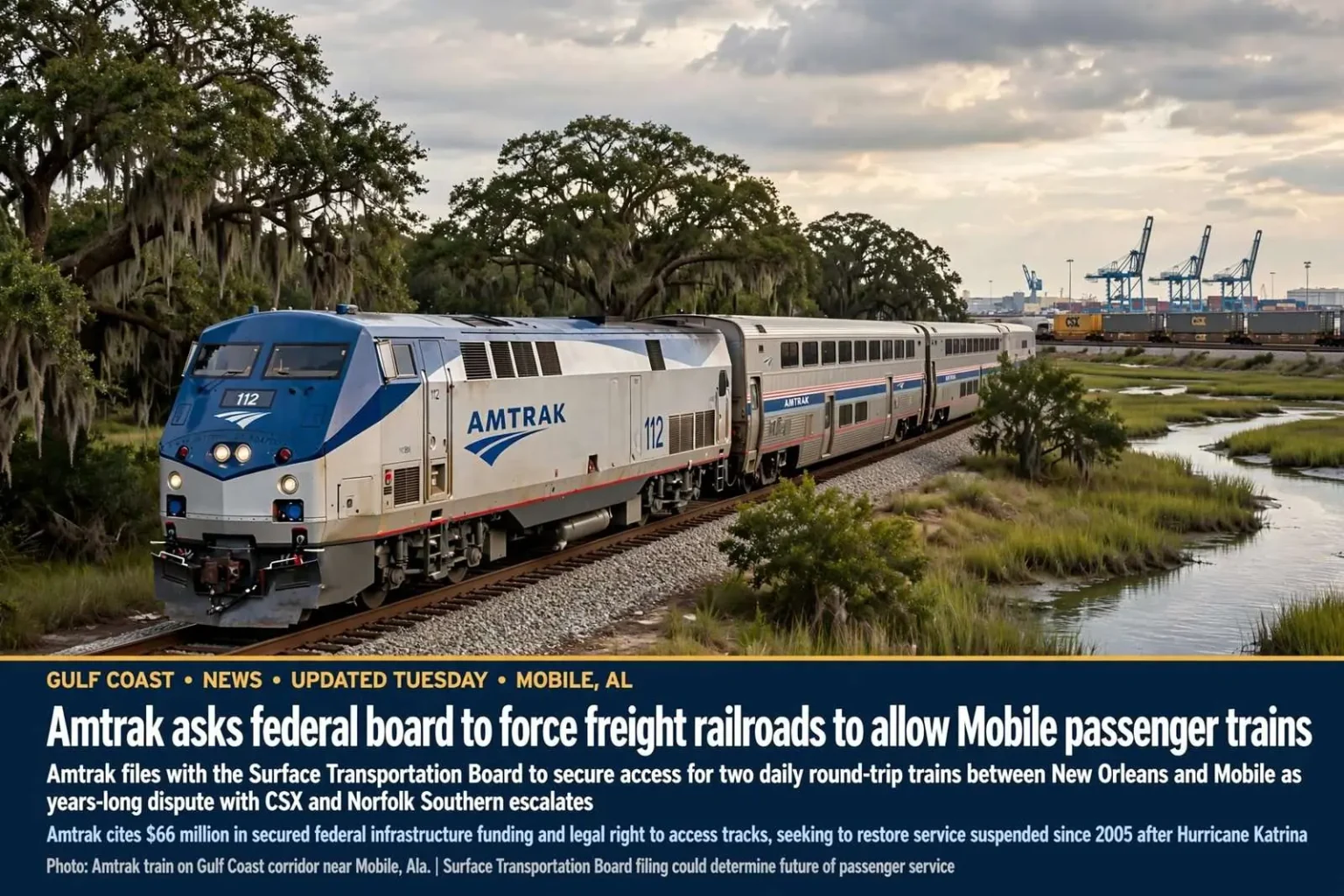
MOBILE, Alabama — Amtrak is asking a federal board to require two freight railroad companies to let it run passenger trains between New Orleans and Mobile, even as some Mobile councilors say the deal is all but dead. In a filing Tuesday, Amtrak said the Surface Transportation Board should make CSX and Norfolk Southern provide access for two daily round-trip trains starting in 2022.
Amtrak says it has a legal right to use the route and up to $66 million for targeted improvements already approved by the Federal Railroad Administration. The railroad argues that the statutory framework governing passenger service gives it the standing to seek such access when voluntary negotiations fail, and that the money for the needed track work is already in hand rather than dependent on future appropriations.
“Amtrak has a right to use these railroads’ tracks but, unfortunately, we have been unable to reach agreement after years of effort just to operate two short and quick round trip Amtrak trains,” said Dennis Newman, Amtrak’s executive vice president for planning and asset development.
Southern Rail Commissioner Knox Ross noted a 2017 study identified about $66 million in infrastructure needs, funding that is now secured. “Our local communities are frustrated by all the years of studying and waiting, and we are hoping this public and transparent process will resolve all outstanding issues,” Ross said.
A Dispute Years in the Making
The filing escalates a dispute that has dragged on for the better part of a decade, as passenger rail advocates pushed to restore service along a Gulf Coast corridor that has been without trains since 2005. The Surface Transportation Board is the federal agency that oversees railroad rates, service and access disputes, and Amtrak’s move asks the board to exercise its authority to order the freight host railroads to open the line.
Negotiations between Amtrak and the two freight companies have foundered over questions of who pays for infrastructure upgrades and how much priority freight traffic would receive if passenger trains share the tracks. Freight railroads have generally resisted adding passenger service, arguing that new trains create scheduling conflicts on lines built and maintained for freight, while passenger advocates counter that the public has already funded the improvements the service requires.
The route at issue runs roughly along the Gulf through southern Mississippi, connecting New Orleans with Mobile and passing through cities such as Bay St. Louis, Gulfport, Biloxi and Pascagoula. Those communities lost their passenger rail link when the Sunset Limited was suspended, and civic leaders across the coast have lobbied for its return ever since, arguing that the corridor’s growing population deserves a transportation alternative to the congested Interstate 10.
Service Ended by Hurricane Katrina
Before Hurricane Katrina, Amtrak served the Gulf Coast, but the Sunset Limited was suspended between New Orleans and Florida when Katrina damaged CSX track in 2005. The hurricane wiped out bridges, signaling and roadbed across the coastal route, and while the freight railroad rebuilt its line, passenger service was never restored east of New Orleans.
In the years since, the Southern Rail Commission — a congressionally recognized body that promotes passenger rail across Louisiana, Mississippi, Alabama and neighboring states — has kept the idea of restored service alive. Commissioners from coastal communities have argued that the corridor is one of the strongest candidates in the country for new passenger trains, citing the population growth along the Gulf since Katrina and the absence of any rail alternative for commuters and travelers.
Under the proposed schedule, trains would depart each morning and afternoon from both Mobile and New Orleans. That would give riders a daytime option for trips between the two cities, with intermediate stops potentially serving the Mississippi Gulf Coast communities along the way. Advocates say the pattern would suit both business travelers making a same-day round trip and coastal residents visiting family or connecting to longer-distance trains in New Orleans.
Supporters also point to the broader economic case. Passenger rail service, they argue, would tie Mobile more closely to the Gulf Coast tourism economy, give residents of storm-prone coastal areas an evacuation option when highways are gridlocked, and signal to employers that the region is investing in its transportation network. The $66 million in Federal Railroad Administration funding earmarked for track and signal improvements, they note, was awarded specifically to make the corridor ready for those trains.
The Legal Path Forward
Federal law gives Amtrak the right to use freight railroad tracks, and it directs the Surface Transportation Board to step in when the parties cannot agree on terms, including the compensation a host railroad may charge and the on-time performance standards that apply. If the board sides with Amtrak, it can order the freight companies to provide the access, setting a precedent that rail advocates have watched closely for years.
Such proceedings are uncommon, and they can take months to resolve. The board would weigh evidence on the capacity of the route, the infrastructure improvements already funded, and the impact on freight operations before reaching a decision. Both sides have hired experienced railroad counsel for the fight, and the outcome will shape not only the New Orleans-Mobile corridor but also how future passenger rail disputes are handled nationwide.
Some Mobile councilors remain skeptical. Councilman Joel Daves said the commitments his council made were contingent on a modeling study and mitigation of impacts, and called the project “dead” after Amtrak appeared to abandon the study. Councilman John Williams agreed the study issue was “plain and simple.”
The council’s concerns center on how added passenger trains would interact with freight traffic serving the Port of Mobile, one of the busiest deepwater ports on the Gulf of Mexico. Daves has argued that the modeling study was meant to answer whether the passenger service would interfere with the movement of goods through the port and whether the impacts could be mitigated before trains started running.
Councilman Fred Richardson asked colleagues to support Amtrak’s position, arguing the freight rail dispute is not the council’s business. Daves pushed back, calling the freight rail and the port the No. 1 driver of the local economy.
The disagreement within the council reflects a tension that runs through the whole project. Mobile has spent heavily in recent years to expand its port and attract new industrial business, and city leaders are reluctant to do anything that might complicate the freight rail operations that serve it. At the same time, the city stands to gain a downtown passenger terminal, a new transportation link to New Orleans and a visible sign of its growing regional stature if the trains run.
What Happens Next
The Surface Transportation Board’s process will now determine the near-term future of the project. Amtrak’s filing asks the board to order access so that the two daily round trips could begin in 2022, but any service start would depend on how quickly the board acts and whether the freight railroads comply with or challenge an order. In the meantime, the $66 million set aside for improvements remains available, though the parties disagree about how it should be spent.
Both freight companies have previously opposed Amtrak’s access request, arguing that the corridor’s freight traffic has grown and that adding passenger trains would create delays without sufficient benefit to the railroads. Their formal responses to the filing will be part of the public record as the board gathers evidence.
For residents of Mobile and the coastal communities between it and New Orleans, the stakes are straightforward. If the board rules for Amtrak, the Gulf Coast could see its first intercity passenger trains in nearly two decades, restoring a connection severed by Hurricane Katrina. If the board declines, the corridor’s supporters say they will keep pressing, arguing that the population growth along the Gulf since 2005 has only strengthened the case for the service that already has its funding in hand.
Either way, the filing marks a turning point: after years of closed-door negotiation, the dispute over Gulf Coast passenger rail is now squarely before a federal regulator, and the next development will come not from a council chamber or a negotiating table but from a ruling in Washington.
The corridor’s case rests largely on numbers that have changed since the trains stopped. The coastal counties of Mississippi and Alabama have added hundreds of thousands of residents since Katrina, and the Interstate 10 corridor that parallels the rail line has become one of the most congested stretches of highway on the Gulf, regularly backed up during hurricane evacuations and peak tourism seasons. Planners with the Southern Rail Commission have argued that a rail alternative would relieve pressure on that route at precisely the moments when it matters most.
Business and civic groups in Mobile have also framed the service as an economic development tool. A downtown terminal would put visitors within walking distance of the city’s revitalized waterfront district and connect the city’s convention and tourism business to travelers from New Orleans, while giving Mobile residents a new way to reach the cultural attractions of Louisiana’s largest city without driving.
Skeptics counter that ridership projections for similarly sized corridors have often fallen short, and that the council should not commit city resources until the modeling study shows how the trains would affect port operations. That study, which was to model freight and passenger traffic on the shared corridor, was the condition the council attached to its earlier support, and its abandonment is the specific grievance Daves cited in declaring the project dead.
Amtrak’s decision to go to the board instead suggests the railroad believes the legal and financial groundwork is already sufficient. With the infrastructure funding secured and a statutory right to access at stake, the company is betting that a public regulatory process will force the questions that private negotiation never resolved — and that the answer, this time, will be trains on the Gulf Coast.


