Amtrak Livestreams Mississippi Rail Line to Bolster Case for Mobile-New Orleans Passenger Service
Amtrak launched a Twitch livestream of a Mississippi rail line this week to argue that restoring Mobile-New Orleans passenger service wouldn't disrupt freight traffic, a claim CSX and local rail officials say oversimplifies the issue.
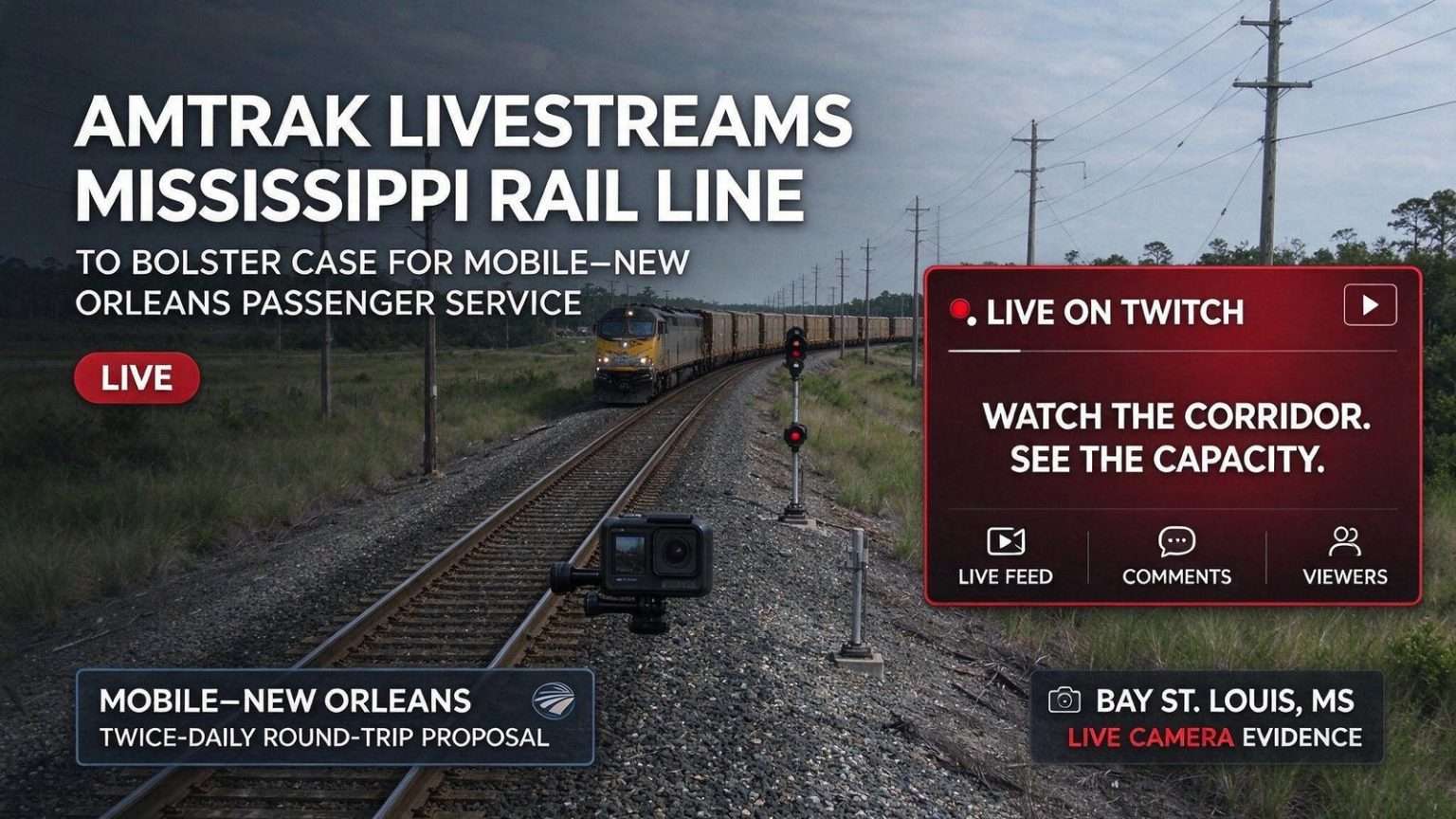
As federal regulators continue weighing whether Amtrak can restart passenger service between Mobile and New Orleans, the rail carrier has turned to an unconventional tool to make its case: a live video feed broadcast on the streaming platform Twitch.
Amtrak set up a camera along a stretch of freight track in Bay St. Louis, Mississippi, this week, allowing anyone online to watch in real time just how often — or infrequently — freight trains pass through the corridor. The stream is part of an ongoing effort by Amtrak to convince the federal Surface Transportation Board that reviving twice-daily, round-trip passenger service along the Gulf Coast route would not meaningfully interfere with freight operations.
The choice of platform was deliberate. Twitch, best known as a home for video game broadcasts, draws millions of viewers a day, and a 24-hour train camera is precisely the kind of low-cost, endlessly watchable content that spreads on social media. Every hour the stream ran without a train passing was, in Amtrak’s telling, an hour of evidence that the line has idle capacity — an argument regulators could watch rather than merely read about in filings.
The dispute has been building for years. Since Amtrak first proposed restoring passenger rail between Mobile and New Orleans, freight railroads operating in the corridor, along with the Alabama Port Authority, have raised concerns that adding passenger trains to the line could worsen congestion and slow the movement of freight through the Port of Mobile. The Surface Transportation Board has been hearing testimony from both sides as it decides whether to grant Amtrak access to the tracks.
What the camera showed
Amtrak spokesman Marc Magliari said the livestream camera, which relied on a GoPro-style setup, had some technical hiccups and was intermittently offline between noon and 5 p.m. on the day it launched. Magliari said he personally observed the track from 8 a.m. to 5 p.m. and counted five freight trains passing the fixed camera location during that window.
Five trains in nine hours was the point Amtrak wanted the record to reflect. If the busiest single-track segment of the corridor moves that little freight during daylight hours, the carrier argued, two scheduled round-trip passenger trains a day could slot into the gaps without forcing freights to hold, reroute, or lose hours. Amtrak framed the livestream as transparency — an unedited view anyone could check against the railroads’ congestion claims.
CSX, one of the freight railroads that operates on the corridor, pushed back on the idea that a single camera positioned at one point along the line could capture the full picture of freight activity. CSX spokeswoman Cindy Schild said in a written statement that the company runs eight to 10 trains per day over the tracks, in addition to coal trains and other local traffic that may not travel the entire route between Mobile and New Orleans.
“It takes a freight train about eight to 10 hours to travel between New Orleans and Mobile,” Schild wrote. “Focusing on one point of a line that traverses approximately 138 single-track miles, major ports and interchange points, and then purporting that it is indicative of the operational realities of the entire line is grossly misleading. Anyone that understands railroad operations, including Amtrak, would know that.”
Her point was one that railroad operating people repeat constantly: a line is not a road. Freight trains do not flow past a fixed point on a schedule; they stack up at sidings, wait for meets with opposing trains, and accumulate delay through the interchange yards and port terminals that a single camera never sees. A train count at Bay St. Louis, CSX argued, measured the wrong thing — the pipeline’s throughput at one gauge, not the congestion building behind it.
Magliari, in turn, suggested that some of the figures CSX cited were misleading in their own way, noting that a portion of the coal trains referenced by Schild never leave the Mobile area and instead shuttle between McDuffie Island and other nearby points. Trains that run a few miles between a coal terminal and a local yard, he argued, occupy the corridor briefly and should not be counted as through traffic competing with passenger schedules across 138 miles.
Why the route matters to the Gulf Coast
The Mobile–New Orleans corridor is the last missing piece of the old Gulf Coast passenger network. Amtrak’s Sunset Limited, the train that linked the two cities, has not run through the segment since Hurricane Katrina wrecked the route in 2005; service east of New Orleans was cut back and never restored, leaving the Gulf Coast — and the city of Mobile specifically — without intercity rail for the first time in generations.
The proposal now before regulators would run twice-daily, round-trip trains between the two cities, restoring stations along the Mississippi and Alabama Gulf Coast and connecting Mobile’s passengers to the national network at New Orleans. For communities such as Bay St. Louis, Pascagoula, Biloxi and Mobile, the argument is economic: a coastal tourist corridor with no passenger rail loses visitors and workers who would rather board a train than drive Interstate 10, which on peak weekends is a wall of traffic from Mobile Bay to Lake Pontchartrain.
The freight railroads’ objections rest on the same geography. The corridor carries trains serving the Port of Alabama State Docks, chemical and paper plants along the coast, and interchange traffic between CSX, Norfolk Southern and the western carriers at New Orleans. A single-track line with limited sidings cannot absorb long delays, the railroads argue, because every held train backs up the next one, and the Port of Mobile — one of the fastest-growing container ports in the country — depends on the corridor’s fluidity.
The Alabama Port Authority has pressed that concern in the regulatory proceeding, warning that passenger schedules written for the convenience of travelers would become priorities the freight network could not plan around. Port officials note that container ship sailings, grain export windows and coal berthing commitments all depend on rail arrivals, and that a train stuck behind a delayed passenger consist can strand an entire export order.
Local transportation planners have added a domestic note to the same argument. Mobile’s coastal commuters and the region’s growing logistics workforce would gain an option they lost in 2005, and Mississippi’s coastal cities — still rebuilding their tourism economies two decades after the storm — have treated the proposed stops as anchors for downtown revitalization. Mayors along the route have filed comments in the proceeding describing the trains as the cheapest infrastructure the coast could get: the track already exists, the stations largely do too, and the missing ingredient is access.
How regulators will decide
The Surface Transportation Board is the forum where this fight is being settled because federal law gives it authority over rail carrier access disputes. Under the statutory framework Congress strengthened after years of Amtrak-versus-freightroad conflict, a carrier seeking access to another railroad’s tracks can ask the board to order it, and the board weighs the passenger carrier’s need against the freight railroad’s burden — with the burden of proof resting in part on the railroads to show that added trains would impair their operations.
That allocation of proof explains the livestream’s strategic value. The railroads must document congestion; Amtrak must document capacity. A publicly visible camera showing long gaps between trains, with a timestamp archive anyone can inspect, is the kind of evidence a regulator can weigh directly — and the kind of counter-evidence the railroads had to answer in writing, as Schild’s statement did, point by point.
The hearing record has blended the operational dispute with a broader regional argument. Gulf Coast mayors, state transportation officials and members of Congress from both parties have pressed for restoration, pointing to the federal investment already made in rebuilding Katrina-damaged track and to the growth of coastal tourism since the storm. The railroads have answered with operating data, and Amtrak has answered with data of its own — five trains in nine hours being the figure its spokesmen now cite alongside the livestream itself.
Whatever the board decides, the corridor’s future will be measured in the same units both sides used this week: trains per day, minutes of delay, and hours of travel between Mobile and New Orleans. The camera in Bay St. Louis did not settle the dispute — CSX immediately reframed its count as a misleading sample — but it changed the medium. A regulatory fight that had lived in filings and depositions now had a public window, and both sides understood that whatever the stream showed, thousands of people had already watched it themselves.
For Mobile, the stakes are concrete. A downtown multimodal station, a direct link to New Orleans, and a place on the national passenger map are the visible prizes; the invisible one is the argument, now memorialized in a Twitch stream, that the freight line has room for both.