
An $80 ‘Flu Tissue’ Sold Out Online — Here’s What Mobile Residents Made of It
The Vaev tissue — deliberately exposed to flu germs — sold out at $79.99. Mobile residents and doctors say: just get the flu shot.
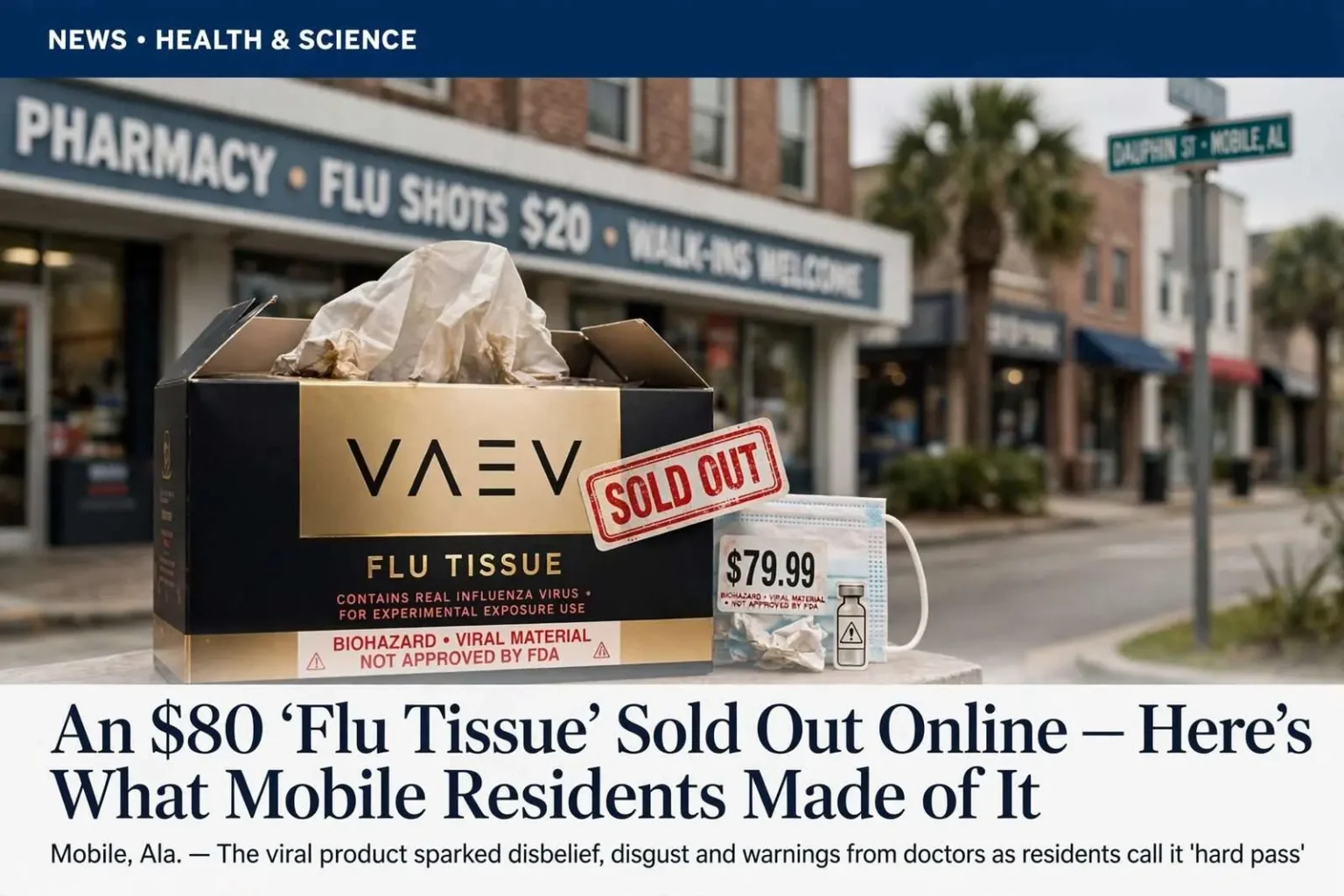
MOBILE, Ala. — A company selling tissues deliberately exposed to the flu virus managed to sell out its $79.99 product online, and the reaction on the streets of Mobile ranged from disbelief to flat-out disgust.
The product, called the Vaev tissue, promises to work “hand in hand with the human body” — the idea being that a customer breathes in germs left on a tissue a sick person used before them. The company’s pitch turns conventional wellness marketing on its head: rather than avoiding germs, customers pay a premium to encounter one, on purpose, and let their immune system do the rest.
Founder Oliver Niessen told Time.com the pitch is about timing: get sick now, on your own schedule, rather than later. The thinking, as the company presents it, is that a consumer can plan an illness the way they plan a vacation — picking a week when being sick costs the least, instead of catching the flu at the worst possible moment.
The mechanics are as unusual as the concept. Niessen said the company keeps ten “go-to sneezers,” verifies each is genuinely ill, then has them sneeze into batches of tissues that are packaged and shipped. Every box, in other words, carries a real dose of whatever virus its donor was fighting — shipped to a stranger’s door for $79.99.
Mobile’s verdict: hard pass
Asked about it around Mobile, residents were skeptical. Julie Wiseman admitted she initially assumed the whole thing was a joke.
“So I thought you were lying. I thought this was a major joke,” she said.
Scott Stone simply said, “No, I don’t think it’s real.”
Both reactions track with the most common response to the product nationwide, which has generally been to assume the story is satire. But the sellout — the company reported its first batch selling out online — confirms that enough buyers were willing to spend the price of a nice dinner on a used tissue to empty the inventory.
Wiseman’s objection was economic as much as medical.
“Why wouldn’t you just go to the pharmacy and get the 20-dollar flu shot?” she asked — a comparison that gets at the strangest part of the pitch. A flu shot costs a fraction of the tissue’s price, is available at pharmacies across Mobile without an appointment, and carries none of the uncertainty of catching the real thing.
Though she allowed that at $20 instead of $80, she might actually try it — a hesitancy that illustrates how the product’s steep price shapes the conversation. At a lower price point, curiosity might convert some skeptics; at $80, the market is limited to the genuinely committed.
Ron Durbin was less flexible. “I think it’s absolutely ludicrous,” he said, calling the concept an old wives’ tale and urging people to rely on a well-developed flu vaccine instead. His framing matches the mainstream medical consensus: deliberate infection is not a wellness strategy, and the tools for preventing influenza already exist in refined form.
Doctors aren’t buying it either
Medical experts quoted in the same Time article were no more kind. Dr. Charles Gerba of the University of Arizona labeled the tissues an “incredible liability,” noting there is no way to predict how any individual will react to exposure to a virus.
Gerba’s concern gets at the heart of why physicians rejected the product on sight. Influenza is not a benign inconvenience: it produces severe illness, hospitalization and death every season, particularly among infants, older adults, pregnant women and people with chronic conditions. A customer who pays to be exposed has no control over which strain they receive, how severe their illness becomes, or who else in their household catches it afterward.
The timing argument fares no better under scrutiny. Deliberate exposure does not guarantee illness on schedule — infection depends on viral dose, the specific strain, and the customer’s own immunity at the moment of exposure. A buyer could spend $80, inhale a used tissue and never get sick, or get sick and stay sick far longer than the week they penciled in.
What the flu shot actually offers
The contrast with vaccination is stark. The flu vaccine, reformulated every year to match the circulating strains, exposes the immune system to inactivated or weakened virus — enough to train the body’s defenses without causing disease. It is recommended annually for nearly everyone, is available across Mobile at pharmacies, clinics and doctors’ offices, and its development, testing and monitoring represent decades of accumulated medical science.
Vaccination does not guarantee a flu-free season — effectiveness varies year to year depending on how well the formulation matches the circulating strains — but it reliably reduces the risk of illness and, most importantly, the risk of severe outcomes. For public health officials, the choice between a lab-monitored vaccine and a used tissue is not a choice at all.
There is also the matter of everyone else. A person who deliberately catches the flu becomes contagious — to coworkers, classmates, grandparents and anyone with a compromised immune system. The product’s marketing treats illness as a private scheduling decision, but influenza has never worked that way; every deliberate infection adds to the community’s seasonal burden.
Viral marketing, literally
The product’s sellout says as much about modern marketing as it does about consumer behavior. Shock sells: the Vaev tissue generated headlines across the country precisely because it violates every instinct about hygiene and health, and the company’s founder has leaned into the notoriety rather than shying away from it. Whether the buyers were true believers or people purchasing a conversation piece is unclear — and possibly doesn’t matter to the company’s bottom line.
The $79.99 price point itself reads as part of the strategy. A cheap used tissue would be laughable; an expensive one sounds like a luxury product, complete with the suggestion that deliberate exposure is a bespoke service. The markup also insures the company against the small batches its sneezer-verification process can produce — ten confirmed-ill donors can only sneeze into so many boxes.
Health regulators, for their part, face a genuine puzzle with products like this. Shipping biological material to consumers sits in a gray zone between novelty and medical product, and the attention the Vaev tissue received has renewed questions about what oversight applies when a company sells exposure to a pathogen as a service.
The Mobile takeaway
For now, the Gulf Coast’s flu seasons will be fought the ordinary way. Local pharmacies stock the vaccine each fall, employers and schools run shot clinics, and health departments push the annual reminder that the safest flu is the one never caught. The consensus on the streets of Mobile — a joke, a scam, ludicrous — matches the medical consensus: a used tissue is not medicine.
The episode leaves one useful lesson behind. The questions Mobile residents asked about the product — is it real, is it safe, why pay $80 for what costs $20 — are exactly the questions worth asking of any health product sold online. In a market where a used tissue can sell out, skepticism remains the best medicine available over the counter.
Until that changes, Mobile’s verdict stands with Wiseman, Stone and Durbin: hard pass — and a reminder that the flu shot at the corner pharmacy remains the best $20 in preventive health care.
How flu season plays out on the Gulf Coast
Flu season arrives on the Gulf Coast with the same rhythm every year: activity builds through the fall, peaks in the winter months, and lingers into spring. Mobile’s role as a regional hub — with its hospitals, port traffic, tourism and large retail corridors — makes the area’s spread patterns typical of mid-sized Southern cities, where respiratory illness moves quickly through schools and workplaces once the season turns.
Public health campaigns across Alabama emphasize the same measures every winter: annual vaccination, staying home when sick, covering coughs, washing hands and disinfecting shared surfaces. Those basics look mundane next to the Vaev tissue’s shock marketing, but they are the interventions that actually bend the curve of a flu season. The measure of any flu-fighting tool is simple — does it reduce illness without creating new risk — and deliberate exposure fails that test on both counts.
The economic side of the flu is substantial as well. Missed workdays, reduced productivity and medical costs follow every significant season, hitting hourly workers and small businesses hardest, since many workers on the Gulf Coast cannot take sick days without losing pay. A product that invites illness — scheduled or not — pushes in the opposite direction from every public health priority, adding avoidable sick days to the regional tally.
The wider world of wellness gimmicks
The Vaev tissue belongs to a recognizable genre: health products that wrap an old myth in modern packaging. The belief that catching a mild illness “boosts” the immune system has circulated for generations — the basis of chickenpox parties before the vaccine era and a recurring theme in wellness marketing ever since. Immunology does not support it. The immune system is not a muscle that grows stronger with deliberate exposure; infection carries real risk with no guaranteed benefit, which is why medicine replaced those practices with vaccines wherever vaccines exist.
The product’s quick sellout also reflects the strain of contrarian thinking that runs through parts of the wellness market. A segment of consumers is drawn to anything that positions itself against mainstream medical advice, and the more strongly doctors object, the more credible the product looks to that audience. Gerba’s “incredible liability” assessment will, in other words, be worn as a badge by some of the very buyers it was meant to warn.
What separates the flu tissue from most wellness fads is the stakes. A dubious supplement wastes money; a product that ships live virus to households does something no supplement can — it turns a purchase into a potential public health event, affecting everyone under the customer’s roof and everyone the customer meets while contagious.
Where the story lands
The story ends where most viral health fads do: with a burst of headlines, a sold-out first batch and a medical community waiting for the trend to burn out. Mobile’s contribution to the conversation was a string of blunt street interviews that captured the public’s verdict in real time — amusement, disbelief and a firm preference for the pharmacy over the mailbox.
Wiseman’s parting thought remains the most practical summary of the entire episode. At $20, with a syringe instead of a sneeze, the flu shot offers what the tissue cannot: a controlled, tested, doctor-recommended way to prepare for flu season. The $80 tissue offers a gamble with someone else’s cold germs and no refund policy. Mobile has made its choice, and medicine has long since made its own.