An Estimated 87,000 Turned Out for the Conde Explorers’ Pre-Parade Party
An estimated 87,000 celebrants packed downtown Mobile for the Conde Explorers' 2011 Mardi Gras pre-parade party, capping the Carnival season.
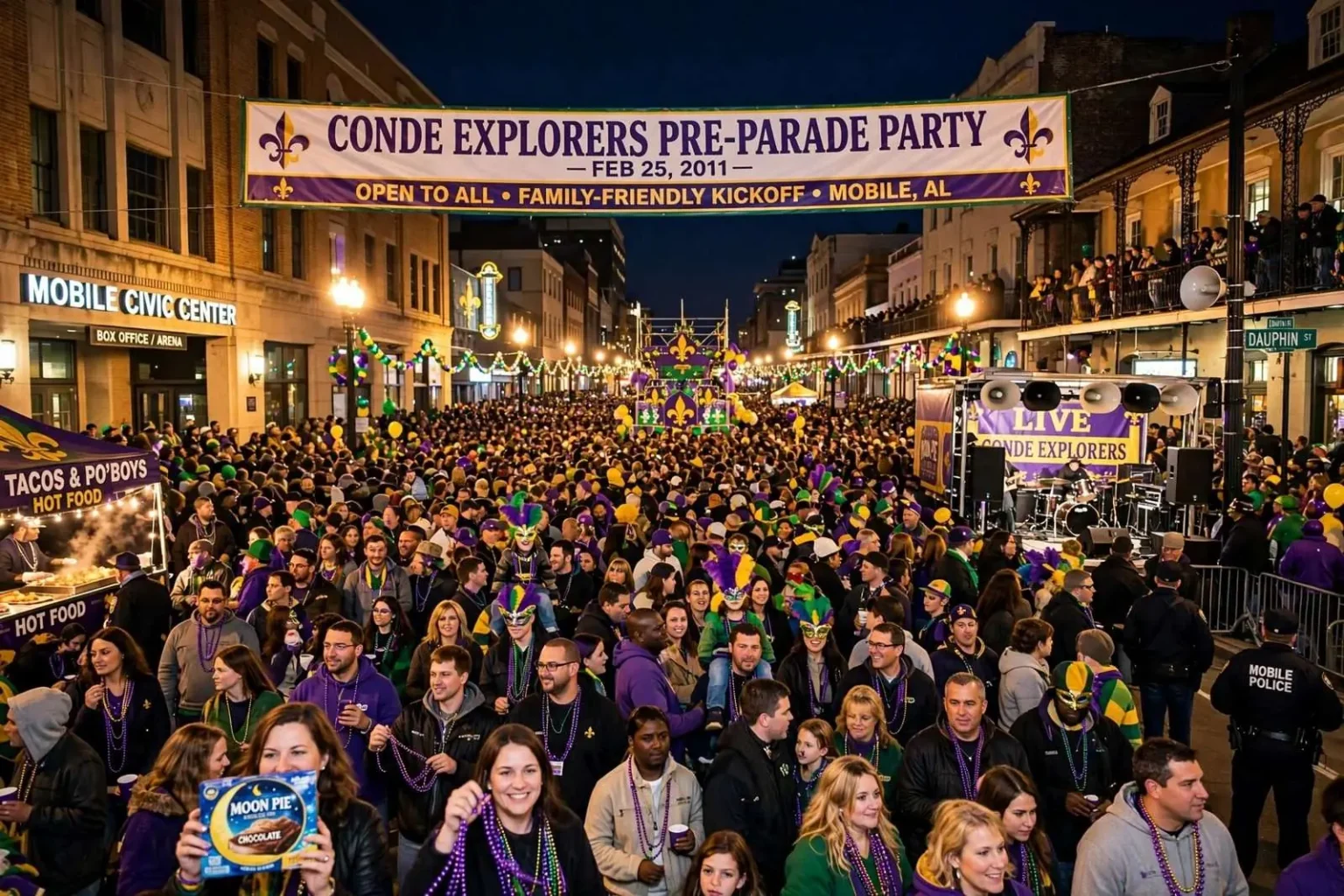
Mobile’s Mardi Gras season is measured in moon pies and marching orders, but the Conde Explorers’ 2011 pre-parade party delivered a number worth noting: an estimated 87,000 people filled the streets for the society’s pre-parade festivities, according to organizers. The gathering served as the launch point for the Conde Explorers’ parade ride, with the society’s leadership — including Kris Skoda and Benji — on hand as members and revelers celebrated ahead of the procession through downtown Mobile.
A crowd of 87,000 puts the party in the company of the city’s largest single-event gatherings — on the scale of the parade crowds that line the streets of downtown Mobile on the season’s biggest nights. That the count came at a pre-parade party, before the society’s floats ever rolled, says something about the place the Conde Explorers have built for themselves in Mobile’s Carnival calendar in a relatively short span of years.
The pre-parade party has become the society’s signature: an open gathering where members and the general public mingle ahead of the ride, with food, music and the building anticipation of a parade about to step off. For many families it functions as a full evening’s entertainment in itself — arrive early, eat, dance, claim a spot on the route — and for the society it is both a celebration and the engine that powers its annual procession.
A Party Built for the Whole City
Unlike the formal invitation-only balls that dot the Carnival calendar, the pre-parade party is an open-streets celebration, and the Conde Explorers have built their reputation around exactly that accessibility. The society, founded to bring a family-friendly, open-membership flavor to Mobile’s oldest celebration, has made its pre-parade gathering one of the signature kickoff events of the season.
That openness distinguishes the Explorers within Mobile’s mystic society tradition. The city’s older societies — some tracing their lineages back generations — guard their membership rolls and their balls as private affairs, with debutantes, tableau presentations and invitations that pass through families. The newer societies, of which the Conde Explorers are a leading example, took a different path: anyone may join, dues are within reach of working families, and the society’s public events welcome the entire city. The result is a Carnival organization that looks more like the crowds who watch its parade than the ballroom societies of the city’s oldest traditions.
The family-friendly label is more than marketing. Mobile’s Carnival has always had a family dimension — generations claiming the same stretch of median along Government Street or the same corner downtown, children hauling home sacks of throws, grandparents retelling the parades of their youth — and societies that organize themselves around that sensibility have found an eager audience. The Conde Explorers’ growth tracked the appetite of Mobilians who wanted in: members who wanted to ride, families who wanted a party they could bring the kids to, and a parade that anyone could enjoy without an invitation.
The Night the Season Kicks Off
Organizers said the mood was pure Mardi Gras: crowds packed along the route, throws flying, and music carrying from the Civic Center area down into the downtown core.
The geography matters to anyone who has spent a Mobile Carnival season downtown. The area around the Mobile Civic Center serves as the traditional staging ground for parades, where floats assemble, bands tune up and societies stage their pre-ride festivities before rolling out into the downtown grid. On a night when 87,000 people converge on those blocks, the streets fill shoulder to shoulder, the music from the stage carries for blocks, and the city’s season reaches one of its early peaks.
Moon pies — the marshmallow-chocolate confection that has been Mobile’s signature throw for generations — flew from the floats and changed hands through the crowd, alongside beads, cups and the rest of the night’s haul. For the uninitiated, the throws may look like simple souvenirs; for Mobilians they are the currency of Carnival, caught in the streets and collected by the sackful.
A video tribute documenting the party and the ride that followed was in the works, the society noted, with footage capturing the crowd, the floats, and the unmistakable energy of a Mobile Carnival weekend.
Mobile’s Carnival Tradition
Mobile lays claim to the oldest Carnival celebration in the United States, with organized mystic societies and parades predating the more famous festivities on the Gulf’s other Carnival cities by generations. The season builds through the weeks before Lent, culminating on Mardi Gras day itself, and it runs on the labor of thousands of society members who spend all year planning parades, building floats and ordering throws.
Into that tradition the Conde Explorers arrived with a modern sensibility. Open membership changed who could afford to ride, and community events like the pre-parade party changed who the Carnival experience belonged to. The society’s approach has been credited — along with that of other open societies — with expanding Mobile Mardi Gras into a celebration that better reflects the whole city, drawing crowds and members from neighborhoods that the invitation-only tradition never reached.
The economics of the season are substantial as well. Hotel rooms fill, restaurants and bars along Dauphin Street and the surrounding blocks do some of their best business of the year, and the crowds that gather for parties and parades flow through downtown businesses on some of the coldest, busiest nights of the winter. An estimated 87,000-person crowd represents an economic pulse for the city center that few other events approach.
The Ride That Followed
The party is the prologue; the parade is the point. When the Conde Explorers rolled out on their 2011 ride, the floats carried the society’s members down the traditional downtown route, past the crowds who had spent the evening at the party and the thousands more waiting along the streets. Each parade is the product of a year’s work — float construction, costume design, throws ordered by the case, bands contracted, police escorts and street closures coordinated with the city.
For the society’s leadership, nights like this one are the payoff. Skoda and the other officers on hand for the festivities have steered an organization that has grown from a start-up among Mobile’s mystic societies into one with the drawing power to pack downtown blocks before its floats ever move. The estimate of 87,000 attendees, offered by the society itself, stands as the kind of number that organizations once reserved for their biggest parade nights — not their warm-up party.
The video tribute promised by the society aims to capture all of it: the crowds at the party, the floats on the route, the throws in the air. For an organization that has made accessibility its brand, the film serves both as a record and an invitation — proof to the next wave of Mobilians that the Conde Explorers’ party is where the season kicks off, and that everyone is welcome when it does.
The Conde Explorers’ rise mirrors a broader change in Mobile Carnival over the past few decades. The mystic society roster has expanded well beyond the handful of historic organizations that once defined the season, with new societies forming around workplaces, neighborhoods and shared interests, each adding parades, parties and members to the calendar. The growth has made Carnival season longer and busier — parades now roll on nearly every night of the final two weeks — and it has pushed the traditional societies to share a celebration they once defined exclusively.
Open societies carry their own traditions as well. Members design their own throws, ride their own floats and throw their own parties, and the fundraising and planning fall on the membership rather than on an established endowment. The pre-parade party doubles as the society’s biggest showcase and its biggest gathering of the year, the night when the work of the season turns into the celebration the city sees.
For downtown Mobile, nights like this one have become a measuring stick of the season’s health. Crowds of this size fill parking decks, spill out of restaurants and keep police and sanitation crews busy into the small hours — the working infrastructure behind the celebration. City officials have invested in the downtown core over the years precisely because Carnival crowds reward it, and each year’s turnout numbers feed the argument that Mobile’s festival economy is among the strongest in the region.
The 2011 season, and the 87,000 people who gathered for the Explorers’ party, offered that proof on one of the year’s first big nights: the old celebration, opened up to the whole city, still growing — and still measured in moon pies, marching orders and a crowd that came early and stayed for the ride. For the society’s members and the city alike, it was a start to the season that will be hard to top.