Annexation Debate and a Councilman’s Posthumous Bid Defined Mobile’s 2021 Elections
Four new members joined the Mobile City Council after a 2021 election cycle marked by the death of Councilman Levon Manzie before his runoff, a renewed fight over annexation and Mayor Sandy Stimpson's third-term win.
Mobile closed out 2021 with a municipal election cycle unlike any in recent memory, one that reshaped nearly half of the City Council while a long-simmering debate over annexing new territory into the city limits hung over almost every race.
When the votes were tallied for good, four of the council’s seven seats changed hands, marking the most turnover the body has seen since Mobile adopted its mayor-council form of government under the Zoghby Act in 1985. Mayor Sandy Stimpson, meanwhile, won a third term after campaigning on a promise to revive an annexation push that had stalled out in 2019.
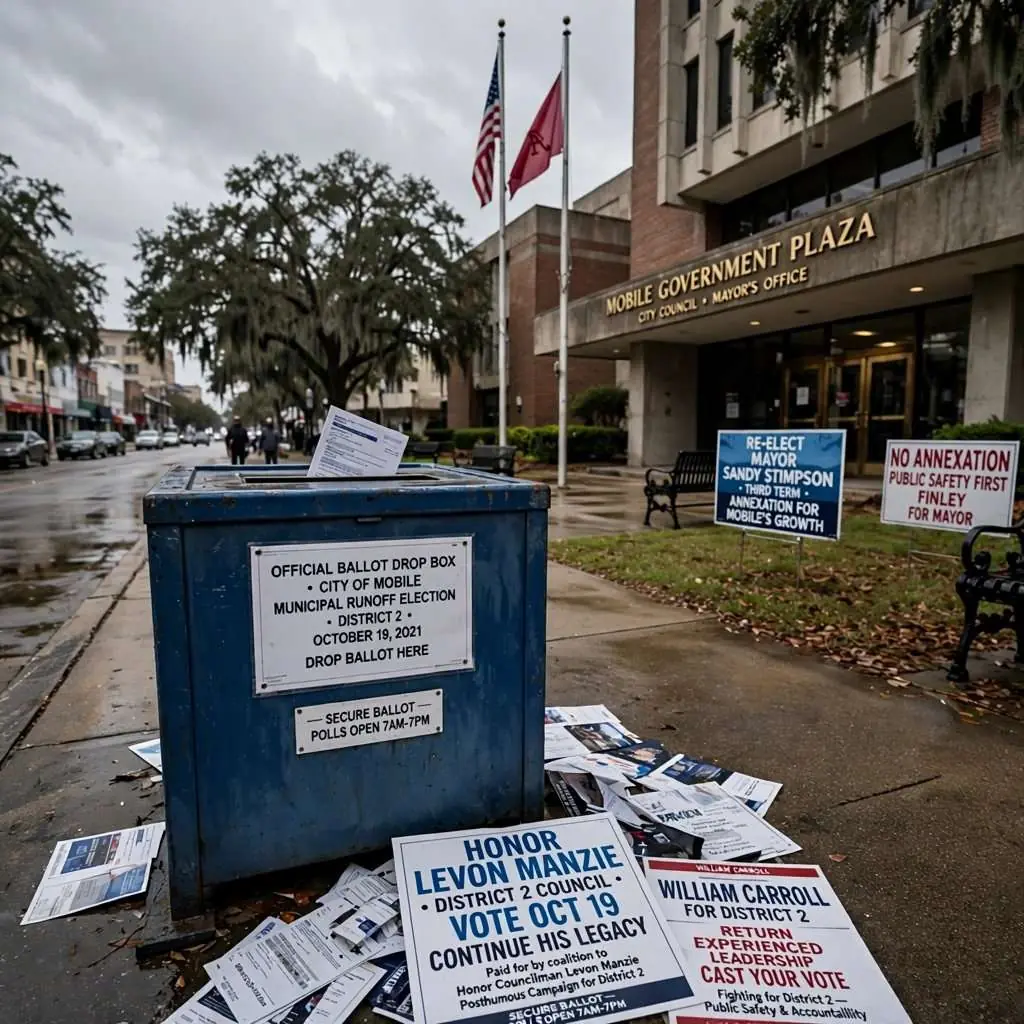
No race captured the strange nature of the election year more than the contest for the District 2 seat. Councilman Levon Manzie topped a crowded field of challengers in the August election but fell short of the majority needed to avoid a runoff. Former District 2 Councilman William Carroll finished second among the challengers and set up a rematch with the incumbent.
Before that runoff could take place in October, the 39-year-old Manzie died of complications from kidney disease, an illness he had battled since he was a teenager. His death did not end the contest. A coalition of Manzie supporters, joined by backers of the annexation effort, mounted an unusual campaign to have him reelected posthumously, a win that would have triggered a special election for the seat. Financial backing for that push came in part from supporters of Mayor Stimpson, including one of the mayor’s brothers.
The effort fell short. Carroll won the runoff and returned to the council seat he had last held eight years earlier.
The mayor’s race was expected to be the marquee contest of the cycle. Stimpson, seeking a third term, faced two well-known challengers: District 1 Councilman Fred Richardson, who gave up the council seat he had held for roughly two-and-a-half decades to run for mayor, and Mobile Municipal Judge Karlos Finley.
Stimpson campaigned heavily on his record over two terms in office and on plans to bring the annexation question back before the public after the 2019 effort failed to gain traction. Richardson and Finley both opposed annexation, at least in the near term, and instead centered their campaigns on combating violent crime, pointing to the city’s persistently high rate of gun-involved incidents. Stimpson significantly outraised both opponents, drawing much of his financial support from the business community and from residents who favor growth on the city’s west side. Despite predictions of a close race and a possible runoff, Stimpson won reelection outright in August.
Since securing a third term, Stimpson has said reviving the annexation debate is among his top priorities for the new term, though as the year drew to a close he had not yet unveiled a formal proposal to the public.
Richardson’s departure left the District 1 seat open for the first time since 1997, and that race also went to a runoff. Cory Penn and former Mobile County Circuit Judge Herman Thomas emerged from a crowded summer field as the top two finishers, with Thomas edging out Chamyne Fortune Thompson for the second runoff spot. Thomas’s appearance in the runoff drew scrutiny given a 2009 indictment accusing him of paddling and sexually abusing jail inmates; he was not convicted of those charges. Penn went on to win the runoff in November, becoming the first person other than Richardson to represent District 1 since 1997.
District 6 produced the year’s third runoff, pitting Josh Woods against Scott Jones after both advanced past a field that also included Tony Dughaish and Daryl Pendleton. Jones picked up endorsements from three former District 6 representatives, while Woods earned the backing of his own primary opponents. Jones won the runoff comfortably and was sworn in to succeed longtime Councilwoman Bess Rich, who did not seek reelection.
Rounding out the four new council members was Ben Reynolds, who was backed by former Councilman John Williams and defeated Fred Rettig in the August election without need for a runoff.
Those four newcomers joined a trio of incumbents — Councilman C.J. Small, Councilman Joel Daves and Councilwoman Gina Gregory, who all won reelection — to form the council that will govern Mobile heading into 2022.
The election unfolded against the backdrop of a pandemic that refused to loosen its grip on the region. Just as life in Mobile seemed to be returning to normal — the statewide mask mandate had been lifted, schools were back to a regular routine and restaurants and bars were seeing business rebound — the Delta variant of COVID-19 drove a sharp spike in cases across the area in August and September. The more contagious mutation pushed medical professionals to redouble public education efforts and vaccination campaigns even as officials stopped just short of pleading with residents to take precautions. Local hospitals filled with patients, and at one point the volume of emergency calls left the Mobile Fire-Rescue Department short on available ambulances.
By the numbers, 2021 was the deadliest year of the pandemic for both Mobile County and the state as a whole. Mobile County recorded 883 COVID-19 deaths during the year, while Alabama recorded 9,232 deaths statewide, pushing the state’s cumulative pandemic death toll to 16,418. Hospitalizations swung wildly throughout the year, according to the Alabama Department of Public Health’s COVID-19 dashboard: the state began 2021 with 101 patients hospitalized with the virus on Jan. 1, and hospitalizations peaked on Sept. 5, when 3,165 Alabamians were hospitalized with COVID-19 in a single day.
The year also brought the broadest vaccination push of the pandemic. By year’s end, roughly 2.7 million Alabamians had completed a full vaccine series, with another 500,000 having received a single dose. In Mobile County, about 52 percent of residents had been vaccinated, with roughly 441,000 total doses administered locally, according to ADPH figures.
As Delta cases began to recede late in the year, health officials turned their attention to a new concern: the Omicron variant. No confirmed Omicron case had been identified in Mobile County by the end of December, though public health officials said they believed the variant was likely already circulating in the community.
Election Day in District 2: Thin Turnout and a Debate Over a Reset
On the morning of the October runoff, the District 2 contest drew notably light traffic at the polls. At one precinct, just three voters were lined up as doors opened, an early signal of the low turnout that would characterize the race.
The stakes were unusual: a Carroll victory would settle the seat outright, while a posthumous win for Manzie would send the seat to a special election. Voters on both sides framed that choice very differently.
For some longtime constituents, the vote was about honoring the incumbent they had backed for years. “I liked everything about him, he was always a nice man, loved him,” said Manzie voter Edward Timmons.
Carroll supporters, meanwhile, voiced unease about the money flowing into the campaign to reelect a deceased councilman. “We don’t need outside forces making sure they get what they want, what’s the hidden agenda going on when someone’s doing that,” said Carroll volunteer Melvin Cole.
Supporters of the posthumous effort countered that a special election would function as a reset, opening the field to candidates who had been reluctant to challenge a popular sitting councilman while Manzie still held the seat.
“You would have an opportunity for anyone who lives in the community that is interested in public service can come forward and put their name on the ballot you could have 15-20 people who want to run,” said Manzie volunteer Jesse McDaniel.
Inside the Posthumous Campaign: Mailers, a Mysterious PAC and a Withdrawn Appointment
Fresh details emerged in the days after Manzie’s Sept. 19 death about how the unusual campaign operated. Residents of District 2 received glossy flyers urging support for Manzie in the runoff — mailings that never mentioned his passing and were sent by a political action committee based in Auburn, more than 200 miles away.
The mailers were funded by “TSA PAC,” which described itself online as a supporter of conservative candidates for state legislature and constitutional offices — making its involvement in a Mobile city council race conspicuous. Records show TSA PAC was formed Aug. 31 and received $25,000 on Sept. 20 — the day after Manzie died — from Southern Impact LLC, a company directed by John Skipper. The PAC was founded by Tripp Skipper, who shares the surname and runs a public affairs firm called the Skipper Group. Skipper did not respond to requests for comment.
The episode also included a short-lived effort to seat Manzie’s mother. Jeanette Manzie accepted Mayor Sandy Stimpson’s appointment to her son’s council seat, urging voters to back him so “he can feel confident that he fought until the end” — then withdrew the night after her appointment. Research showed she did not appear to be registered to vote in Mobile and had no voting history there. Stimpson subsequently said that because state law sets no timeline for filling a council vacancy and the runoff was imminent, no interim appointment would be made at that time.