Anonymous Creator Defends Video Attacking DA Candidate Ashley Rich, Denies Ties to Rival Campaign
The anonymous maker of an online video criticizing 2010 Mobile County district attorney candidate Ashley Rich says the project was an independent citizen effort, not a coordinated attack tied to rival candidate Mark Erwin's campaign.
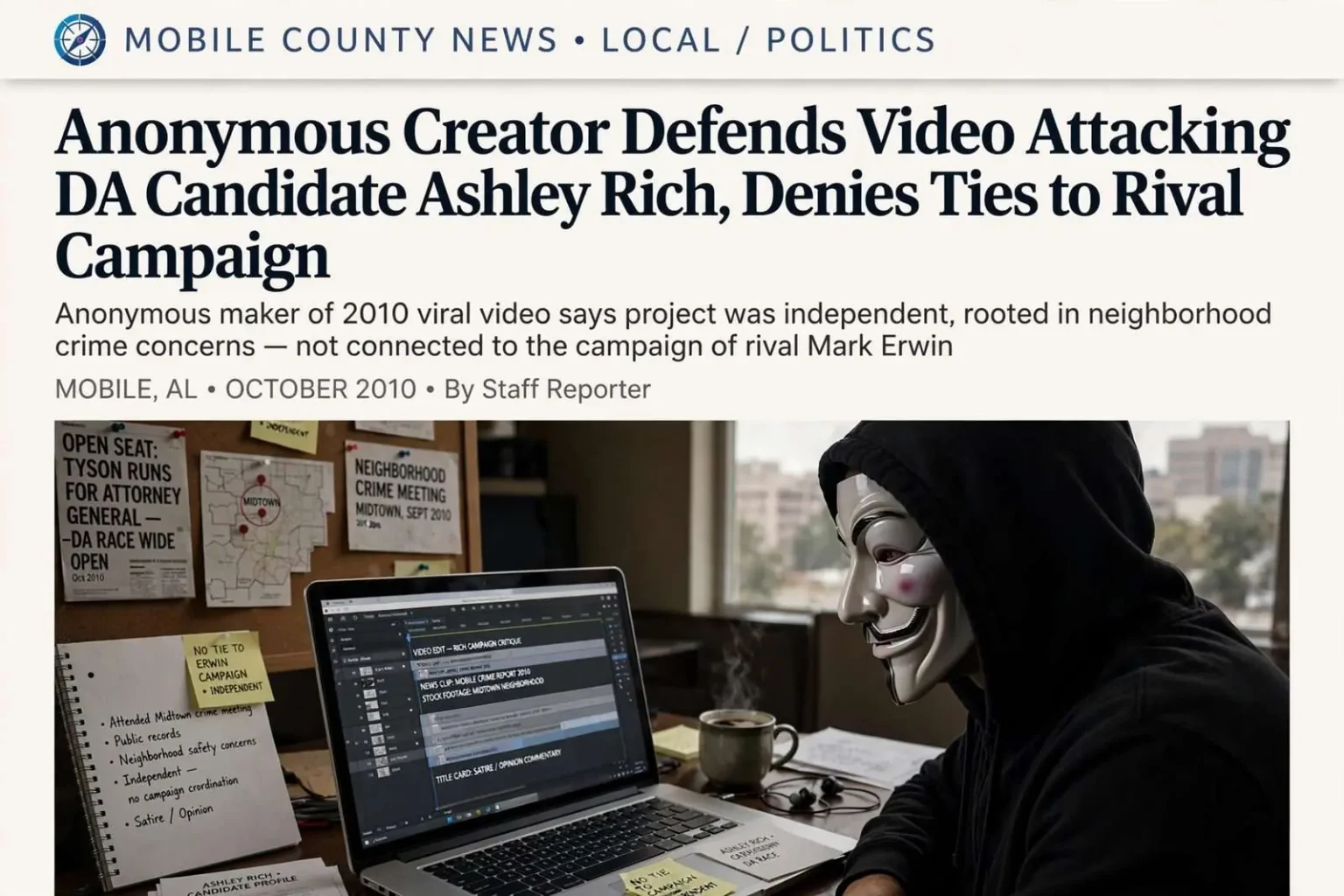
The anonymous maker of a widely circulated online video attacking Mobile County district attorney candidate Ashley Rich has issued a statement defending the project, insisting it was produced independently and had no connection to the campaign of her 2010 rival, Mark Erwin.
The video, part of a broader wave of homemade political content that surfaced ahead of that year’s Republican primary for Mobile County district attorney, drew attention for its sharp criticism of Rich’s record and her characterization of local crime trends. Its creator, who has not been publicly identified, described the effort as a personal project rooted in concern about neighborhood safety rather than a coordinated campaign tactic.
Who Made the Video, and Why
In a statement responding to questions about the video’s origins, the creator said they were a Midtown Mobile resident and a registered Republican voter who decided to speak out after attending a neighborhood crime meeting. According to the statement, concerns raised at that meeting about crime trends in the area did not match the picture Rich had presented publicly about her record and her experience inside the district attorney’s office.
The creator said the video relied entirely on publicly available editing software, stock or archival images, and broadcast news clips, and characterized the finished product as political satire rather than a factual news report. That distinction matters under both election law and platform policy, since satire and opinion commentary are treated differently from statements of verified fact, even when they reference real public officials and real public records.
The statement also addressed why the creator chose to remain anonymous, saying the decision was meant to protect their family from potential retaliation. Anonymity in political speech, particularly speech critical of a sitting or aspiring prosecutor, is not unusual in local politics, where the person making the criticism may work, live near, or otherwise interact with the very officials being criticized.
The Race for Mobile County District Attorney
The controversy played out against the backdrop of a genuinely contested race for one of Mobile County’s most powerful local offices. The district attorney oversees the prosecution of felony and misdemeanor cases across the county, supervises a staff of assistant district attorneys and investigators, and plays a central role in how aggressively or leniently the local criminal justice system treats everything from violent crime to property offenses and drug cases. It is an elected position in Alabama, meaning voters — not judges or governors — decide every four years who holds it, which routinely makes district attorney races some of the most closely watched contests on local ballots.
The 2010 race was notable because it was an open seat. Longtime Mobile County District Attorney John Tyson Jr., who had led the office for many years, ran that same election cycle for Alabama attorney general rather than seeking another term as district attorney, a bid that reshuffled the field of candidates hoping to succeed him. Ashley Rich, who had spent well over a decade as an assistant district attorney under Tyson, entered the race positioning herself as the candidate with the deepest institutional knowledge of the office. She would go on to become a fixture of Mobile County law enforcement in the years that followed, eventually serving multiple terms as district attorney.
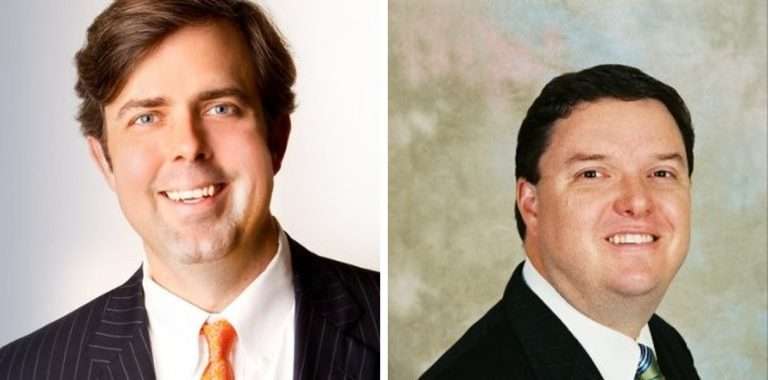
Mark Erwin ran as one of Rich’s opponents in that primary contest. Like many local prosecutor races, the campaign centered heavily on competing narratives about crime statistics, courtroom experience, and each candidate’s vision for how the office should operate — the kind of granular, records-heavy debate that rarely draws statewide attention but can dominate conversation at neighborhood associations, civic clubs, and, as this episode shows, amateur video projects circulated among local voters.
Neighborhood Crime Meetings as a Political Flashpoint
Neighborhood crime watch meetings and community policing forums have long served as informal pressure valves in Mobile-area politics. Residents use these gatherings to compare notes on break-ins, vandalism, and other quality-of-life offenses, often relying on personal observation and word of mouth rather than official crime statistics. That informal, anecdotal character is part of what makes such meetings politically potent: a handful of vivid stories about crime in a particular neighborhood can shape public perception in ways that official year-over-year crime data, which can look very different depending on how it is categorized and reported, sometimes does not.
It is a familiar dynamic nationally as well. Local law enforcement agencies and prosecutors frequently find themselves defending statistical trends — for instance, a decline in overall reported crime — against a public that may perceive rising danger based on recent, memorable incidents in their own neighborhood. That gap between lived perception and aggregate statistics has fueled political disputes in district attorney and sheriff races across the country for decades, and the Mobile County contest in 2010 appears to fit that broader pattern.
Anonymous Political Speech and the Law
The creator’s decision to remain anonymous touches on a long-recognized area of American election law. The U.S. Supreme Court has repeatedly held that anonymous political speech enjoys strong First Amendment protection, most notably in its 1995 decision in McIntyre v. Ohio Elections Commission, which struck down an Ohio law requiring campaign literature to identify its author. The Court reasoned that an author’s decision to remain anonymous, like other decisions about what to say and how to say it, is protected because it is a form of expression that has a long history in American political discourse, tracing back to pamphleteers of the founding era who often wrote under pseudonyms to avoid retaliation.
That legal backdrop does not mean anonymous political content is free from scrutiny. Federal and state election laws generally require disclosure and disclaimers when a video or advertisement is coordinated with, or paid for by, an official campaign committee — rules intended to keep voters informed about who is actually funding political messaging, even when the speaker prefers not to attach their own name to it. An independent citizen posting a homemade video online, without campaign coordination or paid promotion, typically falls outside those stricter disclosure requirements, which is part of why the question of coordination — addressed directly in the creator’s statement denying any link to the Erwin campaign — carries legal as well as political weight.
The Rise of Homemade Political Video
The 2010 election cycle fell squarely within a period when video-sharing platforms were transforming amateur political commentary into a genuine force in local and state races. In the years following YouTube’s launch in the mid-2000s, ordinary voters increasingly found it easy to produce and distribute their own campaign commentary using basic editing software, without needing access to television airtime or a newspaper printing press. That shift lowered the barrier to entry for political speech dramatically, allowing individuals to reach potentially large local audiences directly, but it also blurred long-standing lines between grassroots citizen commentary and coordinated campaign messaging — precisely the ambiguity at the center of the dispute over this particular video.
Campaigns of that era often found themselves in the position Erwin’s did: publicly distancing themselves from supportive content they did not create, produce, or fund, out of concern that voters or opponents might otherwise assume coordination. Election watchdogs and campaign finance regulators have wrestled for years with how to treat this kind of independent digital activity, particularly when a video is sympathetic to one candidate’s campaign without any documented financial or organizational tie to it.
What the Statement Says About the Video’s Content
According to the creator’s account, the video combined publicly available broadcast clips and imagery with original editing to build its critique, rather than relying on undisclosed or privileged information. The creator framed the final product as satire aimed at prompting public debate rather than a straightforward factual news report, a distinction that traditionally affords creators broader latitude under both defamation law and platform content standards, since satirical or opinion-based political commentary is generally understood by courts to be less likely to mislead a reasonable viewer into believing they are watching objective reporting.
The statement framed the video’s existence as part of a broader civic argument: that voters deserve access to a range of viewpoints and critical perspectives on candidates before they cast a ballot, not only the messaging produced by the candidates and their official campaigns. That argument echoes a long tradition of independent political commentary in American elections, from pamphlets and letters to the editor in earlier centuries to blogs, message boards, and video platforms in more recent ones.
Why the Episode Matters Locally
Beyond the specifics of a single video, the episode captures a moment when local Mobile County politics intersected with a national shift in how political messaging reaches voters. District attorney races, often overshadowed by higher-profile statewide contests, can hinge on exactly this kind of grassroots activity — a homemade video, a neighborhood meeting, a chain of word-of-mouth concern about crime — as much as on formal debates or mailers. For a Gulf Coast community grappling with the ordinary mix of urban and suburban crime concerns common to mid-sized Southern cities, the fight over how to characterize the district attorney’s record was, in many ways, a fight over which narrative about public safety would shape the outcome at the ballot box.
The creator’s statement leaves several questions unanswered, including their identity and the full extent of the video’s reach among Mobile County voters. What it does make clear is that, even in a relatively low-profile local election, anonymous citizen-made media had already become a factor campaigns and candidates could not fully control — a dynamic that would only grow more pronounced in the elections that followed as digital tools became more accessible and social media platforms more central to how local political arguments are made and consumed.