Archdiocese of Mobile pushes back as petition seeking removal of church leaders tops 14,000 signatures
The Archdiocese of Mobile responded Friday as a change.org petition seeking the removal of Archbishop Thomas Rodi and two school leaders topped 14,000.
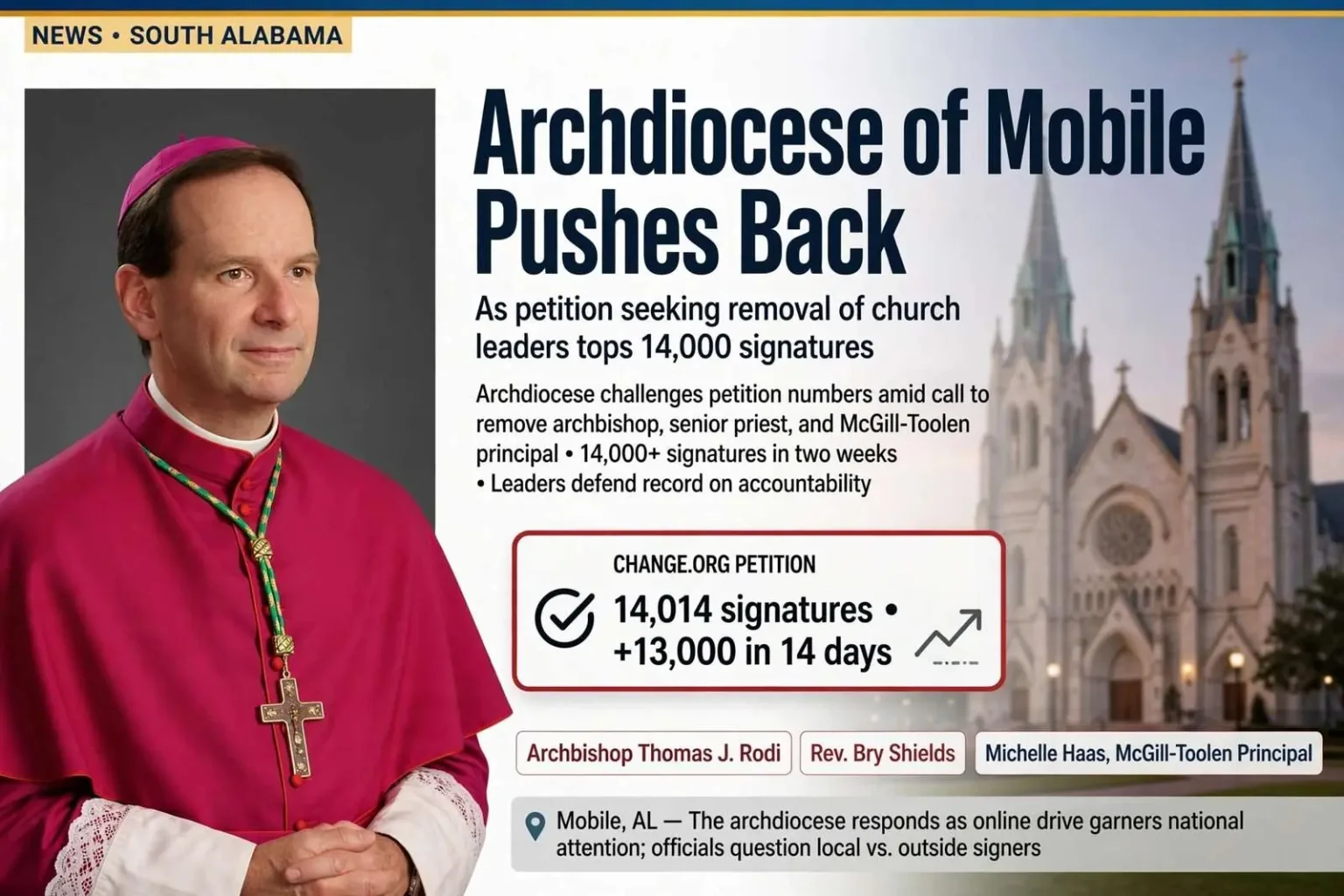
The Archdiocese of Mobile says a rapidly growing online petition calling for the removal of three of its top leaders does not reflect only local sentiment, pushing back publicly as the drive passed 14,000 signatures. The archdiocese’s response marks its most direct public engagement yet with the criticism campaign, and it frames the petition’s numbers as unmeasurable rather than as a referendum on local Catholic leadership. The exchange has put one of the Gulf Coast’s oldest Catholic institutions in the unusual position of debating the meaning of an online signature count.
A change.org petition posted in late September calls for Archbishop Thomas J. Rodi, the Rev. Bry Shields, and McGill-Toolen Catholic High School Principal Michelle Haas to be removed from their positions. The three names span the top of the archdiocese’s structure: the archbishop who leads it, a senior priest of the local church, and the principal of the region’s flagship Catholic high school. Calling for all three at once framed the petition as a broad vote of no confidence rather than a dispute over a single decision.
The effort was launched by the Catholic Warrior Initiative, a group of Catholics who say they are frustrated with how the archdiocese has handled recent controversies. The group has positioned itself as a movement of lay faithful pressing for accountability, using the petition as its most visible tool. Its organizers have promoted the drive through Catholic social media channels, which helps explain the speed of its growth.
Rev. Shields has served in senior roles in the Mobile church for years and is a familiar figure to Catholics across the archdiocese, which is why his inclusion in the petition drew particular attention locally. Named petitions aimed at a diocese’s second tier of leadership are less common than those targeting a bishop alone, and their inclusion signaled that the organizers’ complaints extend beyond the archbishop’s office to the administration of parishes and schools.
Within roughly two weeks it grew from about 1,000 signatures to more than 14,000. That trajectory, more than the raw total, is what turned the petition into news: an increase of more than thirteen-fold in a fortnight signaled that the drive was being amplified well beyond the Archdiocese of Mobile’s parish boundaries. Supporters shared it across state lines and in national Catholic discussion groups.
The Archdiocese Questions Who Is Signing
In a statement released Friday, the archdiocese noted that change.org describes itself as an open platform whose petitions can draw signers from across the country and around the world. The point cuts to the central weakness of online petition metrics: nothing about the platform verifies that a signer is Catholic, lives in south Alabama or has any connection to the parishes and schools involved. Anyone with an email address can add a name to the total.
“In other words, reaction to a ‘local’ petition is not necessarily restricted to local response,” the release states, adding that such petitions are “quite likely to elicit response from those nationally, and even globally, that may have other unrelated grievances.” The archdiocese stopped short of dismissing the petition entirely, but it argued that the signature count cannot be read as a measure of local sentiment. The statement implied that national frustration with church leadership generally was being imported into a local dispute.
The archdiocese’s statement also carried a practical message for petition supporters: removal of a bishop or a pastor is not accomplished by popular vote. Catholic governance vests appointment and removal authority in church hierarchies — the pope for bishops, with diocesan and canonical processes for priests and school leaders — so the petition operates as an expression of sentiment rather than a mechanism of change. Organizers have acknowledged as much, describing the drive as a way to demonstrate the depth of lay concern.
The argument reflects a broader reality that institutions of every kind have confronted in the petition-platform era: totals that look impressive can mix genuine stakeholders with coordinated campaigns, anonymous signers and drive-by participation. For a diocese weighing whether the petition represents its own people, the platform’s design makes that determination essentially impossible.
The Backdrop: Rodi’s Video Message
The statement comes after Rodi addressed criticism directly last week in a video message that discussed the case of Alex Crow, a former Mobile priest who left the diocese amid an investigation, and reiterated what the archbishop described as zero tolerance for sexual misconduct. The Crow case has become a flashpoint for local Catholics, generating questions about oversight and disclosure that the archdiocese has faced in interviews, pews and online forums. Rodi’s message was an attempt to speak past intermediaries straight to the faithful.
In the video, the archbishop confronted the criticism aimed at his leadership while restating the church’s child protection commitments. Archdioceses across the United States have operated under the Dallas Charter since 2002, the national framework requiring abuse allegations to be reported to civil authorities and reviewed by lay review boards. Rodi’s invocation of zero tolerance placed the Mobile archdiocese within that national structure.
Leadership Defends Its Record
Friday’s statement echoed those themes and defended the archdiocese’s record under Rodi, who has led the archdiocese since 2008. Sixteen years at the head of the local church makes Rodi one of the longer-tenured American archbishops, and his tenure has spanned the period in which dioceses nationwide published credibly accused clergy lists and expanded transparency measures. The archdiocese’s defense drew on that institutional record.
“School and parish officials have responded to every complaint of misconduct with the full force of the office within — and with respect for — canon and civil laws,” the statement reads in part. The formulation paired the archdiocese’s internal legal framework with its obligations to civil authorities, an argument intended to rebut claims that church officials handle accusations privately. It asserted that no complaint has gone without an institutional response.
Rodi repeated a pledge he has made before: that when he arrived in Mobile 15 years ago, he could not guarantee there would be no cases of misconduct, but he did guarantee such conduct would not be tolerated. The distinction between promising prevention and promising enforcement has been Rodi’s recurring formulation on the subject. It acknowledges the limits of what any institution can guarantee while committing to action when failures surface.
The Institution Under Pressure
The archdiocese oversees Catholic parishes and schools across south Alabama, including McGill-Toolen Catholic High School, the region’s largest Catholic high school. The archdiocese’s territory stretches across the southern third of the state, from the Mississippi line to the Georgia border, encompassing parishes in Mobile, Baldwin County and the Wiregrass. Its school system is among the largest private education networks in Alabama.
McGill-Toolen families have been among the most engaged participants in the dispute, since the school’s community experiences the leadership structure daily. Parents receive communications from the archdiocese’s Catholic schools office, from the school administration and from parish leadership, and the petition has circulated through the same parent networks that coordinate volunteering and fundraising. That overlap has made the controversy a topic of conversation at school events across the city.
McGill-Toolen sits at the center of the dispute because the petition names its principal alongside the archbishop, and because the high school is the most visible Catholic institution in Mobile. Generations of Mobile families have passed through its halls, and its athletic and academic profile gives it a prominence that extends beyond the Catholic community. Any controversy touching its leadership reaches a wide local audience.
Local observers note that the petition’s timing, in late September, coincided with heightened attention to the Crow matter in local news coverage, giving the launch a ready audience. Campaigns of this kind typically ride a news cycle, and the signature curve, roughly 1,000 in the first days before spurring past 14,000, is consistent with a drive that caught fire once it reached channels beyond the immediate parish community.
The Catholic Church in south Alabama is historically significant beyond its numbers. Mobile is the original see of the church in the region, with a Catholic lineage reaching back more than two centuries to the French colonial era, and the Cathedral-Basilica of the Immaculate Conception anchors one of the oldest Catholic communities in the United States. That long history raises the stakes of institutional disputes in ways a younger diocese would not feel.
The archdiocese has faced criticism campaigns before, but the petition era gives them a measurable public face that earlier internal disputes lacked. A letter-writing effort in a previous generation would have left only anecdotal impressions; a change.org counter produces a number that journalists and supporters can cite. That shift in the technology of dissent is part of what has forced a public statement from an institution that historically preferred private responses.
Petition campaigns aimed at church leadership have become an established tactic among lay Catholic groups nationally, following patterns set in other dioceses where online drives demanded resignations, investigations or disclosure. Organizers of such campaigns point to precedent, while church officials have generally resisted treating signature counts as binding expressions of Catholic opinion. The Mobile dispute follows that familiar script.
National Catholic media took note of the drive as it grew, covering it as another chapter in the tensions between lay groups and church leadership that have followed the abuse scandals of the past two decades. For the Mobile archdiocese, that wider attention cuts both ways: it amplifies the criticism while also situating the local dispute within the broader national conversation about accountability structures in the American church.
For now, the archdiocese’s position is that the petition’s numbers cannot be taken at face value, and the Catholic Warrior Initiative’s position is that 14,000 signatures speak for themselves. Neither position is likely to shift quickly. What the exchange has established is that the controversy over the archdiocese’s handling of recent events is no longer confined to private complaint — it is being argued in public, with institutional statements and signature counters doing the talking.
Parishioners with concerns, according to the archdiocese’s statement, retain ordinary channels of raising them: contacting the archdiocese directly, raising issues with pastors, or using the review processes established under national church norms. Whether those channels satisfy the petition’s supporters will shape whether the drive continues to grow or settles into a standing grievance.