Archdiocese of Mobile Releases List of 28 Clergy, Religious Workers Credibly Accused of Child Sex Abuse
The Archdiocese of Mobile has named 28 former priests, a deacon and religious brothers found to have been credibly accused of sexually abusing children since the 1950s, sharing the list with state and local prosecutors even though most of the accused are deceased or already barred from ministry.
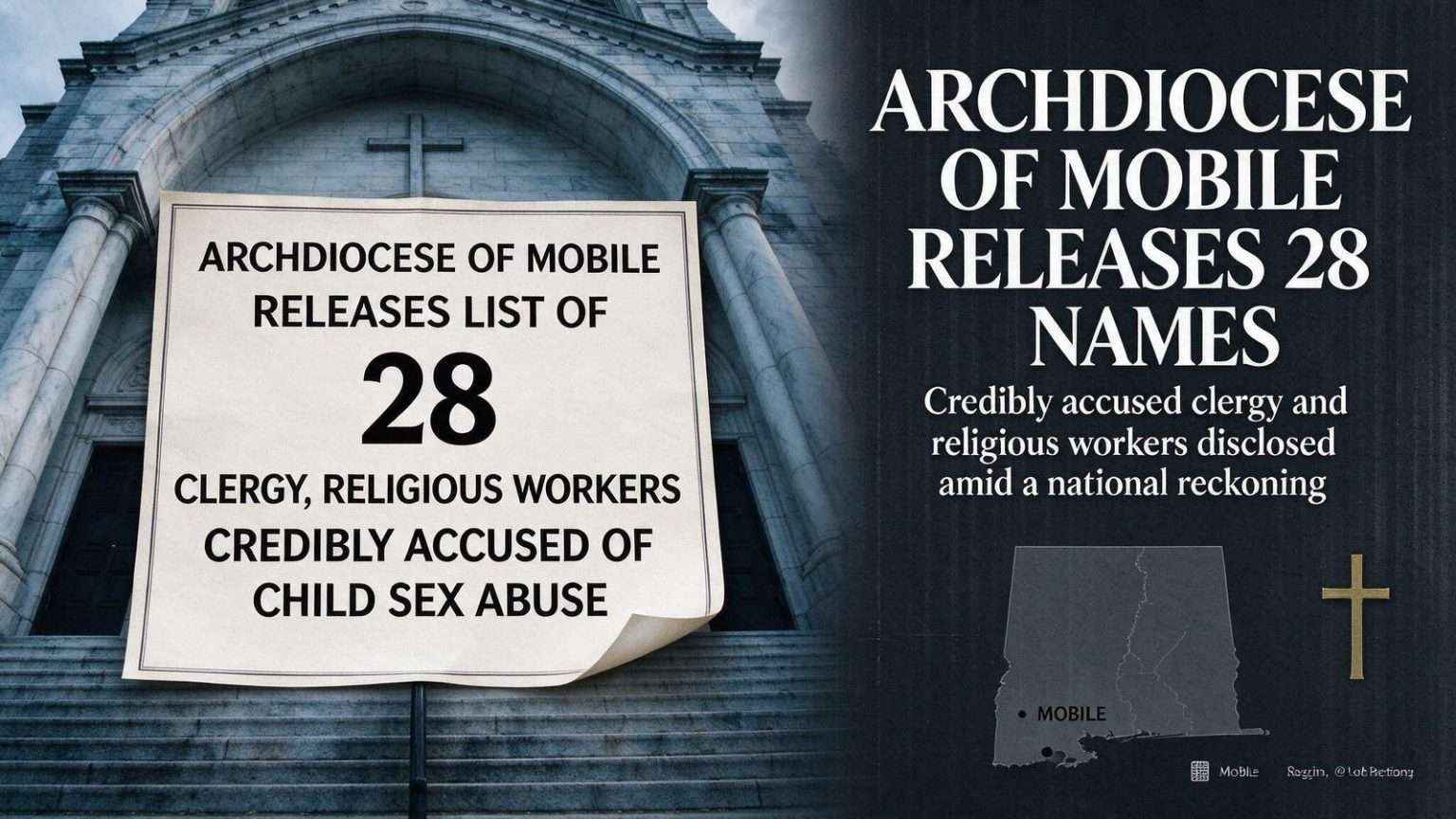
The Archdiocese of Mobile has released the names of 28 former priests, deacons and members of religious orders who were credibly accused of sexually abusing children over a span of roughly seven decades, making good on a pledge Archbishop Thomas Rodi made last month to publish the records amid a wave of similar disclosures by Catholic dioceses across the country.
The list, issued in two parts, names priests and a deacon who served within the Archdiocese of Mobile alongside a separate roster of priests and brothers belonging to religious orders who worked in local parishes, schools and institutions. Of the 28 individuals named, 16 are deceased. The accusations span from the 1950s through the 2010s and touch parishes, schools and other Catholic institutions throughout Mobile, Baldwin, Escambia and Montgomery counties, among other areas.
Archbishop Rodi said in a statement accompanying the release that the archdiocese has shared the list with both the Alabama Attorney General’s Office and the Mobile County District Attorney’s Office. He wrote that he hoped the disclosure would aid survivors without causing further harm. “It is my prayer that this will not re-traumatize anyone but will assist in the healing for which victims desperately long,” Rodi wrote. “I also pray that it will help all the people of the Church, and of the broader community, to know that the Archdiocese of Mobile is not allowing anyone to minister in our archdiocese who has credible accusations of sexual misconduct with minors.”
Rodi noted that the accusations involve roughly 2 percent of the 457 priests who have served in the archdiocese since 1950, and he closed his statement with an apology, asking forgiveness for what he called the “devastating harm done by clerics and religious who have abused the little ones.”
The released materials do not detail how individual allegations were investigated, whether any administrative penalties were imposed, or what steps, if any, were taken to keep the accused from having further contact with children after accusations were made. The archdiocese’s note accompanying the list also does not describe any cooperation with civil authorities on cases predating 2003, the year the U.S. Conference of Catholic Bishops’ national policies on reporting abuse allegations took full effect locally. Rodi’s statement acknowledges only that “there were a variety of ways in which accusations were received and investigated” prior to that point.
Because 16 of the named individuals are deceased and the remaining accused men have already been removed or barred from ministry, the practical effect of the release on ongoing law enforcement action is likely to be limited. Local law enforcement officials have previously indicated that, absent new victims coming forward, they are generally positioned only to investigate fresh allegations rather than reopen decades-old cases.
Priests Named and Their Assignments
Among those named are several priests with long histories of assignments across the archdiocese, including multiple stints at McGill-Toolen High School and Little Flower Parish in Mobile, St. Margaret Parish in Bayou La Batre, and St. Thomas the Apostle Parish in Chickasaw. One entry, Archdiocesan Deacon Robert L. Nouwen, is noted as having been convicted of possession of child pornography, with misconduct dated to 2012. Another case, involving a man identified as Cordell Lang, carries a special note explaining that a civil court jury found in his favor despite accusations that led to his removal from ministry.
The Archdiocese of Mobile’s release follows a 2004 report, issued two years after the clergy abuse scandal broke in Boston, in which the archdiocese acknowledged that 13 of its priests had been accused of abusing minors since 1950 and disclosed more than $700,000 in related legal settlements, fees and victim assistance costs. Since then, the archdiocese has maintained a written child protection policy requiring background checks and training for employees and volunteers who work with minors, along with annual instruction for children in Catholic schools and parish programs on recognizing and reporting misconduct.
Part of a National Reckoning
The Mobile release is part of a broader reckoning among Catholic dioceses nationwide that intensified after an August grand jury report in Pennsylvania documented more than 1,000 child victims of roughly 300 priests over several decades. In the months since, dioceses in Louisiana, Missouri, Texas, New York and elsewhere have released or been ordered to release similar lists. The Archdiocese of Mobile’s disclosure was coordinated with the release of comparable lists from the other Catholic dioceses covering Alabama and Mississippi.
Advocates for survivors of clergy abuse have said that while the lists represent an important step toward transparency, the absence of investigative detail in many diocesan disclosures, including Mobile’s, leaves open questions about how thoroughly past allegations were examined and what happened to accused clergy after complaints were substantiated internally.
Parents of Catholic School Children Respond
While the disclosures unsettled many in the broader Catholic community, some parents of children enrolled in local parish schools said they were reassured by the Archdiocese of Mobile’s decision to release the list voluntarily rather than wait for outside pressure.
Reaction From Schools Where Accused Clergy Served
At Little Flower Catholic School in Mobile, where five of the accused clergy once served, parents said they were not alarmed. Several said they were instead proud of the archdiocese for coming forward on its own initiative as part of an effort to confront abuse within the church.
“They have a procedure in place to keep those types of things from happening now, so that I feel comfortable with my children in school here,” said Bernadette Johnson, a parent at Little Flower Catholic School.
Mapping Where the Accused Served
A closer look at the service records behind the list shows a striking pattern of overlap: several of the accused clergy cycled through the same Mobile parishes and schools, sometimes at the same time their alleged abuse was taking place.
Three men on the list served at both McGill-Toolen Catholic High School and Little Flower Parish. Allegations against Vernon Dahmen span from the mid-1970s into the early 1980s, while accusations against Arthur Schrenger – who also served at McGill-Toolen and Little Flower – run from the 1960s through 1982. Patrick Nicolson, accused in 1976, likewise served at both institutions.
The overlapping assignments mean multiple parishes and schools were left with more than one accused cleric on their histories, and the time frames of the allegations against them intersect as well – a mapping that illustrates the long-running criticism that the church moved accused priests between assignments rather than removing them from ministry.
Background on the Archdiocese and Policy Reforms
The Archdiocese of Mobile covers the southern portion of Alabama, including Mobile and Baldwin counties and parts of surrounding counties. It is one of five Catholic archdioceses or dioceses with territory in Alabama, alongside the Diocese of Birmingham, the Diocese of Huntsville and the dioceses covering Montgomery and the Mobile-area portions served by religious-order personnel.
McGill-Toolen Catholic High School, founded in Mobile in 1896 as an academy for boys and girls, is the largest Catholic secondary school in the archdiocese. The school has long been one of the archdiocese’s flagship institutions and has been referenced multiple times in disclosures of credibly accused clergy because of its long history and the number of priests and brothers who served there over the decades.
The U.S. Conference of Catholic Bishops’ 2002 Charter for the Protection of Children and Young People established a national framework for dioceses to investigate allegations of sexual abuse, remove credibly accused clergy from ministry and report to civil authorities. The charter took full effect locally in dioceses across the country in 2003 and has been revised several times in subsequent years.
Catholic dioceses across the United States have released lists of credibly accused clergy in waves since 2018, prompted in part by investigations in Pennsylvania, New York and other states. The Archdiocese of Mobile’s release was coordinated with comparable disclosures from other dioceses in Alabama and Mississippi.
The Archdiocese of Mobile’s release was coordinated with the dioceses of Birmingham and Huntsville, as well as the Diocese of Biloxi, to coordinate public disclosure across the Gulf Coast. The list included members of religious orders who served in the archdiocese even though they were not incardinated in it, a distinction that has historically complicated how abuse allegations are tracked and disclosed across overlapping jurisdictions.
The Child Protection Policy referenced in the archdiocese’s accompanying materials has been in place since the early 2000s and includes background checks for all employees and volunteers who work with minors, as well as annual training for children in parish schools and religious education programs. The policy represents the archdiocese’s response to the broader clergy abuse crisis and is reviewed periodically to align with national guidelines from the U.S. Conference of Catholic Bishops.
The survivors of clergy abuse have organized into advocacy networks that have pushed for the kinds of disclosures the Archdiocese of Mobile has now made. Groups like the Survivors Network of those Abused by Priests, or SNAP, have called for full disclosure of how individual allegations were investigated and resolved, including the names of clergy who were removed from ministry. The Mobile release includes names but does not detail investigative procedures, a limitation that advocacy groups have noted.