Archdiocese of Mobile to Publish Names of Clergy Removed Over Abuse Accusations
Archbishop Thomas Rodi says the Archdiocese of Mobile will release the names of clergy removed from ministry over abuse accusations dating back to 1950, part of a wider push for transparency among Catholic dioceses nationwide.
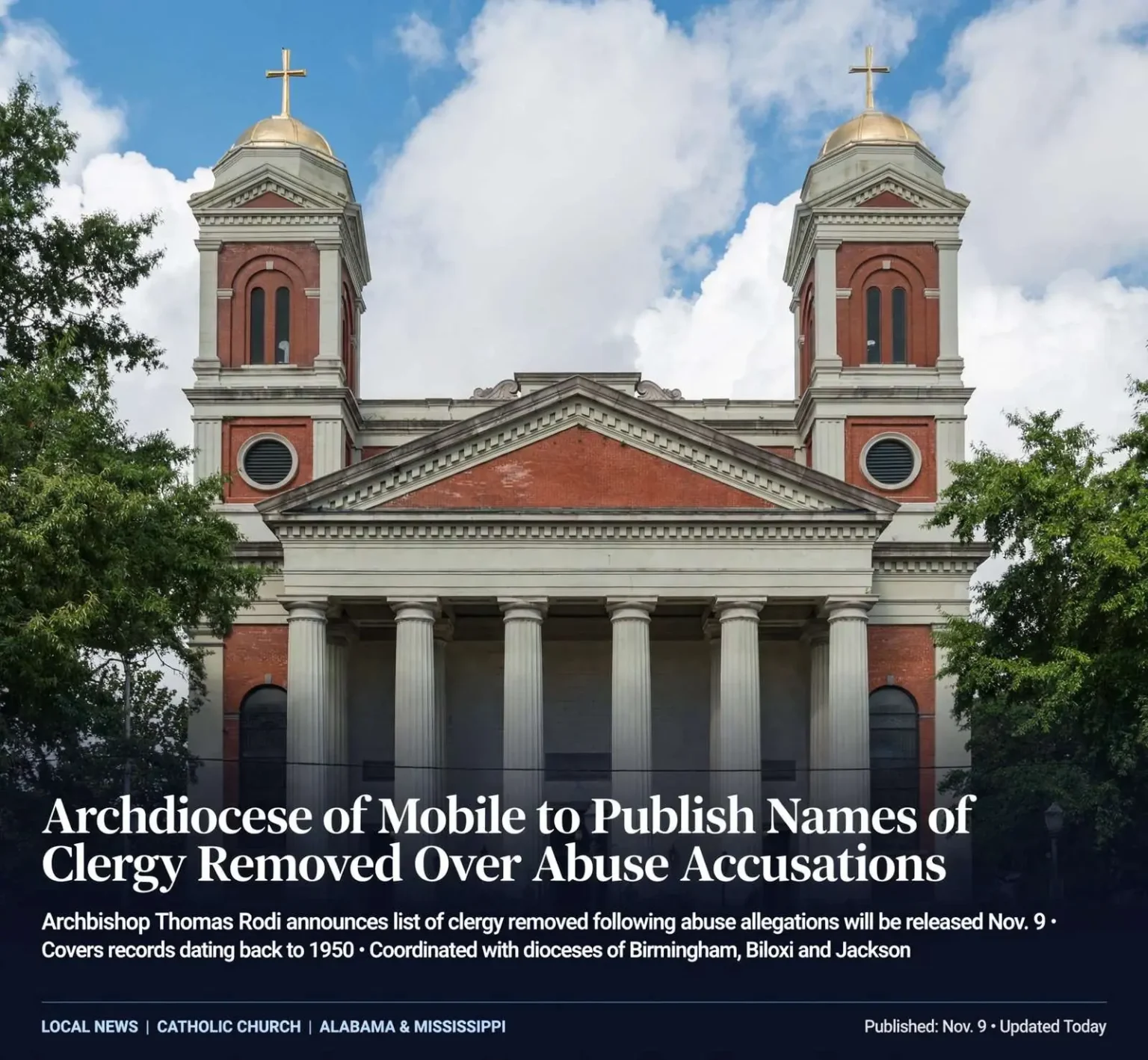
The Archdiocese of Mobile will publish a list of clergy and religious officials who were removed from ministry following accusations of abusing a minor, Archbishop Thomas Rodi announced in a statement issued Nov. 9. The list will cover accusations dating back to 1950 and will be released alongside similar lists from the three other Catholic dioceses covering Alabama and Mississippi — the dioceses of Birmingham, Biloxi and Jackson — a coordinated disclosure that would make the church’s accounting for nearly seven decades public across the two states.
The announcement comes amid renewed scrutiny of the Catholic Church nationally following a Pennsylvania grand jury report published in August that documented more than 1,000 child victims of roughly 300 priests accused of abuse over several decades. The Pennsylvania report, the most sweeping of the state-level investigations that followed the Boston scandal, catalogued decades of institutional failure — priests shuffled between parishes, complaints that never reached prosecutors, victims who were never told why their abusers disappeared. Its publication set off a wave of lists, disclosures and investigations across the country.
In the months since that report became public, dioceses in New Orleans, Missouri, Texas, New York and other states have either been ordered to release similar records or have done so voluntarily in response to public pressure. The pattern has transformed the question from whether dioceses would publish their histories to when, and Mobile’s announcement placed it on the side of voluntary disclosure rather than waiting for a subpoena or an attorney general.
The framework behind the disclosure
Archbishop Rodi’s decision follows a broader pattern set after clergy sexual abuse in the Catholic Church was widely exposed in Boston in 2002. That scandal prompted the United States Conference of Catholic Bishops to adopt the 2002 Charter for the Protection of Children and Young People, a policy framework that calls for accused priests to be removed from ministry immediately pending an investigation and requires all abuse allegations involving clergy to be reported to civil authorities.
The Charter changed the church’s operating rules in the United States: no more internal handling of accusations, no more quiet reassignments, no more treatment of abuse as a sin to be managed rather than a crime to be reported. Every American diocese now operates under its requirements, subject to audits by outside firms, and the credibility of any new disclosure rests on the extent to which those rules have actually been followed.
The timing of the Mobile archdiocese’s announcement comes as the Vatican has reportedly asked the bishops’ conference to delay a vote on additional measures meant to hold bishops accountable for failing to protect children from abuse. It remains unclear how that development will affect the release of Mobile’s list. The proposed accountability measures — which would have created mechanisms for investigating bishops who cover up abuse — were the most significant structural change on the table, and the Vatican’s intervention suggested the question of episcopal accountability would be resolved in Rome rather than by the American conference.
In a column published earlier this year in The Catholic Week, the archdiocese’s newspaper, Rodi wrote that the bishops’ conference has no authority over individual bishops and that any action by the national body is binding on a diocese only if it is approved by the Pope. The column was a reminder of the church’s structure: each bishop answers to the Pope, not to his national conference, which means reforms adopted in Baltimore bind a diocese like Mobile only to the extent Rome approves them.
Not the first disclosure
This will not be the first time the Archdiocese of Mobile has disclosed information about abuse within its ranks. In 2004, two years after the Boston scandal broke, the archdiocese released a report acknowledging that 13 of its priests had been accused of sexually abusing minors since 1950, involving a total of 18 victims. That report also disclosed that the archdiocese had paid more than $700,000 in legal settlements, fees, victim assistance and other related costs.
The 2004 report made Mobile one of the dioceses that chose to audit itself in the immediate aftermath of the Boston revelations, and its figures — modest compared with the numbers that would later emerge in the Pennsylvania investigation — were nonetheless a formal admission that the abuse documented across the American church had occurred in Alabama’s oldest diocese as well. The pending list of removed clergy will update that 2004 accounting, naming the individuals rather than counting them.
What the archdiocese says it does now
Since that 2004 report, the archdiocese has maintained a formal child protection policy, which is published on its website, mobilearch.org. Under that policy, every volunteer and employee who has contact with minors undergoes a background check and receives training in child protection, with annual retraining required afterward. Children enrolled in the archdiocese’s Catholic schools, parish youth groups and religious education programs also receive annual training on how to recognize, avoid and report misconduct.
The scope of that requirement is easy to underestimate. In a diocese that operates schools and parishes across south Alabama, “every volunteer and employee who has contact with minors” reaches from principals and teachers to the coaches, catechists, choir directors and concession-stand volunteers who staff a parish’s youth programs. Annual retraining for all of them, and annual age-appropriate training for the children themselves, turns child protection into a recurring institutional habit rather than a one-time screening.
The archdiocese has employed a full-time director of Child Protection since 2003, a position responsible for receiving misconduct accusations, assisting alleged victims through the process of reporting and overseeing investigations into those claims. All allegations involving minors are reported to civil authorities, and cases are also reviewed by an independent board made up of people unaffiliated with the archdiocese who come from a range of professional backgrounds, according to Rodi.
The independent board — a requirement of the 2002 Charter — is designed to inject outside judgment into what would otherwise be a purely internal process, drawing on professionals such as law enforcement officers, counselors, attorneys and child welfare specialists who have no institutional stake in the outcome. An outside national firm conducts an annual audit to verify that the archdiocese is following through on the child protection commitments it has made, Rodi wrote, describing the review as a check on the policy’s effectiveness going forward.
In his statement, Rodi acknowledged that compiling the list would take time, given the volume of records involved. “It is a time-consuming effort to examine each clergy personnel file from the last almost seven decades,” he said. “This effort is underway and will be completed as quickly as possible.”
The archive work is the unavoidable labor behind every such disclosure. Personnel files dating to 1950 — assignments, complaints, evaluations, letters — must be read and cross-checked name by name, and the standard for publication is high: a list that wrongly implicates a priest is its own injustice, while one that misses a name betrays the stated purpose. Dioceses that have published similar lists have typically needed months to complete the review.
The archdiocese and its leadership
Rodi has led the Archdiocese of Mobile since 2008, when he was named archbishop after transferring from the Diocese of Biloxi. He succeeded Oscar Lipscomb, who had served as archbishop for 28 years before stepping down. Lipscomb remains in Mobile, where he holds the title of Archbishop Emeritus.
The succession meant the announcement fell to the archbishop who inherited the post-reform institution rather than the one who led it through the Boston crisis. Rodi arrived with direct experience of the Gulf Coast church, having led the Biloxi diocese through the years after Hurricane Katrina, and his tenure in Mobile has been marked by the implementation of the Charter-era policies the archdiocese now points to as its current framework. That the disclosure decision — and the accountability for how the archdiocese’s list is compiled — rests with him is a consequence of that 2008 transition.
The archdiocese itself is the oldest institution of its kind in the region, with Catholic roots in Mobile dating back more than three centuries to the French colonial era. Its parishes and schools are spread across south Alabama, and its history — like that of every American diocese of its age — spans eras in which abuse allegations were handled very differently than the Charter requires today. The list Rodi has committed to publish is, in effect, the archdiocese’s own cross-reference of that history: the personnel files of nearly seven decades, read against the standard of 2002 rather than the standards of the decades that produced them.
What happens next
For Alabama and Mississippi Catholics, the coordinated release across the region’s four dioceses will provide, for the first time, a single accounting of the clergy removed from ministry in both states since 1950. The Mobile archdiocese’s contribution will update the 2004 report’s count of 13 accused priests and 18 victims with names, assignments and the dates and outcomes of the actions taken against them — the details victims and their families have sought for years.
Whether the disclosure satisfies its critics will depend on execution. Advocates for abuse survivors generally judge such lists by their completeness, the clarity with which each name’s history is explained, and whether the diocese has simultaneously ensured that law enforcement has every credible allegation in its files. The Charter-era reporting requirements mean the archdiocese’s civil authorities and its independent review board are already part of that machinery; the list adds the final element, which is public knowledge.
Rodi’s statement committed the archdiocese to completing the work “as quickly as possible,” a phrase that acknowledges both the urgency of the demand and the difficulty of the task. For the families in Mobile’s Catholic community, the period between the announcement and the publication of the list is a waiting period — and for the archdiocese, a test of whether the transparency it has promised will match the transparency the moment requires.