Argument over car battery turns deadly in Chatom, police say
A man was shot and killed in Chatom on Wednesday night after an argument over a car battery, according to the Washington County Sheriff's Office.
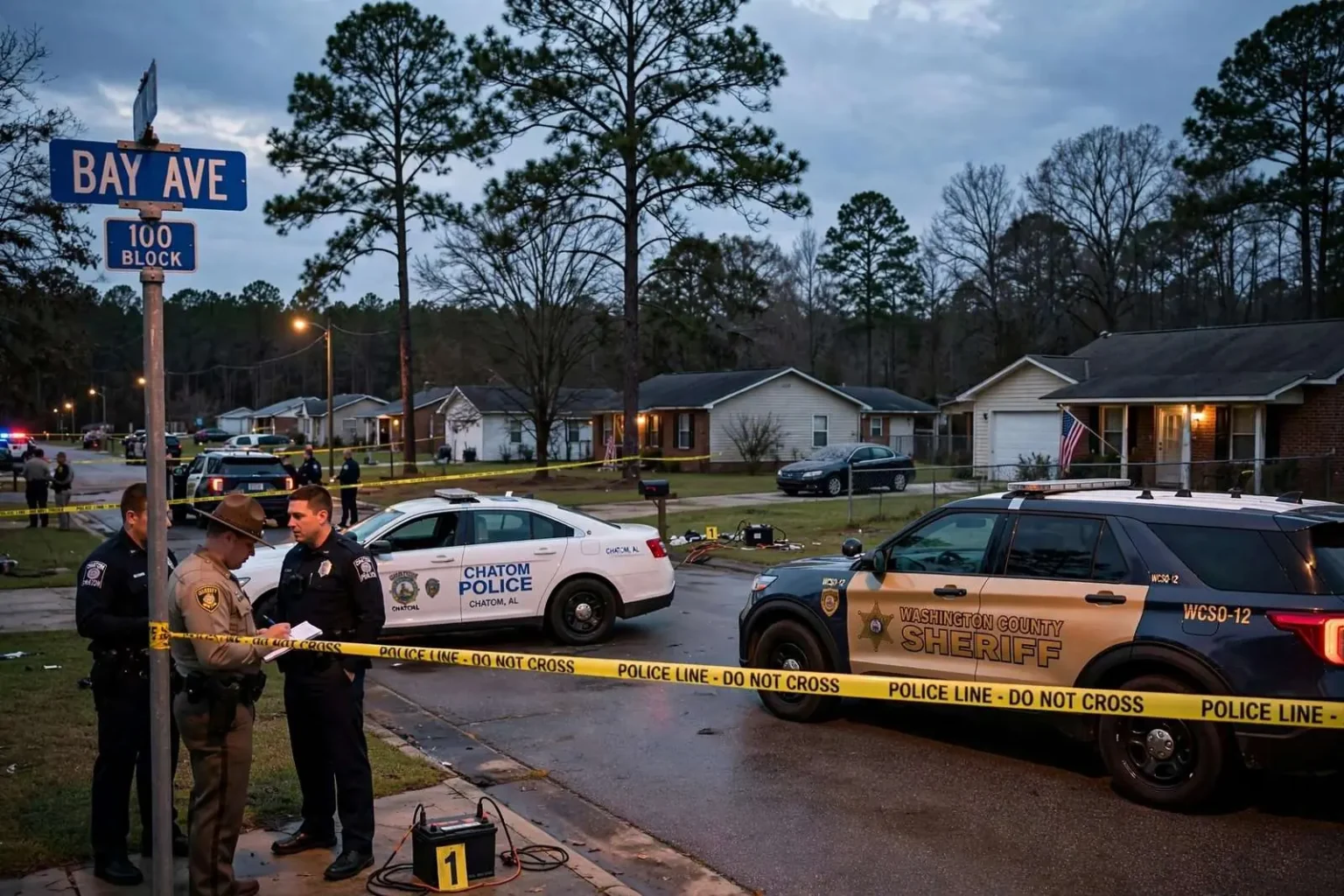
CHATOM, Ala. – A disagreement over a car battery turned deadly Wednesday night at a housing development in Chatom, according to Washington County Sheriff Richard Stringer. The shooting, which occurred on Bay Avenue just before 7 p.m., ended a conflict that authorities said began as an argument between two men who had been friends for years, and it left investigators working a homicide scene in a small town unaccustomed to such events.
Chatom Police confirmed that the conflict began as an argument over a car battery, one of the most mundane objects imaginable at the center of a fatal encounter. Officers said Renaldo James shot the victim once during the dispute. The single wound proved fatal, and the shooting transformed a quarrel between acquaintances into a murder case in the Washington County courts.
James was arrested and taken to the Washington County Jail, where he was charged with murder. The arrest followed within hours of the shooting, a timeline that reflected how quickly the circumstances came into focus for the small departments handling the case: the scene on Bay Avenue, the witnesses in the housing development, and the identification of both the suspect and the man who died.
The victim’s identity had not been released as police worked to notify out-of-state family members. That detail, unremarkable in procedural terms, said something about the case itself: the man who died had family ties far from Washington County, and officers were following the careful practice of informing next of kin before releasing a name to the public.
Chatom and Washington County
Chatom is the county seat of Washington County, a rural county in southwest Alabama along the Mississippi line. The town is small by any measure, serving as the administrative and commercial center for a county whose population is dispersed across farming communities, timberland and small settlements. Life there is organized around the courthouse square, the schools and the churches that anchor rural Alabama towns.
Bay Avenue sits within the residential fabric of the town, and the housing development where the shooting occurred is the kind of neighborhood where residents know one another’s vehicles and routines. A fatal gunshot just before 7 p.m., in early evening rather than deep night, in a neighborhood of that size, drew immediate attention and brought residents outdoors as law enforcement arrived.
Law enforcement in Washington County operates at the scale rural Alabama demands. The sheriff’s office covers the entire unincorporated county with a limited roster of deputies, while municipal departments like Chatom Police handle their towns. The two agencies working the same case, as they did on Bay Avenue, is standard practice in communities where neither department has deep homicide experience on hand and mutual support is simply how the work gets done.
An argument, a gun, a death
The account authorities gave of the shooting, an argument over a car battery escalating to a single fatal shot, fits a pattern that homicide investigators describe across the country. Disputes between people who know each other, arguments that begin over property or money or pride, can turn lethal in minutes when a firearm is present. The speed of such escalations is what distinguishes them from planned violence and what makes them so difficult for anyone nearby to interrupt.
That the suspect and the victim had been friends for years, as authorities said, added the dimension that makes these cases hardest on everyone around them. Neighbors in the housing development knew both men, and the loss of a friend at the hands of another friend, over an object as ordinary as a car battery, left the community sorting through grief, disbelief and the questions that follow any sudden death among acquaintances.
For investigators, the familiarity between the two men shaped the work. Cases involving friends produce witnesses who can speak to the relationship, the history of the quarrel and the events of the evening, and they produce physical evidence in a contained setting, a single scene, a single neighborhood, a short span of time. The rapid arrest and murder charge reflected that investigative reality.
The arrest and the charge
Taking a suspect into custody the night of a shooting is the outcome every small department hopes for, and the move from arrest to a formal murder charge happened quickly in the Washington County Jail. The charge reflects the legal judgment that the killing was unlawful, but it begins rather than ends the legal process: an initial appearance, defense counsel, and the slow machinery of a case moving toward resolution all follow the night on Bay Avenue.
The decision to charge rests on the evidence the two departments assembled in the hours after the shooting. Witness accounts from the housing development, the scene itself, and the statements taken from those involved support the account authorities gave, and prosecutors review that record before and after charges are filed. The public record of the case, as preserved in local reporting, consists of what Sheriff Stringer and Chatom Police stated at the time.
What that record does not include is any outcome in court, and the historical account of the case stops where the reporting stopped: an arrest, a murder charge, a jail booking, and a victim’s name withheld pending family notification. Nothing in the account should be read as a conclusion about any later proceedings.
Withholding a name until family is found
The decision to withhold the victim’s identity while police worked to notify out-of-state family members follows a practice that law enforcement agencies observe carefully. In a case with interstate family ties, notification can take longer than it would locally, and departments hold the name rather than let family members learn of a death from news coverage. The delay is a courtesy with real weight in rural communities, where news travels fast and everyone has a phone.
The detail also sketching the victim’s circumstances, family living out of state, a friendship with the suspect measured in years, hints at a life that connected Chatom to places beyond it. Rural Alabama communities are full of such connections, residents whose children and relatives have moved to cities elsewhere, and whose deaths draw family back to the county for the hardest of occasions.
For the news record, the withheld name is a gap that time often fills but that historical summaries should respect. The account preserves what was known at the time: a man died on Bay Avenue, his identity was being protected pending notification, and the charge against Renaldo James was murder. The rest belongs to the case file, not the summary.
Small-town homicide investigations
A homicide in a town the size of Chatom strains the resources of the agencies that handle it, and the response depends on cooperation. The Washington County Sheriff’s Office brings investigative capacity and jail facilities; Chatom Police bring local knowledge and the first response; and the district attorney’s office guides the legal steps. State agencies stand ready to assist when rural departments request help with specialized work.
The aftermath in the community follows its own course. Housing developments where a death occurs often see an increased law enforcement presence in the days that follow, both to reassure residents and to continue canvassing for information. Churches and neighbors absorb the grief, and in towns where the parties are known by name even before it is released, the case becomes part of local memory quickly.
The lesson communities draw from cases like this one is the one authorities repeat after every dispute-turned-fatal: arguments have outcomes that no one intends, and a gun present in a quarrel converts anger into a death and a prison charge within seconds. Sheriff Stringer’s account of a friendship ending over a car battery is the kind of case that rural law enforcement cites when it asks residents to walk away from conflicts and call for help instead.
This account preserves the reported facts of the Chatom shooting as authorities stated them: a Wednesday night argument over a car battery, a single gunshot on Bay Avenue just before 7 p.m., the arrest and murder charge against Renaldo James in the Washington County Jail, and a victim’s identity withheld pending notification of out-of-state family. It does not state any final court outcome, and none should be inferred from the charges as reported.
Washington County’s landscape and law enforcement
Understanding the case means understanding the county it happened in. Washington County is one of Alabama’s oldest counties, carved out when the state was still a territory, and it remains one of its most rural. Timber and agriculture shape the economy, the county’s population is spread thin across a large area, and its communities, Chatom, McIntosh, Millry, Vinegar Bend and others, are small enough that a single incident resonates through all of them.
The sheriff’s office that Sheriff Richard Stringer leads is the backbone of law enforcement across that territory. Rural sheriff’s offices of this kind handle everything from traffic and property crime to major investigations, often with deputies covering long distances between communities, and they rely on the mutual aid that flows naturally between neighboring departments and municipalities.
Chatom Police, headquartered in the county seat, work the same territory at street level. On the night of the Bay Avenue shooting, the two agencies’ roles overlapped as they do in the county’s serious cases: city officers secured the scene and interviewed witnesses in the housing development, while the sheriff’s office provided investigative support and the county jail received the suspect. The murder charge followed from the combined work of both.
Violence between friends in rural communities
Cases in which long friendships end in violence carry a distinctive weight in small communities, where the suspect and the victim are both known quantities and the grief and anger of the aftermath have nowhere to hide. Researchers who study homicide consistently find that disputes between acquaintances are among the most common circumstances of fatal violence, which means small towns are not exempt simply because they are small.
The role of firearms in dispute homicides is equally consistent in the research and in investigators’ experience. An argument over property, and a car battery is as ordinary an object as disputes arise over, ends one way without a weapon and another with one. The single shot that authorities said Renaldo James fired on Bay Avenue stands as the fatal version of that arithmetic.
Community responses in rural counties tend to emphasize prevention through the channels small towns actually have: churches, schools and families. When a dispute turns deadly, the questions residents ask, about what could have been said or done to stop the escalation, circulate through those same channels, and law enforcement’s message that conflicts should be walked away from rather than pressed finds its most receptive audience in the days after a case like this one.
What the record preserves
The historical account of the Chatom case preserves the essential reported facts. A disagreement over a car battery at a housing development in Chatom turned deadly on a Wednesday night. Washington County Sheriff Richard Stringer reported the fatal outcome; Chatom Police confirmed the dispute’s origin. Officers said Renaldo James shot the victim once on Bay Avenue just before 7 p.m. James was arrested, taken to the Washington County Jail, and charged with murder. The victim’s identity was withheld pending notification of out-of-state family, and authorities said the two men had been friends for years.
Those are the facts as they stood in the hours and days after the shooting, and the summary adds nothing to them. It does not name the victim beyond what authorities released, does not describe the legal process that followed, and does not state any disposition of the murder charge. Preserving that boundary is what makes the account reliable history rather than speculation.
What remains from the episode for Washington County is the familiar warning of small-town violence: an ordinary disagreement, a weapon, and a death that no argument could justify. The case stands in the record as the night a dispute over a car battery ended a years-long friendship on Bay Avenue, and left Chatom Police and the sheriff’s office working a homicide in the county seat.