
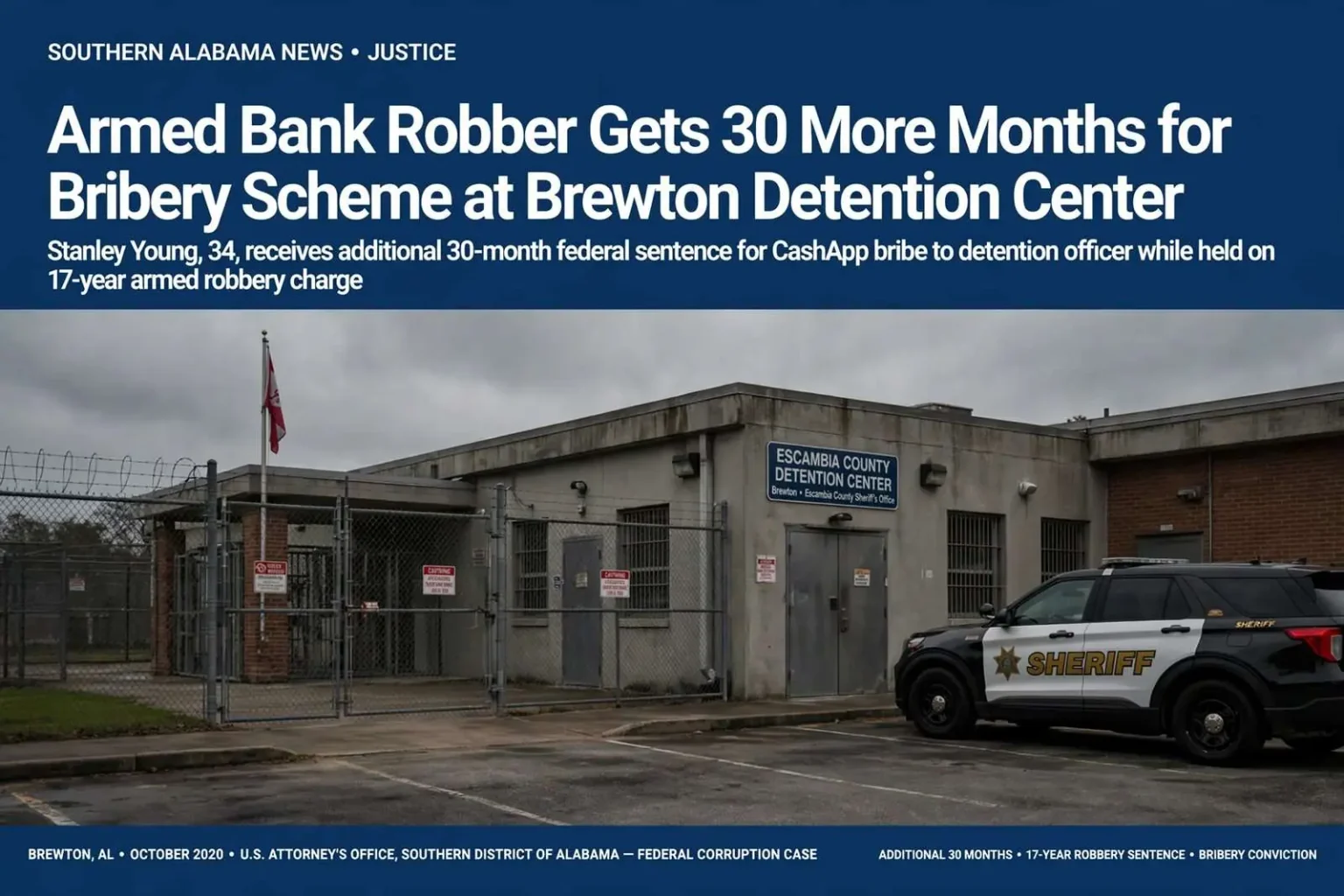
A man already facing decades behind bars for an armed bank robbery picked up an additional 30-month federal sentence for bribing a corrections officer while he awaited trial, according to the U.S. Attorney’s Office for the Southern District of Alabama.
Stanley Young, 34, was being held at the Escambia County Detention Center in Brewton on the robbery charge when prosecutors say the bribery scheme took shape. He has since been convicted and sentenced to 17 years for the robbery itself.
The additional sentence means Young’s federal time will run on top of the 17-year term, a stacking that federal prosecutors pursue deliberately in corruption cases behind bars. Bribing a corrections officer is not treated as a footnote to an underlying crime; it is charged as its own offense because the integrity of a detention facility depends on every officer’s refusal to trade access for payment. A breach at that level endangers inmates and staff alike, and prosecutors across the country have increasingly used federal charges to send that message to both the inmates who offer money and the officers who consider taking it.
The Escambia County Detention Center in Brewton houses inmates for the county in south Alabama’s interior, far from the coastal population centers, and facilities of its size face the same contraband pressures that challenge large urban jails: phones, drugs, weapons and money all command enormous prices inside, and the demand creates a marketplace in which a single corrupt employee can become the entire supply chain.
Cash App Payments and Contraband
Court documents allege Young admitted paying the officer more than $5,000 through the CashApp in exchange for what officials described as “corrupt actions on his behalf” — including a $4,000 down payment on an Infiniti at a Mobile car dealership.
The alleged use of a peer-to-peer payment app to move bribe money illustrates how everyday financial technology has entered the contraband economy. Apps that transfer cash in seconds with little friction are a routine part of legitimate life — splitting rent, paying a friend back — but investigators say they have become equally routine in illicit arrangements, leaving a digital record that can later become the backbone of a prosecution. In this case, the paper trail allegedly connected the payments not just to contraband but to a luxury car down payment at a Mobile dealership, an unusual purchase for a man with no lawful income awaiting trial.
In return, authorities said, the officer smuggled prohibited items into the facility for him: money, cell phones and K2 spice paper.
Each of the three items carries its own black-market premium. Cash is currency for further deals inside. A smuggled cell phone is the most valuable of all, because it connects an inmate to the outside world without monitoring — a communication line that jail administrators spend enormous effort trying to sever. K2, the synthetic cannabinoid soaked into paper and dried, is prized because a single sheet can be divided into dozens of doses, passes through mail and hands undetected, and cannot be detected by many standard drug tests.
In August 2020, the officer acknowledged she had a personal relationship with Young and had brought the items into the jail.
That acknowledgment shifted the case from allegation to admission, at least on the officer’s side, and it exposed the classic vulnerability that correctional administrators warn about: personal relationships formed across the custody line. Staff training on maintaining professional boundaries exists precisely because such relationships develop gradually — familiarity, then favors, then payments — and by the time the arrangement surfaces it has usually been operating for months.
Federal Investigators Follow the Messages
Using a smuggled cell phone, investigators reviewed Young’s Facebook activity. Messages allegedly showed him arranging purchases of K2 spice paper with third parties, and exchanges with the officer about her selling marijuana outside the detention center on his behalf.
The irony at the center of the case is hard to miss: the phone smuggled in as contraband became the instrument of the prosecution, its social media activity documenting the very scheme it was used to conduct. Digital forensics teams routinely mine such accounts for patterns — who was contacted, how purchases were arranged, how proceeds flowed — and the resulting message logs give prosecutors a near-transcript of the criminal enterprise.
The alleged outside drug operation attributed to the officer extended the scheme’s reach well beyond the jail. Selling marijuana on an inmate’s behalf requires street contacts, coordination and trust, and it demonstrates how a jailed defendant with a smuggled phone can continue directing criminal activity in the community as though incarceration had never happened.
At the time of the sentencing announcement, officials had not said whether the corrections officer would face charges.
The case highlights how contraband phones can extend criminal activity well beyond jail walls — in this instance reaching from a Brewton lockup to a Mobile dealership lot.
The Broader Problem of Contraband Phones
Correctional agencies across the country describe smuggled phones as the single most disruptive form of contraband they confront. Unlike drugs, which are consumed and gone, a phone functions indefinitely as a command center: inmates use them to run fraud schemes, intimidate witnesses, coordinate continued trafficking, and — as this case allegedly shows — manage corrupt arrangements with employees. The phones themselves are small, flat and increasingly difficult to detect, and new models arrive constantly to replace the ones found and confiscated.
The technology to stop them exists in various forms — managed access systems that block unauthorized signals inside a facility, wireless detection arrays, body scanners at intake — but each carries significant cost, and small county jails like the one in Brewton often operate with budgets that make such systems difficult to acquire. That leaves screening, searches and staff vigilance as the primary defense, and the integrity of staff as the linchpin. A facility can search every inmate daily, but if an officer is willing to carry contraband through the front door, the physical security measures mean little. That is why prosecutors treat employee bribery with particular seriousness: the sentence handed to Young is one side of the ledger, and a decision about the officer’s conduct is the other.
How the System Responds
For the Southern District of Alabama, whose prosecutors handle federal crimes from Mobile across the southern tier of the state, cases like this one serve an additional purpose beyond punishing the individual defendant. Each announcement signals to detention staff statewide that the consequences of crossing the line are real, and to inmates that a jail sentence is not an invitation to continue operating. The arithmetic of Young’s case makes the point numerically: a 17-year term for the robbery, plus 30 months more for the corruption while awaiting trial — the add-on being the clearest way the justice system can say that what happens inside a jail counts as much as what happens outside it.
The path from scheme to sentence in such cases typically runs through cooperation between multiple agencies — local detention administrators who notice anomalies, federal investigators who trace financial and digital records, and prosecutors who assemble the pieces into charges. The digital trail in this case, allegedly running from CashApp transfers to Facebook messages to a car dealership down payment, is the kind of modern evidence picture that older contraband cases never had, and it reflects how investigations have adapted: the same connectivity that makes a smuggled phone powerful inside a jail also makes every transaction it touches traceable outside one.
For Brewton, a small Escambia County city whose detention center is one of its larger public institutions, the case is a local story with regional reach — proof that the flows of contraband, cash and communication modern crime depends on pass through even the smallest county facilities, and that the response to them now does too.
Inside the Economics of Jail Contraband
Understanding why these schemes persist means understanding the pricing. Inside a facility, a pack of cigarettes or a dose of synthetic marijuana can sell for many times its street price, because the risk of supplying it is built into every transaction. A working cell phone can command hundreds of dollars or more. That margin makes recruitment of a single insider enormously profitable: one officer willing to carry items in can supply an entire housing unit, and the money flows back out through the same app that started the scheme.
Administrators fight the trade with everything from random cell searches to K-9 sweeps to intelligence sharing between agencies, and they also watch the financial side — unusual deposits, unexplained purchases by staff, and inmates with no lawful income who nevertheless move money. In Young’s case, prosecutors pointed to the car dealership down payment as exactly that kind of red flag: a man awaiting trial on an armed robbery charge, with no visible source of income, putting four thousand dollars toward an Infiniti in Mobile. Transactions like that raise questions that follow a paper trail backward through the payment apps into the scheme that generated the cash.
The human cost of the trade is less visible but no less real. Synthetic drugs like K2 have been linked to erratic and violent behavior among users, endangering inmates and officers alike. A phone in the wrong hands can facilitate witness intimidation or organize violence inside and outside the walls. And when staff are compromised, the safety of every person in the building — the vast majority of them inmates simply serving their time without incident — depends on the one person who broke the rules. The 30-month sentence announced in this case is, in that light, a statement about protecting everyone else inside the facility, as much as it is a punishment for the man who corrupted the system from his cell.


