Armed Man Taken Into Custody After Early-Morning Standoff in West Mobile
Mobile police took an armed man into custody before dawn after a standoff near Schillinger Road and Tanner Williams Road.
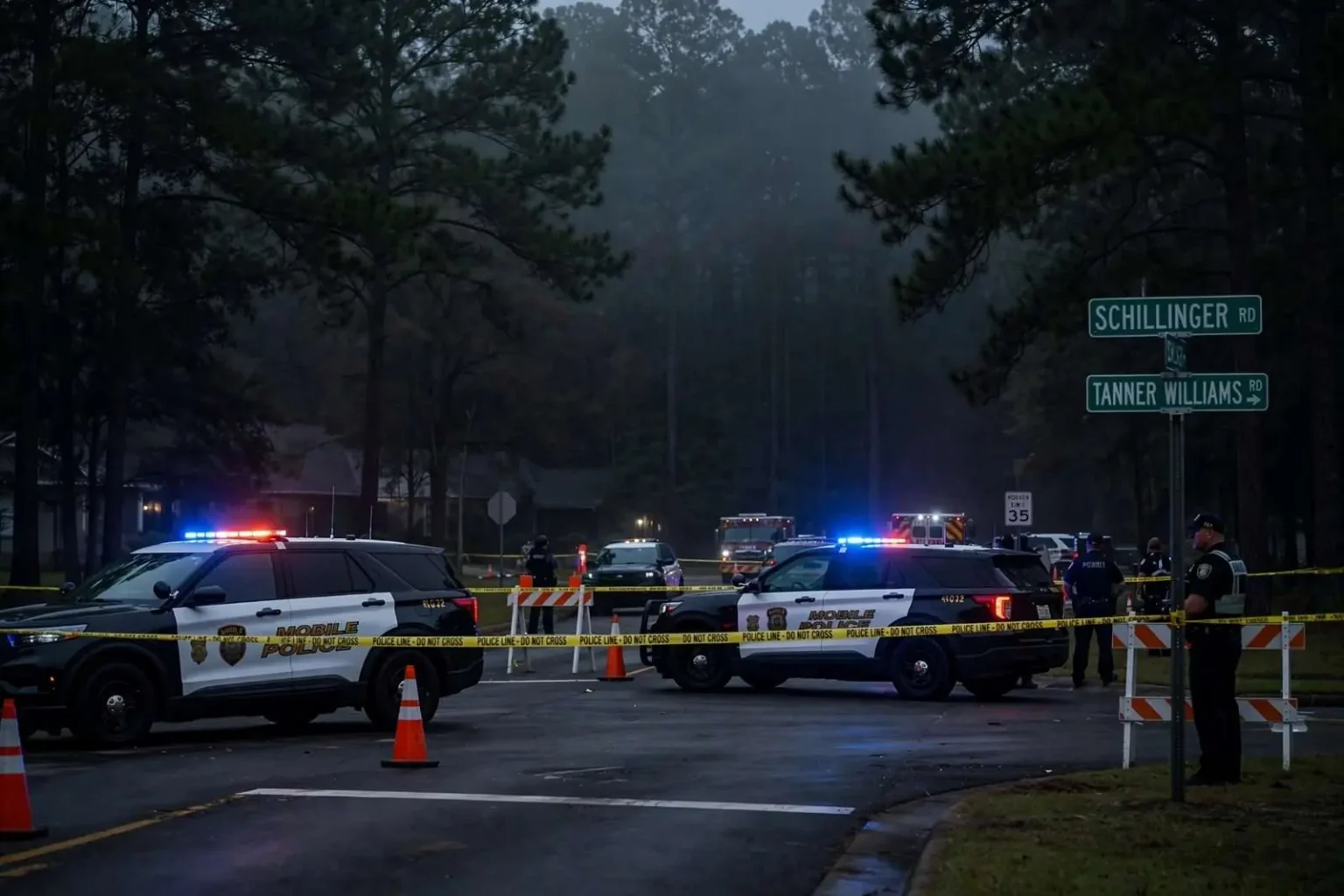
WEST MOBILE, Ala. — Police took an armed man into custody early Thursday morning after a standoff in the area of Schillinger Road and Tanner Williams Road, bringing a quiet residential stretch of west Mobile to a temporary standstill before the situation ended without any injuries.
According to officers at the scene, the man ran into a wooded area off the roadway when police made contact, prompting officers to establish a perimeter around the property and begin the careful work of coaxing him out. The standoff stretched into the early-morning hours before the suspect was taken into custody shortly before 4 a.m.
Police said the man appeared to be experiencing a mental health crisis and was believed to be a threat only to himself. Even so, officers noted that they treat situations involving an armed person as though the individual could pose a danger to others until everyone involved is confirmed safe — a posture that shapes nearly every decision made during a perimeter operation of this kind.
No injuries were reported in the incident, either to the man, to officers, or to any residents in the surrounding neighborhood. The peaceful resolution capped an operation that, from the outside, can look like waiting but that in practice involves constant movement: officers repositioning, supervisors coordinating, negotiators talking, and emergency medical personnel staged nearby in case the situation turned.
How a perimeter works on Schillinger Road
The intersection of Schillinger Road and Tanner Williams Road sits in one of the fastest-growing parts of Mobile County, a corridor of subdivisions, churches, and school zones west of Cronier and Snow roads where wooded lots still separate many homes. When police seal such an area, the effect on residents is immediate — streets close, curious neighbors gather at the tape line, and anyone heading to work before dawn finds a detour in the way.
A perimeter serves two purposes at once. It contains the scene so the subject cannot leave the immediate area without being seen, and it protects the public by keeping onlookers and passing traffic away from the line of sight if the situation escalates. Officers assigned to the perimeter hold fixed positions while crisis negotiators, often working from a position out of the subject’s view, attempt to establish contact and build enough rapport for a voluntary surrender.
Time is deliberately on the police side in these encounters. A person in crisis who has fled into woods is cut off from transportation, and the longer a negotiation continues, the more likely fatigue and de-escalation efforts are to bring the person out safely. That calculus is why standoffs in Mobile County frequently end in custody rather than gunfire, as this one did shortly before 4 a.m.
Mental health crises and the police response
Police statements that a subject “appeared to be experiencing a mental health crisis” describe a category of call that has become one of the most demanding in modern policing. Across Alabama and the nation, law enforcement agencies have increasingly adopted crisis intervention training — commonly called CIT — that teaches officers to recognize signs of psychiatric emergency, slow the encounter down, and use verbal de-escalation before considering force.
In Mobile, officers responding to such calls must balance two obligations that pull in opposite directions: treating a person in crisis with care and mental health resources, and protecting everyone at the scene from an armed individual whose intentions cannot be known. That is what department officials meant when they noted that officers treat such situations as though the person could pose a danger to others until everyone is confirmed safe — the armed subject’s rights and wellbeing matter, but so does the safety of the officers, the neighbors, and any family members nearby.
The mobile mental health landscape offers officers more options than in decades past. Crisis respite resources, the regional 988 Suicide and Crisis Lifeline, and AltaPointe Health — the Gulf Coast’s largest behavioral health provider, headquartered in Mobile — give responders pathways to treatment that did not exist a generation ago. In many cases, a person taken into custody after a mental health crisis is transported for evaluation rather than processed through the criminal justice system, particularly when no one was harmed.
Alabama law provides for involuntary commitment evaluations when a person presents a substantial risk of harm to themselves or others, a process that runs through the county probate court. In Mobile County, that means an individual taken into custody during a crisis may be evaluated at a hospital or behavioral health facility, with clinicians and a probate judge — not jailers — determining what happens next.
What residents saw early Thursday
For neighbors along Schillinger and Tanner Williams roads, the incident unfolded in the way these events usually do: a cluster of police vehicles arriving late in the evening, blue-and-red lights washing over the treeline, an officer or two holding the road, and then — after hours of stillness — the equipment being packed away before the morning commute. Because the man ran into woods rather than toward homes, residents were never ordered to evacuate, and no homes were reported damaged.
The department has not released the man’s name, which is common in cases where the person is taken for psychiatric evaluation rather than immediately charged. Whether charges follow often depends on what officers learn during the encounter — whether the person committed an assault, fired a weapon, or otherwise endangered anyone — and on decisions made with the District Attorney’s Office afterward.
What is documented is the outcome police training aims for: an armed man in crisis, a perimeter instead of a confrontation, hours of controlled patience, and a peaceful surrender shortly before 4 a.m. with no injuries to anyone — the subject included.
West Mobile and the frequency of such calls
West Mobile’s rapid growth over the past two decades has pushed residential development deep into what was once farmland and pine forest, and the patchwork of developed subdivisions and undeveloped woods creates exactly the kind of terrain in which a person in crisis can briefly disappear. Departments in the area have learned to treat wooded tracts as accessible space in their operational planning, bringing more personnel and better lighting to a scene than the nature of the immediate emergency might otherwise suggest.
For the Mobile Police Department, the incident was one call among hundreds handled on any given shift — but it was the kind of call that shows how much modern policing has shifted toward patience and mental health awareness. A generation ago, an armed man running into woods after dark might have drawn a very different response. On Thursday, the tools were a perimeter, negotiators, and time, and by early morning everyone went home safely.
The role of negotiators and the decision to wait
Crisis negotiation is a specialized assignment within the Mobile Police Department, and officers selected for it train on exactly this scenario: a subject who is armed, alone, and in psychological distress, holding position in difficult terrain while officers maintain contact by voice. Negotiators are taught to avoid ultimatums, to ask open-ended questions, and to let silences do part of the work — because the goal is not a quick arrest but a safe one.
Supervisors on the scene make the strategic calls: when to move the perimeter, when to bring in additional resources, and when to hold steady. Bringing in more officers increases control but also increases the chance of a misunderstanding or an abrupt movement being misread; holding the perimeter thin keeps the scene calmer. The several hours between the initial call and the pre-4 a.m. custody suggest commanders chose patience throughout.
Staged nearby, though rarely mentioned in police summaries, are the fire and EMS crews who stand ready for the moment the subject is in custody. Medics evaluate anyone taken from a mental health crisis for dehydration, exposure, or injuries from moving through woods in the dark, and that evaluation often determines whether the next stop is a hospital, a behavioral health facility, or the county jail — or some combination, beginning with an emergency evaluation.
What the community can take from a quiet ending
Incidents like the one on Schillinger Road end quietly far more often than they end badly, and that fact is worth registering in a state where mental health crisis response remains a work in progress. Alabama has expanded mental health crisis centers in recent years, part of a statewide effort to give law enforcement somewhere to take people in crisis other than an emergency room or a jail cell. Mobile’s behavioral health infrastructure — anchored by AltaPointe and supported by crisis line services — is among the resources available to officers making that decision in the middle of the night.
For the residents who live along the Schillinger and Tanner Williams corridor, the episode was a reminder of how quickly an ordinary Tuesday night can turn into an all-hours police operation, and how rarely those operations end with anyone hurt when officers have room to work. No injuries were reported; no shots were fired; no names have been released; and the neighborhood woke to nothing more than a few closed lanes and a story to tell.
The Mobile Police Department has not said whether the man faces charges, and the outcome of any psychiatric evaluation he receives will shape what happens next. In the meantime, the early-morning standoff near Schillinger Road and Tanner Williams Road stands as an example of the response residents of west Mobile hope for whenever an armed person in crisis appears in their midst — slow, deliberate, and resolved without harm.