
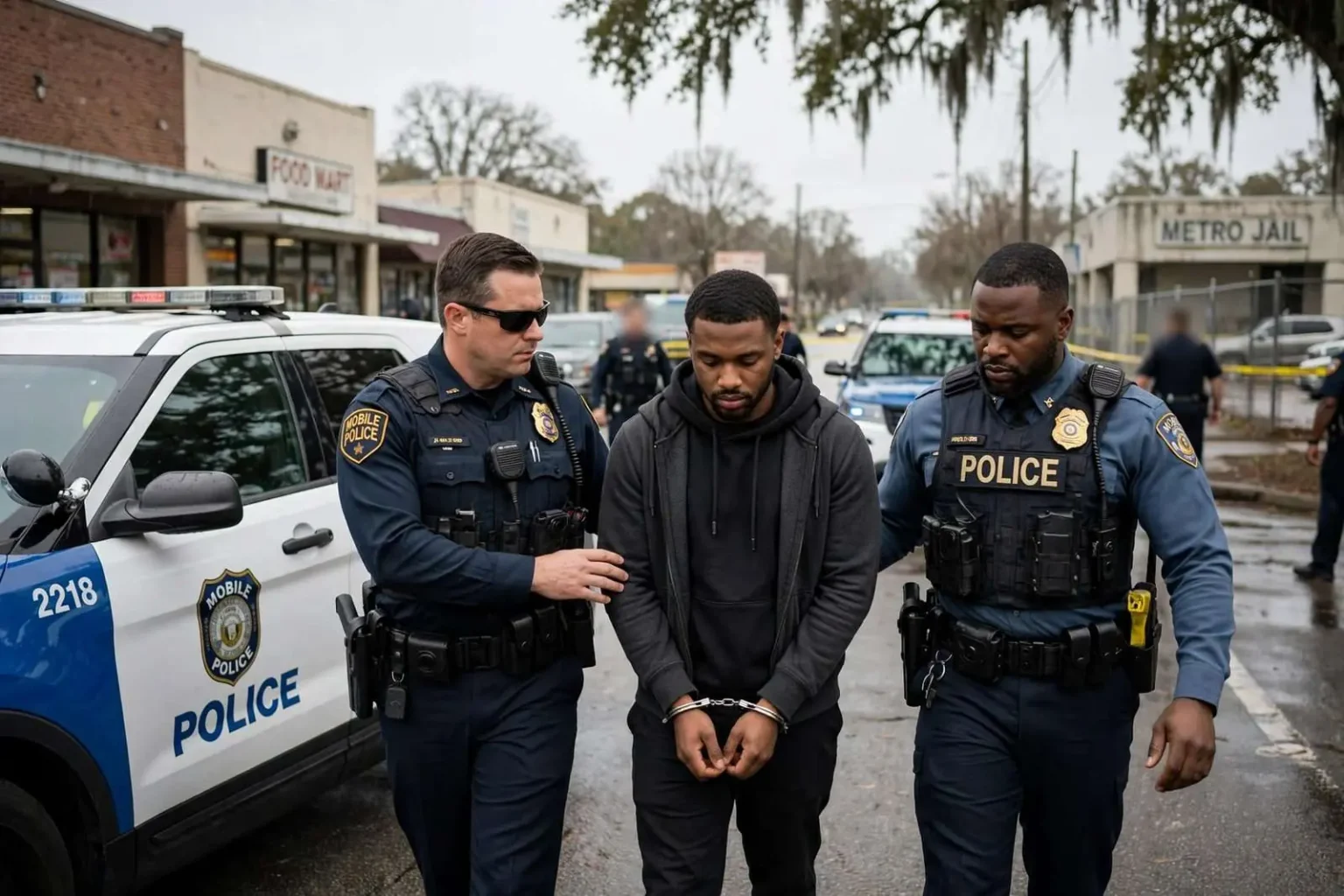
MOBILE, Ala. — The arrest of one of Mobile’s Most Wanted is bringing a measure of relief to the family of a man killed in Mobile County six years ago. Trenteon King was taken into custody by Mobile police in late April and escorted to Metro Jail, where he now faces a slate of charges in both state and federal court — a legal reckoning that the family of D’Anthony Means has waited years to see begin.
King had been featured among Mobile’s Most Wanted, the periodic public listings police use to spotlight suspects who have eluded capture. Those programs put faces and names before the community, generate tips, and signal that outstanding cases have not been forgotten. For the family of a homicide victim, seeing a suspect recaptured is only the start of another long process, but it is the moment the waiting changes into something actionable.
An earlier case collapsed over warrant error
King was one of two people charged in the 2016 killing of D’Anthony Means, but that murder case fell apart after a search warrant was filled out incorrectly, leading a court to suppress key evidence. The error — a failure in the paperwork rather than the underlying investigation — illustrates how fragile a prosecution can be when its foundation documents do not survive a defense challenge. Evidence obtained under a defective warrant can be excluded, and without it, prosecutors are often left unable to proceed.
The mistake has drawn renewed attention as King faces new allegations. For Means’ mother, the lesson is procedural and painful at once. “I hope it makes them more thorough with their paperwork, present it properly, and that the words are worded properly,” said Tiffany Means, the victim’s mother, who has followed King’s case closely. “To ensure other criminals are put to justice — one word over life is not replaceable.”
Her point goes to the heart of how warrant cases work. A search warrant is a sworn document that must describe with precision the place to be searched and the evidence sought, and courts suppress results when that precision fails — not because the underlying suspicion was wrong, but because the constitutional safeguards demand exactness. A single word in the wrong place can cost a case six years of work.
New charges in a Theodore shooting
According to police, King is accused of shooting two people earlier this year during an argument at a store in Theodore, the unincorporated community in southern Mobile County where the confrontation occurred. The new allegations brought King back into the criminal justice system on charges that, unlike the collapsed murder case, are moving forward — and they carry consequences in two courtrooms at once.
When he was arrested in April, officers said he had an illegal gun switch in his possession, and he now faces a federal gun charge for the device. Gun switches, small conversion devices that turn a semi-automatic firearm into one that fires automatically, have become a mounting concern for law enforcement nationally and in Mobile, where federal prosecutors have increasingly taken such cases. The federal charge means King’s alleged conduct is being pursued by prosecutors with the resources of the U.S. Department of Justice behind it, in parallel with the state proceedings.
A family still waiting
For Tiffany Means, the arrest closed one chapter and opened another. Six years after her son’s death, the man once charged in the killing is in custody again — this time on allegations from a different shooting, with the 2016 case still standing as the wound that never healed properly. She said she hopes prosecutors and police will work together more closely going forward. “That’s the only way we’re going to put an end to the crime rate in Mobile County right now,” she said.
Her appeal is a familiar one in communities where cases collapse on technical grounds. When police work and prosecution fail to connect — when evidence gathered on the street is lost in the paperwork — families are left with the sense that the system’s failures compound the original crime. Coordination between investigators and prosecutors, particularly at the warrant stage, is the practical answer to that grievance.
What happens next in court
King was expected back in state court for a preliminary hearing on June 15. A preliminary hearing is where prosecutors must show a judge enough evidence to establish probable cause that the defendant committed the charged offenses — an early checkpoint that determines whether the case proceeds to a grand jury and, eventually, to trial. For the families on both sides of a case, it is the first public airing of the evidence since the arrest.
Because King faces charges in both state and federal court, the two cases will move on separate tracks, with prosecutors coordinating over which proceeds first. Federal gun cases involving conversion devices have carried significant sentences, and the parallel proceedings mean King’s legal exposure will be resolved piece by piece across two systems rather than in a single trial.
Mobile’s Most Wanted and unsolved cases
The Mobile’s Most Wanted program exists precisely for cases like this one — suspects with active charges who have slipped out of reach. Area law enforcement agencies partner with local media to publicize the names, photographs and charges of fugitives, and the publicity regularly produces tips that end in arrests. The listings also serve a public function: they remind the community that old cases remain open and that a name from years ago can still surface.
For families of victims, those periodic features carry mixed weight. Seeing a loved one’s case described in public brings attention, but the attention rarely arrives with answers. The arrest of a suspect like King does not reopen the murder case that collapsed — it proceeds on the new allegations — yet for the Means family, the custody itself is what six years of waiting has looked like.
The warrant lesson for local cases
The suppression that ended the 2016 murder prosecution has become part of a broader conversation about how well Mobile County’s cases are built from the first affidavit forward. Defense attorneys scrutinize warrants line by line, and appellate courts across Alabama have thrown out searches for errors ranging from wrong addresses to descriptions of evidence so vague they satisfied no one. The training answer is preparation: affidavits reviewed before submission, probable-cause paperwork double-checked, and prosecutors consulted before an officer swears to a document that will carry an entire case.
Tiffany Means’ hope — that the collapse of her son’s case makes the next one more careful — is the kind of reform that comes from experience rather than policy memos. Every officer who drafts a warrant and every judge who signs one is the last safeguard between a suspect and a courtroom, and when that safeguard works, cases survive. When it fails, families like the Meanses learn that the difference between a conviction and a walked-out jail door can be, as she put it, one word.
A community watching
King’s case will now play out where it always should have — in courtrooms, on the record, with evidence tested in the open. The preliminary hearing in June gives Mobile County its first look at whether the new charges are built to last, and the federal docket adds a second ledger of accountability. For a family that has watched one prosecution dissolve on a paperwork error, the hearings to come are about more than the new allegations: they are a test of whether the system that failed once has learned to get the words right.
Guns switches and the federal response
The gun switch allegedly found in King’s possession at his April arrest is part of a phenomenon that has reshaped firearms enforcement in recent years. A switch is a small piece of metal or plastic, often imported or made on a 3D printer, that converts a semi-automatic pistol into a machine gun in the eyes of federal law. Possessing one — regardless of how it is used — is itself a federal offense, and prosecutions for the devices have multiplied as officers have recovered them in traffic stops, raids and arrests across the country.
For local police, the devices change the calculus of an arrest. A suspect picked up on state charges who is also carrying a switch brings federal interest, because the machine-gun statute carries steep penalties and the evidence is simple: the device itself. That is how an arrest for a Theodore store shooting becomes two cases — one before a state judge, one before a federal magistrate — each carrying its own exposure.
Theodore and the geography of the case
Theodore, where the store shooting occurred, is one of the population centers of southern Mobile County, a community of neighborhoods, schools and commercial strips along the corridors between Mobile and the bay. Incidents there are worked by Mobile County-area law enforcement like any other part of the county, but the distance from downtown courthouses matters to families: victims, witnesses and relatives commute to every hearing, and a case that stretches over months of continuances asks a great deal of them.
The store where the argument escalated is the kind of everyday location where many such confrontations unfold — not a crime planned in advance, but an argument that turned lethal or nearly so in minutes. Those cases turn on witnesses who were present, surveillance video from the business and physical evidence, all of which prosecutors must weave together quickly while memories are fresh.
What relief looks like six years later
Relief is a relative word for a family that lost a son in 2016 and watched the prosecution of the man charged in his death dissolve. What the late-April arrest provides is motion — a suspect in custody, charges accumulating, hearings scheduled — after years in which the case was a closed courtroom door. Families of homicide victims in Mobile County routinely describe that motion as the difference between grief with purpose and grief without any.
The Means family’s attention now shifts to the June 15 preliminary hearing and the federal case behind it. Whatever the outcome of the new allegations, the family’s broader message — about careful paperwork, coordinated prosecution and the irreplacable value of a life — remains addressed to every officer and prosecutor whose work will decide the next case like this one.


