Arts Alive! Fills Downtown Mobile With Art, Film and Fashion This Weekend
Arts Alive brings Temporal City installations, a Stingray Sam screening and fashion shows to Cathedral Square in downtown Mobile April 8-10.
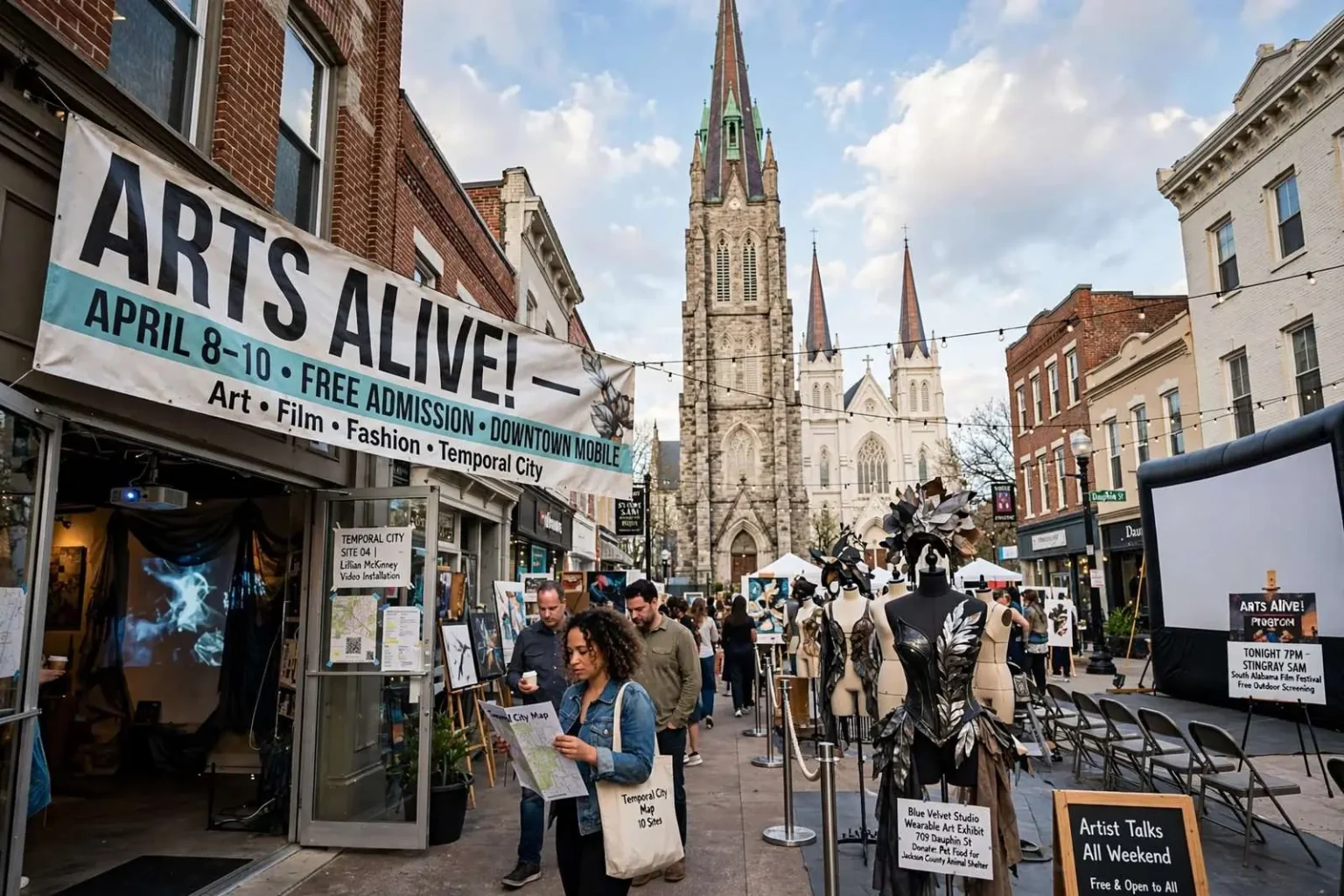
Downtown Mobile’s Cathedral Square district turns into an open-air gallery this weekend as the annual Arts Alive! festival runs Friday through Sunday, April 8–10, with free admission and a schedule that stretches well beyond the usual art-walk format. The festival is the signature event of Mobile’s downtown arts calendar, drawing artists, performers and crowds into the blocks around the square beneath the Cathedral of the Immaculate Conception, and this year’s edition reaches further — into vacant buildings, onto a big screen and down the runway — than a standard weekend of gallery browsing.
Free admission is central to what Arts Alive! has always been about: a festival built to be walked into, not ticketed, where the person who wanders past the square on a Saturday afternoon becomes part of the audience whether they planned to or not. That openness has made the event one of the most accessible cultural offerings on the Gulf Coast, and it sets the stage for a weekend whose centerpiece asks attendees to do something unusual — follow a map into buildings most of downtown walks past without a glance.
Temporal City Turns Empty Buildings Into Exhibits
The most ambitious piece of the weekend is Temporal City, a three-day festival-within-the-festival that places time-based and durational media artwork inside abandoned and unused buildings within a three-block radius of Cathedral Square. Ten artists were invited to create site-specific projects for the duration of the festival, including Lillian McKinney, Joe Hobbs, Adam Taylor, Ryan Jetten, Jimmy Lee, Riley Brenes, A. Friend and Elizabet Elliott.
Site-specific work of this kind cannot simply be hung; it has to be built in response to a place. Each of the ten artists was asked to create a project that exists only in its assigned building — video, performance, sound and durational installations that use the decay, scale and silence of the spaces as raw material. The buildings themselves, empty storefronts and unused upper floors within three blocks of the square, become co-authors of the work. When the festival ends Sunday night, the installations come down and the buildings return to waiting, which is precisely the point of the “temporal” in the title: the city that appears this weekend exists only while the festival does.
Organizers describe the experience as a scavenger hunt: an artist-designed map of downtown marks every installation along with scheduled artist talks and tours, letting patrons plot their own route through the derelict spaces. Maps are available throughout the festival, and guided tours and public conversations with the artists are scheduled across all three days.
The scavenger-hunt framing is a deliberate answer to the problem every multi-venue arts event faces: how to move an audience that would otherwise cluster in one square. A map with ten marked sites scattered across three blocks turns the walk between installations into part of the experience, and it puts festival-goers in front of downtown’s less-photographed corners. The talks and tours give the more curious patrons direct access to the artists — a chance to hear how a project was conceived for a particular floor, stairwell or storefront, and what the artists saw in buildings the rest of the city has written off.
The choice of empty buildings as venues carries its own argument about downtown Mobile. A city’s vacant spaces are usually treated as failures — signs of vacancies, deferred investment and streets that go quiet after dark. Temporal City temporarily reverses that reading, filling the unused spaces with the most current work the local scene can produce and drawing crowds into rooms that have stood dark for months or years. For the duration of the festival, the derelict buildings are the most-visited addresses downtown, and the hope implicit in the programming is that attendees leave with a different sense of what those spaces could become.
Fashion, Film and Wearable Art
The weekend also brings a full slate of events in and around the square:
Stingray Sam screening — Friday, April 8, 7 p.m., Cathedral Square. The South Alabama Film Festival hosts a free outdoor showing of Cory McAbee’s episodic musical space-western, narrated by David Hyde Pierce, which premiered at Sundance in 2009.
An outdoor film screening in a historic square is a genre of its own on the Gulf Coast, and Stingray Sam is an unconventional choice for it: McAbee’s project is an episodic musical built for episodic viewing, a space-western whose narration by the “Frasier” star David Hyde Pierce gives its pulp adventure a deadpan polish. Its Sundance premiere in 2009 marked it as festival fare from the start, and under the stars in Cathedral Square — with downtown’s buildings as the backdrop — its widescreen absurdity gets the kind of communal viewing that streaming at home cannot replicate. The screening puts the South Alabama Film Festival’s banner on the biggest stage the weekend offers.
Blue Velvet Studio wearable-art exhibit — Friday, April 8, 6–9 p.m. at 709 Dauphin Street during the LoDa ArtWalk, featuring costumes, corsets, breastplates and headdresses by more than a dozen local artists including Karen Cassidy, Carrie Cole, Lucy Gafford and Lillian McKinney. Visitors are asked to bring pet food or supplies for the Jackson County animal shelter.
The wearable-art exhibit opens the weekend on Dauphin Street, timed to the LoDa ArtWalk that already brings foot traffic through the lower Dauphin entertainment district on Friday evenings. Wearable art sits at the intersection of sculpture and fashion — pieces built to be seen on a body, constructed with the materials and techniques of costume design, millinery and metalwork. A lineup spanning corsets to breastplates promises range from the delicate to the armored, and the roster mixes established names with the same artists whose work appears in the Temporal City buildings, tying the two halves of the weekend together. The pet-food request gives the opening a charitable mechanism: admission is free, but the door takes supplies for a shelter that needs them.
Cathedral Square fashion show — Saturday, April 9, 4:30 p.m., staged during the festival. The Saturday runway event moves fashion into the square itself in the late afternoon, when the festival crowd is at its fullest. Fashion presentations in public squares blur the line between performance and people-watching — passersby become audience, and the audience spills into the restaurants and shops around the square afterward, which is exactly the multiplier effect downtown merchants have in mind when they support arts programming.
Lunatix & Co. debut fashion show — Sunday, April 10, 1 p.m. in Cathedral Square, showcasing the new boutique’s line from its 662 Springhill Avenue location, emceed by William Masters.
The Sunday closer doubles as a business debut. Lunatix & Co. brings its line from its Springhill Avenue storefront into the square, using the festival’s Sunday-afternoon audience as the launch platform for the brand’s first runway show. For a new boutique, the economics are hard to beat: a festival crowd, a central square and an emcee in William Masters to keep the program moving — exposure that a storefront on Springhill Avenue could not purchase on its own. It also sends the weekend out on a note about Mobile’s creative economy: the same artists whose installations fill empty buildings on Friday are, by Sunday, selling clothes from an actual shop a few blocks away.
All events are free and open to the public. Organizers encourage attendees to pick up a Temporal City map early in the weekend to catch every installation before the sites close Sunday night.
The free-admission model across every event — film, fashion, wearable art and the installations themselves — is what makes the festival’s scope unusual for a city Mobile’s size. A weekend that includes a Sundance-premiered film, a dozen-plus wearable artists, two runway shows and ten commissioned site-specific installations would, in most markets, be a ticketed series. Here it is an open invitation, underwritten by the arts organizations and sponsors that sustain the festival year after year.
The practical advice organizers repeat — get the map early — reflects the one constraint the weekend cannot waive: time. Temporal City’s sites close Sunday night, and the installations will not be extended, relocated or repeated. Patrons who wait until Sunday afternoon to start the scavenger hunt will be plotting routes through ten buildings with the clock running, while those who picked up a map Friday night will have spent the weekend watching downtown’s forgotten spaces become, briefly, the most interesting rooms in the city.
The schedule’s spread across all three days also gives each discipline its own night. Friday belongs to film and wearable art, with the Blue Velvet Studio exhibit overlapping the ArtWalk before the Stingray Sam screening takes over the square. Saturday shifts to afternoon fashion and the full run of Temporal City, typically the busiest stretch of the festival. Sunday winds down with the Lunatix & Co. show at 1 p.m. and the final hours of the installations — a structure that lets attendees build a full weekend around the festival or drop in for a single event without missing the rest.
For the artists involved, the weekend functions as a concentrated portfolio moment. A painter showing in a gallery gets one room; a Temporal City artist gets a building, a slot on a map that hundreds of people will carry through downtown, and a scheduled talk in which to explain the work. The wearable-art cohort gains runway-adjacent exposure for pieces that rarely find an audience outside costume contexts. Local designers get a professional stage in front of their home market. It is a lot of platform for one weekend, and it explains why the festival’s invitations carry weight in the local scene.