Artstream Live Showcased Three Acclaimed Mobile Artists in Online Webcast
Three renowned Mobile artists — a potter, a mixed-media artist and a silkscreen innovator — presented their work in a live Artstream webcast.
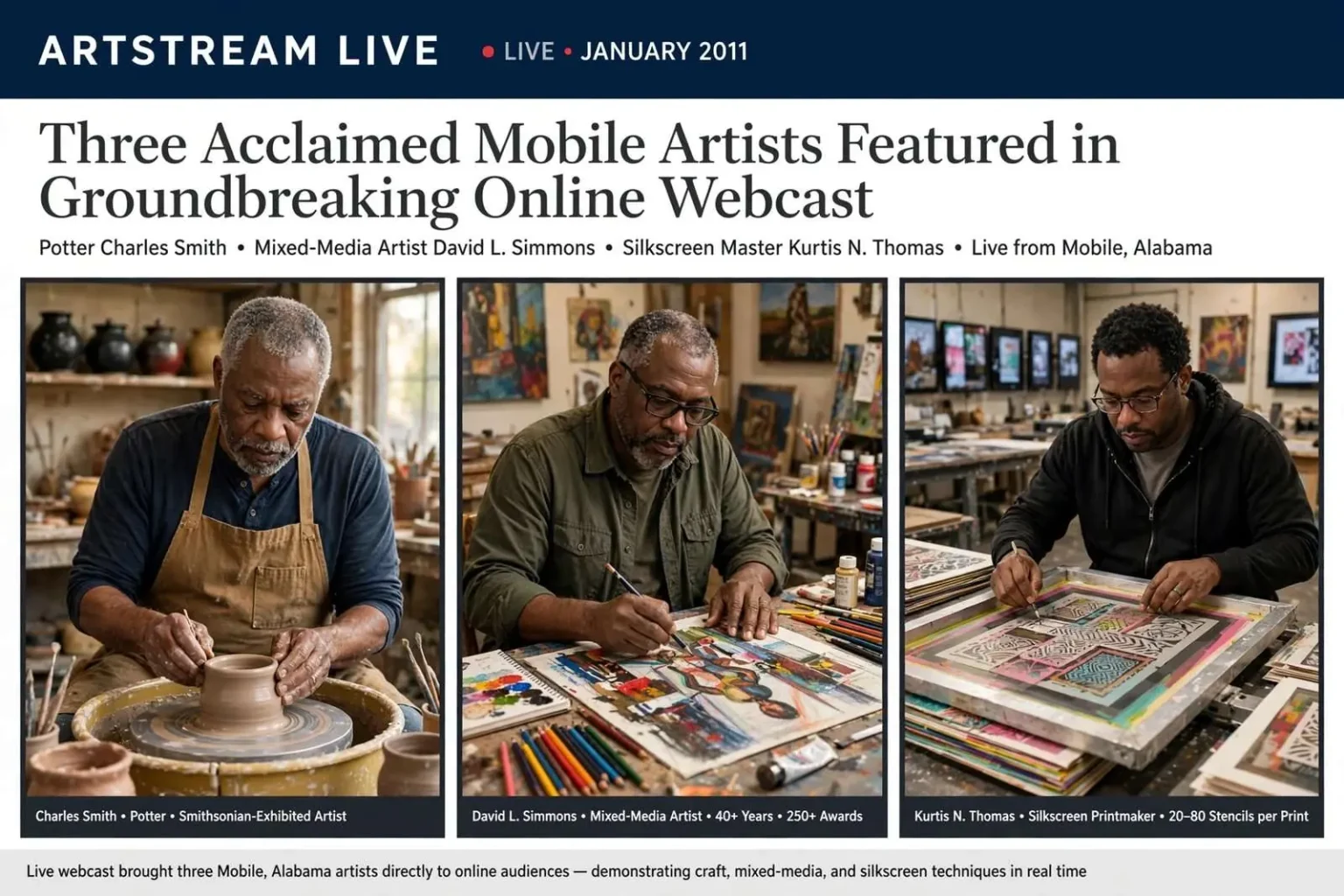
Three celebrated Mobile, Alabama, artists took part in a live online webcast through Artstream Live in January 2011, bringing their creative work to audiences across the internet in a groundbreaking local arts event. The program featured potter Charles Smith, mixed-media artist David L. Simmons, and silkscreen master Kurtis N. Thomas, each offering viewers an up-close look at their artistic processes and creative philosophies.
For Mobile’s arts community, the event was notable as much for its format as its lineup. In an era when most gallery programming remained tied to physical spaces, Artstream Live used streaming webcast technology to carry three working artists directly into homes far beyond the Gulf Coast, letting viewers watch demonstrations and hear the artists explain their choices in real time. Organizers framed the program as a bridge between a deeply rooted local arts scene and a national online audience, a combination that few cities of Mobile’s size were attempting at the time.
Each of the three artists brought a story that stretched well beyond the Gulf Coast. Between them, the panel represented training at two universities, museum collections on two coasts, and creative techniques refined over a combined total of more than a century of studio practice. The webcast gave each of them something a gallery opening cannot: time — the chance to explain, demonstrate and answer questions while the work is literally taking shape in front of the audience.
Charles Smith: a master potter with national recognition
Charles Smith is a well-known Mobile potter whose career began in the early 1970s. He earned a Bachelor of Science degree in Art Education with a minor in Pottery from Jackson State University in Jackson, Mississippi, where he studied under the late professor Marcus Douyon. Smith has credited Douyon with providing a strong foundation in artistic discipline and vision that shaped his career.
That foundation shows in work that has earned national attention, including inclusion in the traveling exhibition “Uncommon Beauty in Common Objects: The Legacy of African American Craft Art.” His pieces have been displayed at the National Museum of American Art at the Smithsonian Institution in Washington, D.C., and the American Craft Museum in New York City — placements that put a Mobile artist’s work in two of the country’s most important venues for American craft and art.
Smith’s more recent pottery has featured bold color combinations of black, red, and tan, a palette he explored during the webcast demonstration. Viewers watching the session saw the full arc of his craft, from the discipline of centering clay on the wheel to the surface treatments that have made his pieces recognizable to collectors. For Smith, pottery has always been as much philosophy as product, and his Artstream session gave audiences a chance to hear how decades of practice inform each form that comes off his wheel.
David L. Simmons: four decades of artistic achievement
David L. Simmons brought more than four decades of artistic experience to the webcast. A graduate of the University of South Alabama, where he earned a Bachelor of Fine Arts degree in 1977, Simmons began exhibiting professionally in 1976 and has since placed artwork in homes, businesses, galleries, and museums both domestically and internationally, accumulating more than 250 awards over the course of his career.
Simmons’ recent work has employed a distinctive combination of colored pencil, acrylic paint, and lacquer — materials few artists combine, and fewer still at the level of finish Simmons has developed. The lacquer surface gives his pieces a depth and luminosity that photography struggles to capture, making a live demonstration an especially valuable way for viewers to understand his method. During his session, Simmons walked audiences through the layering process and the decisions that move a piece between drawing and painting.
He has described his creative focus as exploring “that narrow territory between the figurative and the abstract where things are necessarily reduced to their essence.” That sensibility — distillation rather than decoration — ran through the work Simmons showed during the webcast, and it explains the broad collecting base his career has attracted. Works that occupy the space between representation and abstraction allow viewers multiple entry points, and Simmons’ decades of awards reflect an ability to sustain that balance across series and styles.
His career has also traced the growth of Mobile’s own cultural infrastructure. From the University of South Alabama’s art program, which has trained generations of area artists, to the galleries and institutions that exhibit regional work, Simmons’ four decades of exhibiting map onto the development of a local arts community that has matured alongside its artists.
Kurtis N. Thomas: a silkscreen innovator
Kurtis N. Thomas rounded out the trio with his imaginative silkscreen prints, known for their unusual perspectives and meticulous craftsmanship. Unlike most silkscreen artists who use only a few stencils with large areas of flat color, Thomas employs between 20 and 80 stencils per piece to achieve rich texture, form, and a wide range of colors.
The difference is not merely technical. Traditional silkscreen printing, familiar from pop art and poster work, often embraces flatness as an aesthetic virtue. Thomas’ approach pushes the medium in the opposite direction, using its mechanics to build gradients, shading and detail that approximate the effects of painting. Each additional stencil multiplies the registration challenges — every screen must align perfectly with the ones beneath it — so a piece with 80 stencils represents weeks of planning, cutting, and patient printing. The result is what has been described as a true “painterly” effect, and it has earned Thomas a reputation as a master in the silkscreen medium.
This labor-intensive technique produces prints that reward close viewing, and the webcast format allowed Thomas to show intermediate stages of his process that finished gallery pieces never reveal. Viewers saw how his images accumulate, screen by screen, from simple separations into densely layered final works.
He also works across several other artistic mediums with equal skill, and his Artstream session touched on how the discipline of silkscreen — its demands for planning and precision — informs everything else he makes. Artists who master one of the most exacting printmaking processes tend to carry that rigor into drawing, painting and design, and Thomas’ breadth across media reflects that habit of craft.
Printmakers of Thomas’ ambition occupy a specific place in the art market: their work is produced in editions, which makes it accessible to collectors at price points below unique paintings, yet the labor behind each impression rivals any one-of-a-kind piece. Collectors drawn to Thomas’ prints are effectively buying the accumulated decisions of dozens of stencil screens — an intimacy with the artist’s process that the medium makes unusually visible.
Three careers, one webcast
What made the January 2011 event distinctive was the range of practice on display in a single program. A potter whose work sits in the Smithsonian, a mixed-media painter with more than 250 awards, and a printmaker pushing silkscreen toward painterly effects represent three entirely different traditions of American art — craft, fine art, and printmaking. That one mid-sized Southern city could field all three for a single webcast said something about the depth of Mobile’s artist community.
The sessions also shared a common thread that viewers could hear across all three demonstrations: each artist spoke about discipline. Smith credited his professor’s lessons in discipline and vision. Simmons’ career statistics — four decades of continuous exhibition and hundreds of awards — speak to a workmanlike persistence as much as talent. Thomas’ 80-stencil prints are discipline embodied, weeks of registration work distilled into a single image. For young artists watching online, that message was arguably the most valuable part of the program.
The Artstream Live experiment
The Artstream Live event highlighted Mobile’s thriving arts community and the caliber of talent working in the area, offering a digital platform for local artists to reach broader audiences beyond the Gulf Coast region.
The program’s timing placed it in the early wave of arts organizations experimenting with live streaming. Cultural institutions nationwide were just beginning to explore what the internet could do for audiences who could not attend in person, and Artstream Live’s approach — live demonstrations by working artists, interactive and unscripted — was an early template for the artist-studio broadcasts that later became widespread across social platforms.
For the participating artists, the webcast offered reach that local galleries alone could not. A collector in another state, a student in another city, or a museum curator scanning for regional talent could all watch the same demonstration simultaneously, at no cost of travel. That democratization of access was the event’s quiet ambition: to let the work speak for itself, live, without the filtering of distance.
For Mobile audiences, the event was a reminder of the caliber of artists working in their midst. Cities along the Gulf Coast have historically exported creative talent to larger markets, and programs like Artstream Live make the case that artists of national standing are building careers at home — showing their work in the Smithsonian’s halls and Mobile’s studios alike, and willing to open the studio door to anyone with an internet connection.