As Robberies Rise, Mobile Steps Up Weekend Checkpoints Downtown and in Midtown
Mobile police ran a string of weekend checkpoints downtown, on the Causeway and in Midtown in early March 2008, prompting questions from residents about whether the effort was the best use of officers amid a rise in robberies.
Drivers across Mobile encountered a noticeably heavier police presence the weekend of March 8-9, 2008, as officers set up a string of checkpoints in the downtown area, along the Causeway and in Midtown, part of what appeared to be a coordinated push to check licenses, registrations and proof of insurance.
The weekend operations were hard to miss even for residents accustomed to seeing Mobile police on patrol. Portable lights, generators and clusters of cruisers appeared at major intersections on both sides of the bay, and drivers streaming out of downtown on Saturday evening and through Midtown on Sunday found themselves waved into inspection lanes. Traffic checkpoints are among the most visible things a police department does, and back-to-back operations across multiple corridors over a single weekend told observers that the department was deploying resources at scale.
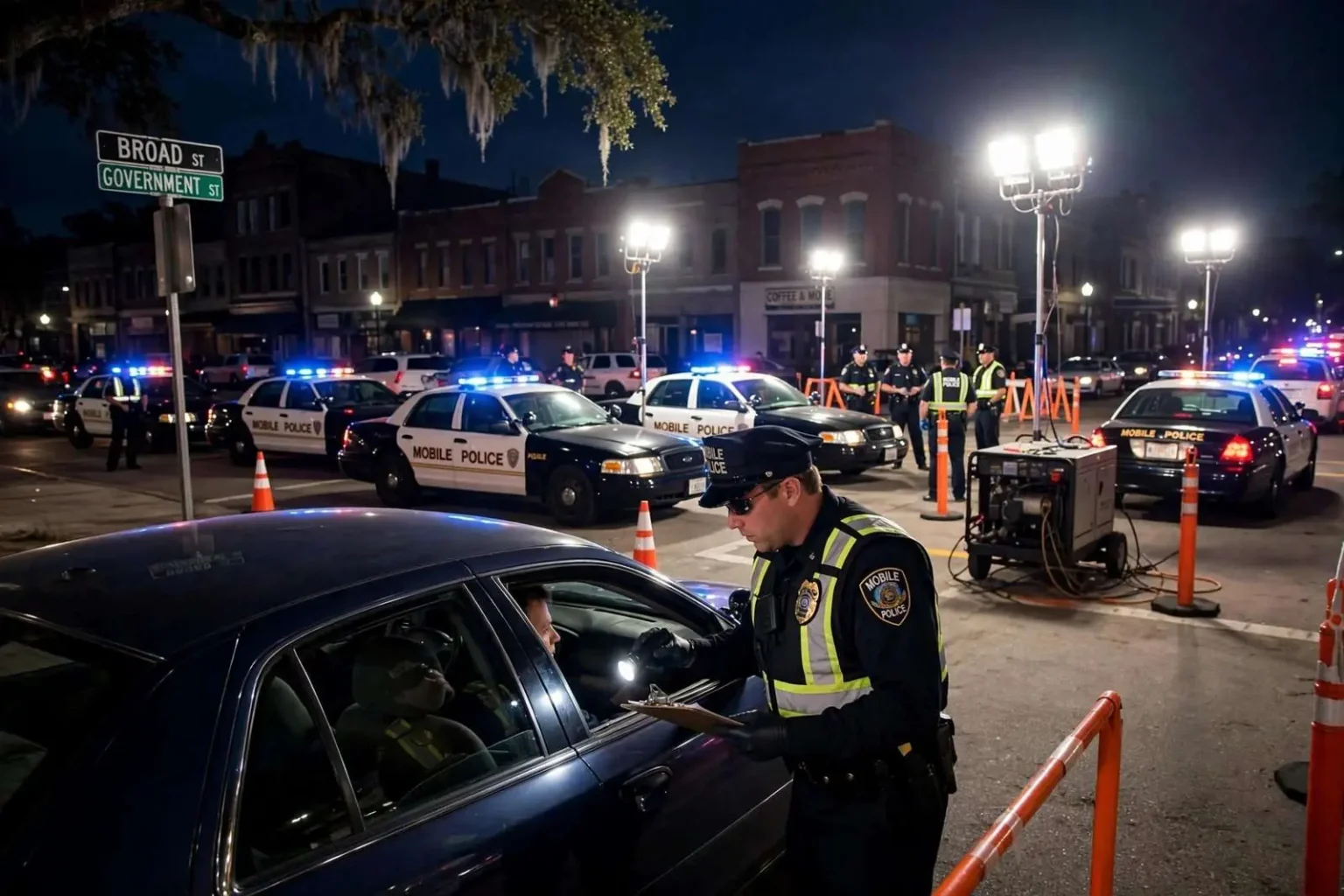
On the evening of Saturday, March 8, six patrol cars and a larger-than-usual contingent of officers gathered in the vacant lot on the northeast corner of Broad Street and Government Street. A generator and a bank of high-intensity lights lit the site while one officer worked westbound traffic, checking licenses and insurance as his colleagues waited nearby.
The intersection of Broad and Government sits at one of the city’s historic crossroads, where Government Street runs from the old city grid toward Spring Hill and Broad Street carries traffic between downtown and the neighborhoods to the north. A checkpoint there catches an enormous cross-section of Mobile drivers: evening commuters, churchgoers, restaurant workers heading home and drivers moving between the city’s east and west sides. For the officers assembled in the darkened lot, the site offered both high visibility — every passing driver could see the operation — and a steady flow of vehicles to screen.
A similar operation was running at the same time just past the eastern mouth of the Bankhead Tunnel, catching traffic headed east on the Causeway toward Baldwin County.
The Bankhead Tunnel location gave the second checkpoint a different character. Traffic emerging eastbound from the tunnel and heading up the Causeway — the rising roadway that carries U.S. 90 across Mobile Bay into Spanish Fort and Daphne — includes commuters, bay-bound shoppers and weekend travelers leaving the city. A checkpoint on that corridor reaches drivers who might never cross an in-city checkpoint zone, and it positions officers along one of the most heavily traveled routes on the Gulf Coast. The U.S. 90 Causeway itself has long been a focus of traffic enforcement because of its mix of high speeds, water on both sides and heavy weekend volume.
The following day, a separate checkpoint drew eight officers and eight cruisers to the intersection of Upham Street and Old Shell Road in Midtown. Not long after that stop wrapped up, a line of police cruisers was seen moving east on Government Street, apparently headed toward another checkpoint elsewhere in the city.
The Midtown operation put the Sunday sweep in one of the city’s busiest residential-commercial corridors. Old Shell Road carries traffic past the University of South Alabama’s nearby campus and through some of Mobile’s most populous neighborhoods, and the Upham Street intersection sits at a crossing where neighborhood traffic merges onto the arterial. Eight officers and eight cruisers — a full shift’s worth of manpower concentrated at one corner — signaled that Sunday’s operation was at least as ambitious as Saturday’s, and the subsequent movement of cruisers east on Government Street suggested the department had planned the weekend as a rolling series of locations rather than a single fixed site.
Checkpoints of this kind are a routine tool for enforcing traffic and insurance laws, and Mobile police have used them for years to catch uninsured and unlicensed drivers. But the scale of the weekend operation, spanning multiple high-traffic corridors over back-to-back days, raised a question for at least some residents: whether that concentration of manpower is the best use of officers’ time while the city is also contending with a rise in violent crime and robberies.
The Crime Backdrop
The concern was not abstract for business owners in some of the areas most affected by that crime spike. One business owner in the Loop business district described the anxiety of wondering, night after night, whether her shop would be the next target amid a run of armed robberies in the area. For her and others like her, a highly visible traffic checkpoint several miles away did little to quiet the question of who was watching their block after dark.
The Loop — the commercial district around Government Street and Florida Street west of downtown — had been hit by a string of armed robberies that left merchants rattled and demanding a stronger police presence. Business owners in the area described closed-circuit footage of stickups, employees afraid to close alone and customers who had begun avoiding evening shopping. In a district like the Loop, where many shops are small and independently owned, each robbery lands hard: insurance deductibles, lost merchandise and frightened staff are not line items a small business absorbs easily.
Against that backdrop, the weekend checkpoints became a lightning rod for a debate about police priorities that plays out in every city. Checkpoints have defenders on their own merits: they remove unlicensed and uninsured drivers from the road, they frequently turn up outstanding warrants, and their visibility deters impaired driving on corridors where speed and traffic combine dangerously. Traffic enforcement, veterans of the profession note, is how many departments find fugitives — a routine license check that reveals an outstanding arrest warrant is a week’s worth of detective work compressed into five minutes.
Critics counter that the same officers staged at a checkpoint could be walking a business district beat, answering robbery calls faster or working the plainclothes details that catch robbers in the act. The arithmetic is stark when crime is rising: a checkpoint might screen several hundred drivers in an evening and yield a handful of citations, while the same eight officers deployed on patrol cover a different set of problems. In a city experiencing a run of armed robberies, residents in the affected neighborhoods ask why the show of force they can see is directed at traffic rather than at the crimes they fear.
What the Operations Accomplish
Police departments answer that question with a body of practice built over decades. Insurance enforcement matters in Alabama, where a significant share of drivers have historically carried no coverage, and checkpoints are the most reliable way to verify proof of insurance at scale — a task that ordinary patrol stops handle one car at a time. Departments also note that saturation enforcement of any kind, including checkpoints, puts a visible mark of police presence into neighborhoods that feel overlooked, and that the intelligence gathered at a checkpoint — who is out, who is armed, who is wanted — feeds investigations well beyond traffic court.
The weekend of March 8-9 will be remembered by most Mobilians, if at all, as a weekend of delays and flashing lights on the way to the bay. But for the merchants of the Loop and the residents of the neighborhoods touched by the robbery spike, the sight of eight cruisers at a Midtown intersection posed the question squarely: the city’s police force is a finite resource, and every hour spent screening drivers on Government Street is an hour not spent on the corners where people are afraid. How Mobile answers that question — in deployments, in budgets and in the priorities set by its command staff — will matter more to the city’s safety than any single weekend’s citations.
The geography of the weekend’s operations reflected a deliberate strategy of visibility across the city’s major corridors. By staging checkpoints on Government Street, at the tunnel and Causeway, and in Midtown, the department touched the routes that connect Mobile’s downtown, its oldest neighborhoods and its western districts — the same arteries most residents drive every day. A driver who crossed town on either weekend day was nearly certain to encounter at least one inspection lane, and the cumulative effect was a demonstration that no corridor was beyond the department’s reach on a given night.
Insurance and license enforcement carries particular weight in a state where the consequences of driving uninsured fall on everyone else. When an uninsured driver causes a wreck, insured motorists absorb the costs through their own policies, and accident victims can be left chasing compensation through the courts. That cost-shifting is why Alabama legislators have repeatedly tightened proof-of-insurance requirements over the years, and why departments consider verification checkpoints a matter of fairness to the drivers who comply with the law rather than an optional revenue exercise.
The debate over the weekend’s deployment is, at bottom, the permanent tension of municipal policing: the difference between what is systematic and what is visible. Checkpoints are systematic — scheduled, staffed and measured. Robbery suppression is reactive, unglamorous and rarely seen until it succeeds. The officers who worked the checkpoints on Government Street, the Causeway and Old Shell Road were doing the work the department’s schedule assigned; the residents watching armed robberies rattle their businesses were asking the city to change the schedule. Both demands cannot be fully met by the same roster of officers, which is why the question of priorities — raised again this weekend in lights on Midtown corners — never really leaves City Hall for long.