Ascension Providence Restricts Inpatient Visitors as COVID-19 Hospital Cases Rise
Ascension Providence in Mobile tightened visitor rules again effective Aug 3, 2021: one visitor, 9 a.m. to 2 p.m., age 18+, no overnight stays.
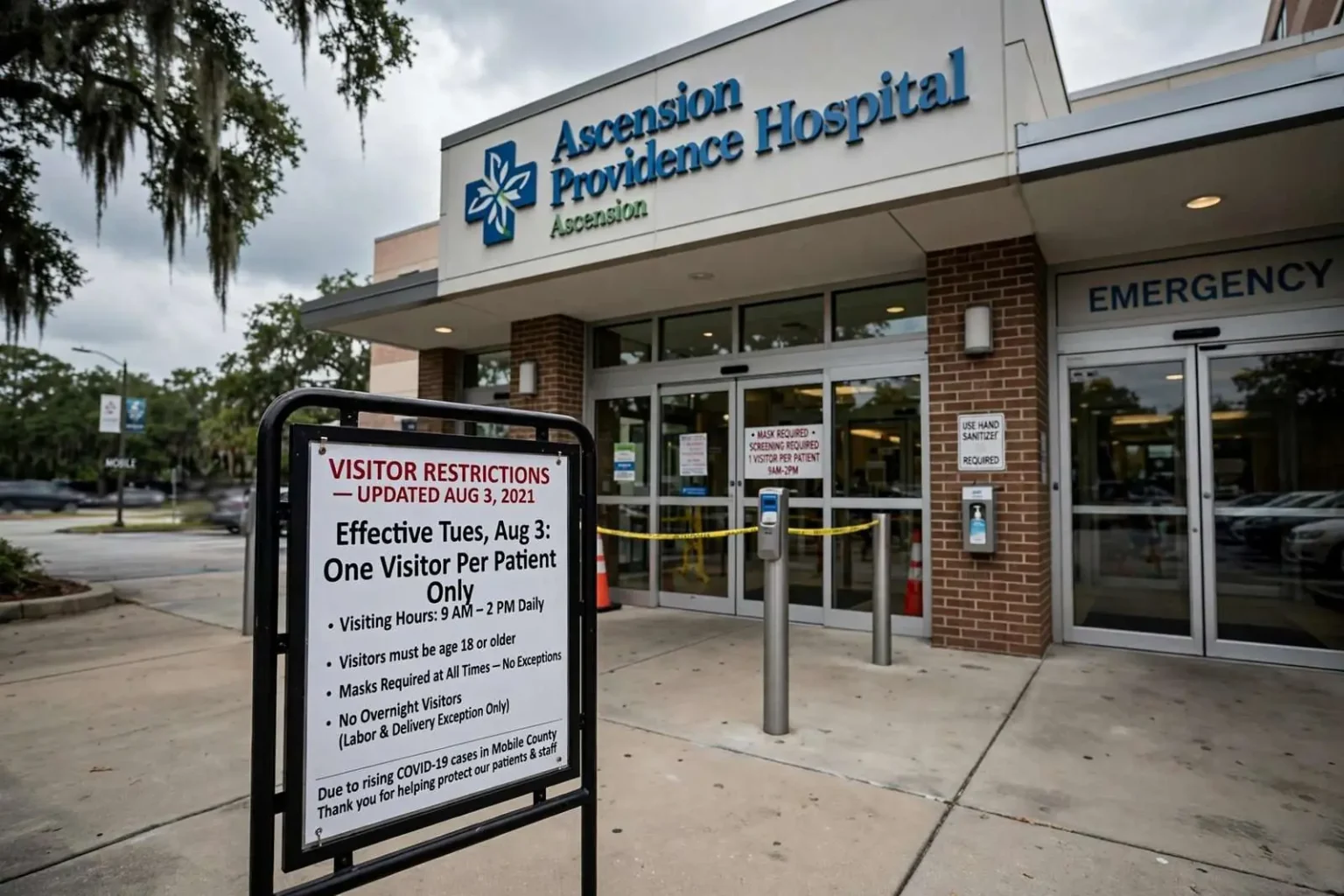
Ascension Providence Hospital in Mobile tightened its visitor policies in late July 2021, citing a rising number of COVID-19 cases both within the hospital and in the surrounding community. The move placed the facility among a wave of Gulf Coast hospitals that rolled back pandemic-era accommodations within a matter of weeks, as the Delta variant transformed what had been a manageable summer into one of the most demanding stretches of the entire pandemic for Mobile-area health care workers.
Under the rules announced in July, inpatient rooms were limited to a maximum of two visitors per day, with visiting hours set between 7 a.m. and 7 p.m. Patients in the emergency department were restricted to one designated visitor. For families accustomed to open visiting throughout the pandemic’s quieter spring months, the change was immediate and noticeable. Spouses, adult children, and other loved ones who had grown used to sitting at a patient’s bedside were suddenly asked to coordinate visits in advance and to time their trips carefully within the published window.
The hospital tightened the rules again in an announcement on Monday, August 2, 2021. Effective Tuesday, August 3, only one visitor per patient was allowed, and only between 9 a.m. and 2 p.m. Visitors had to be 18 or older, and no one was permitted to remain overnight — with a single exception for Labor and Delivery patients. The five-hour visiting window represented a dramatic contraction from the fourteen hours the hospital had allowed just weeks earlier, and the age restriction meant that teenagers could no longer accompany parents to see grandparents or siblings, a rule that proved difficult for many families to explain to younger children.
Why Hospitals Impose Visitor Restrictions
Hospital representatives acknowledged at the time that the restrictions were difficult for patients and families alike, but stressed that they were driven by the realities on the ground. Visitor limits are one of the most powerful tools a hospital has for controlling the spread of a respiratory virus inside its walls, because every person who enters the building is a potential vector. Fewer visitors mean fewer screening checks, fewer masks to distribute, fewer high-touch areas to disinfect on an hourly schedule, and fewer chances for the virus to move between a community setting and a ward full of vulnerable patients.
The successive cutbacks came during a period when the Delta variant was driving a sharp increase in infections across Alabama and the broader Gulf Coast region. Delta, first detected in India in late 2020 and identified in the United States in the spring of 2021, proved roughly twice as transmissible as the original strain of the virus. By late July 2021 it accounted for the overwhelming majority of new American cases, and it hit the South with particular force, where vaccination rates lagged behind the national average. Alabama consistently ranked among the least-vaccinated states during this period, and rural counties along the Gulf Coast saw some of the sharpest case growth in the country.
Mobile-area hospitals saw a significant uptick in admissions, prompting health officials to reevaluate safety measures. Throughout August 2021, intensive care units across the region operated at or near capacity. Elective procedures were postponed at some facilities to free up beds and staff. Emergency departments backed up as patients waited for inpatient rooms to open. Nurses and physicians worked extended shifts, and travel nurses were recruited from out of state to fill gaps. Public health officials in Mobile County urged residents to get vaccinated, to wear masks indoors, and to avoid gathering in crowded spaces, but the case curve continued to climb for weeks.
The strain was not limited to COVID-19 patients. Hospital administrators across the Gulf Coast warned throughout the summer that the surge was degrading care for everyone, because the same staff, beds, and equipment serve cardiac patients, trauma victims, mothers in labor, and cancer patients alike. When an ICU fills with coronavirus cases, a heart attack patient from Saraland or a crash victim from Prichard may find the nearest available bed across the state line. That cascading effect is a large part of why visitor restrictions, which inconvenience thousands of healthy family members, were treated as a necessary trade-off rather than a bureaucratic inconvenience.
From Spring Reopening to Summer Restrictions
Ascension Providence, which operates as part of the Ascension health system, had previously relaxed some visitor guidelines as vaccination rates climbed earlier in the spring. Ascension, one of the largest Catholic and nonprofit health systems in the United States, operates hospitals in well over a dozen states, and its Gulf Coast facilities — including Providence in west Mobile — had spent the spring gradually restoring services that had been curtailed during earlier waves. Outpatient clinics reopened to full schedules. Surgeries that had been deferred were rescheduled. Many families were able to accompany loved ones to appointments for the first time in a year. The summer reversals reflected the changing trajectory of the virus statewide, and they were a reminder that pandemic-era policies could move in both directions depending on conditions.
For patients themselves, the restrictions carried practical consequences that went beyond inconvenience. Elderly patients in particular were often admitted without the family member who managed their medications, their insurance paperwork, or their medical history. A single designated visitor became the family’s sole channel of communication, relaying updates by phone to relatives who could not enter the building. Some families drove to the hospital and waited in parking lots for word from inside. Hospital staff, already stretched thin, absorbed the added burden of relaying messages, coordinating phone calls, and helping patients use video calling to stay in touch with loved ones.
The overnight exception for Labor and Delivery patients reflected an area of medicine where hospitals were most reluctant to impose hard limits. Maternity care providers across the country generally preserved the option of a support partner during labor even at the height of earlier surges, on the guidance of obstetric professional societies, because of the documented role that continuous support plays in safe births. Ascension Providence’s decision to keep that exception while closing the overnight door for everyone else tracked the approach taken by most Gulf Coast hospitals during the same period.
Vaccination Data Behind the Visitor Policy
Health officials throughout the region emphasized that the Delta wave was concentrated among the unvaccinated. Publicly available state and federal data throughout August 2021 showed that the overwhelming majority of hospitalized COVID-19 patients in Alabama had not received a vaccine dose, a pattern that held across age groups. That reality shaped the public messaging that accompanied the visitor restrictions: officials paired each announcement of tighter hospital rules with renewed calls for residents to get vaccinated, describing vaccination as the single most effective step an individual could take to relieve pressure on local hospitals.
The Delta surge also reshaped day-to-day operations at schools, churches, and businesses across the Mobile area in the same weeks. Some school systems reinstated mask requirements. Houses of worship resumed distancing in sanctuaries. Employers that had called workers back to offices delayed those plans. Against that backdrop, the hospital’s visitor policy changes were one visible piece of a broader community-wide retreat from the reopening posture of the spring.
Hospital officials encouraged families to contact the facility before visiting for the most current guidelines and any exceptions that might apply to specific patient situations. That advice applied with special force to families of patients in specialty units — critical care, behavioral health, pediatrics, and end-of-life care among them — where individualized arrangements were sometimes possible even under tightened policies. Families were advised to call ahead, to expect screening at entrances, to bring and wear a mask at all times, and to be prepared for the possibility that rules could change again on short notice if conditions worsened.
How Hospital Communication Has Changed
The episode also illustrated how hospital communication had changed since the pandemic began. Where visitor policies were once posted on a lobby sign and changed rarely, they had become fast-moving public information, distributed through hospital websites, social media accounts, and phone lines, and covered daily by local news outlets. For families navigating a hospitalization in August 2021, checking the latest policy before every visit became as routine as checking visiting hours had once been.
By the standards of the pandemic’s later phases, the restrictions at Ascension Providence were in line with what neighboring systems were doing at the same time. Hospitals across Baldwin County, along the Mississippi Gulf Coast, and in the Florida panhandle adopted comparable limits within the same two-week span, creating a broadly consistent set of expectations for families across the region even as the specific hours and visitor caps varied from one facility to the next.
For the physicians and nurses who worked through the surge, the quiet of restricted visiting floors became one of the defining memories of that summer. Corridors that would ordinarily be full of families were empty. Nurses found themselves not only monitoring IV lines and ventilators but also holding phones to patients’ ears so they could speak to spouses and children standing in parking garages. The experience reinforced, for many on the staff, the stakes behind the case numbers that dominated the evening news.
As the summer wore on, the hope within the medical community was that the restrictions would prove temporary — a bridge across the steepest part of the Delta curve rather than a return to the deepest lockdowns of 2020. That hope depended on the same two levers officials had pressed all summer: vaccination uptake in the community, and the willingness of residents to take basic precautions until the surge crested. In the meantime, the guidance to families remained unchanged: check before you travel, one healthy adult visitor, daytime hours only, and a phone call for everyone else.