At 80, Bayou La Batre Oysterman Bobby Morrison Still Works the Reef by Hand
Bobby Morrison, 80, has spent 64 years tonging oysters by hand out of Bayou La Batre, and he's still working the reefs at Cedar Point alongside his son as Alabama's oyster fishery slowly rebuilds.
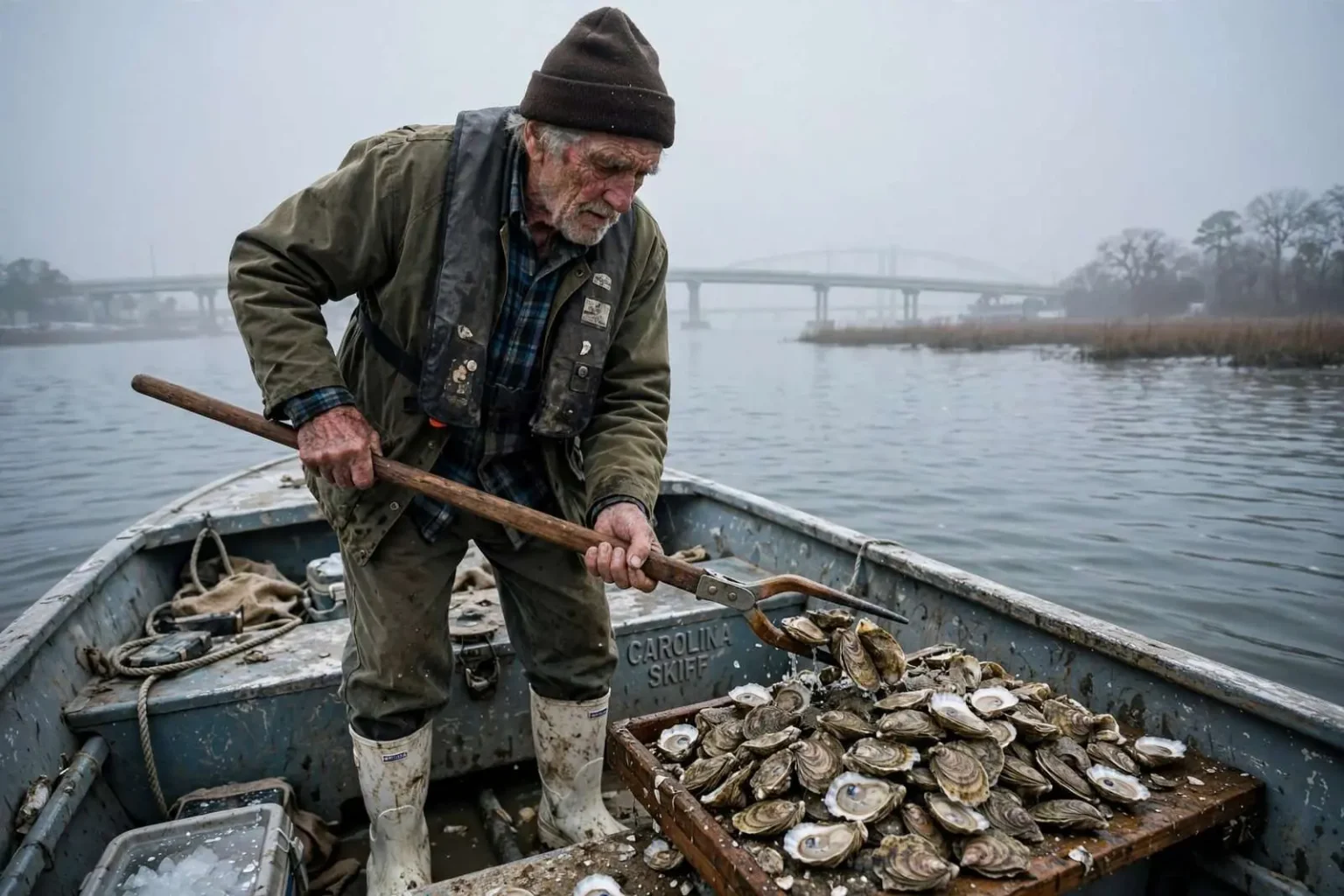
On a cold December morning at Cedar Point West, a headland in south Coden that connects Bayou La Batre to Dauphin Island by bridge, Bobby Morrison stood at the bow of his 2003 Carolina skiff working a set of 10-foot wooden oyster tongs against the reef below. In short, practiced motions, he clamped, pulled and dumped his haul onto the culling board, where a growing pile of oysters caught the pale winter light.
Morrison, 80, is one of the oldest working oystermen on Alabama’s coast, if not the oldest, and he has spent 64 years catching oysters commercially in and around Heron Bay and Cedar Point. Reaching down into the water and lifting loaded tongs for hours at a stretch is grueling work even for a much younger back, and Morrison is candid about what it takes to stay in the trade this long.
“If you have a strong back and a weak mind, you can make a good living,” Morrison said. “Only way you can survive it.”
That particular Tuesday, Dec. 14, was technically his day off. Oystermen in Alabama work a seven-hour window, from 7 a.m. to 2 p.m., to fill sacks that can weigh up to 80 pounds apiece, and by 11 a.m. Morrison was already well into what would have been a full workday for most. He was out anyway, working alongside his son, Robert “Bubba” Morrison, hoping to split a bag of oysters between the two of them.
Morrison was born in 1941 in St. Augustine, Florida, and grew up trailing his stepfather through the shrimping industry from North Carolina to Mexico. At 16, he arrived in Bayou La Batre for the first time as a deckhand aboard a shrimp boat making its way up from Fort Myers Beach, Florida.
“This is where I dropped my anchor,” Morrison said of his arrival in the seafood capital of Alabama. That anchor never came up. It was in Bayou La Batre that Morrison first got pulled into wild oyster harvesting, a pursuit that would occupy him and eventually his whole family for the rest of his life, chasing productive reefs anywhere from East Point, Florida, to Cameron Parish, Louisiana.
“We’d move with the oysters,” Morrison said. “Wherever they would open a season, that’s where we went. And we’d stay there until they ran us off.”
Though he has lived in Bayou La Batre for more than six decades, Morrison’s working life has been defined by that kind of movement, following the seasons of the seafood industry and chasing hot spots for oystering, shrimping or fishing whenever Alabama’s own reefs came up short in the winter months.
A Family Legacy on the Water
Of the 20 to 25 friends and fellow watermen who once surrounded him, Morrison said he is the only one still catching. The rest, he said, have either become physically unable to do the work or have died.
“A lot of us have died off,” Morrison said, describing wild oyster harvesting as something of a dying art, with the average age of working oystermen climbing every year.
For his primary career, Morrison spent 26 years as a boat captain for Graham & Sons, running chemicals, groceries and equipment out to oil rigs in the Gulf. Working two weeks on and one week off, he and his wife used their time ashore to work the oyster reefs as what he called “weekend warriors,” and they built enough of a reputation that other catchers took notice of wherever they set up.
“I’d get back home at 4 o’clock [a.m.] and I’d be oystering by 9 or 10 [a.m.],” Morrison said. He recalled one trip to Eastpoint, Florida, when he and his family were on the reef by 9:30 a.m. and back at the dock with 15 sacks of oysters within two hours. Two other catchers who had been out since before daylight came in an hour later with only two sacks between them. “They said we were catching all the oysters,” Morrison said.
Morrison’s career as a boat captain ended in 2000 after a back injury that required multiple surgeries and years of rehabilitation. He said doctors told him he might never walk unassisted again, and he spent two years disabled during his recovery. Once he was able, he took a four-and-a-half-year job with J&W Marine Enterprises, working from barges to replant oysters, rock and shell along reefs from Florida to Louisiana that had been wrecked by storm surge in the early 2000s. Morrison credits those years of raking oysters from the side of a boat with building the strength that eventually got him back on his feet, and still keeps him working reefs in his 80s.
“Anything that floats on water, I’ve done it,” Morrison said. “But this is one job I’ve always loved, catching oysters. You’re your own boss. You do what you want to. If you’re out here catching a few, but you don’t feel like doing it no more, you can go home.”
“It’s freedom, man,” Bubba added. “[My dad] doesn’t have to be doing this. He just loves it.”
Bubba spent 17 years shrimping before moving into a captain’s role with Bayou La Batre-based Barry Graham Oil Service, following his father’s path from the water to the oil field for steadier ground. He said he would make fishing his full-time work if it were an option.
“Only reason I’m not doing it is because I need insurance,” Bubba said.
The Skill and Feel of Oyster Tonging
There was no shortage of company on the water that morning. Roughly 25 boats were already working the Cedar Point West Reef by the time Morrison dropped a pair of chained-together Ford F-150 rotors into the bay to serve as an anchor. Morrison pointed out a sister, cousins and nephews working nearby without much effort.
“Kin people? That’s about 90 percent of them out here on the water,” Morrison said.
Morrison and his late wife, Gloria Ann Nelson Morrison, raised six children together: Darlene, Bubba, Dennis, Crystal, Amy and Bobbie Jo. The family has since grown to 13 grandchildren and 42 great-grandchildren, nearly all of whom live within 10 to 15 minutes of one another. Both Morrison and Bubba wore the white rubber boots common among the area’s oystermen, boots affectionately nicknamed “Bayou La Batre Reeboks” up and down the working waterfront.
Morrison’s son Dennis said Alabama has produced some of the most skilled oystermen on the Gulf Coast, naming the Harris family among those who grew up in the trade, along with extended family members like his nephew Jack Harman. Amy Huhn, one of Morrison’s daughters, said there are simply too many oystering relatives to count.
“My mom’s brothers and their wives would oyster together,” Huhn said. “I remember lots of times when I was a young girl making my spending money shucking oysters. We used the term ‘opening oysters’ when I was a kid. Very rarely did anyone say they were shucking. Most of us had a part in the seafood industry at some point in our lives. It’s in our blood, as my daddy would say.”
Like most families who have spent generations on the water, the Morrisons carry a running tradition of fish stories. “If you want to do anything in the seafood business, you’ve got to have some tall tales to tell,” Morrison said, adding that his best material tends to surface when he’s trying to hold his grandchildren’s attention. Bubba needles his father right back, joking that “the oysters get bigger every day, just like a fishing story.” Among the tales that still gets retold on the water is the day Bubba and a cousin filled 40 sacks working a stretch of reef near the Dauphin Island Parkway bridge.
Out on the water, conversation was sparse as catchers focused on filling their culling boards, and what little was said could get lost in the wind, the sloshing of rakes and the clatter of shells. Morrison said the sound carries differently depending on conditions. “When it’s foggy, I can hear conversations from boats across the bay,” he said.
Working entirely by feel rather than sight, oyster tongers rely on their hands and the vibration of the rake to locate productive bottom and avoid smashing their fingers between the wooden shafts or snapping the tongs at the fulcrum. Bubba said he skips work gloves altogether because they dull his sense of what is happening on the bay floor.
“You’ve got to find them. You feel them,” Morrison said.
“You’ve got to shake your rake and pile them up, is what you do,” Bubba said. “If you don’t feel none on the bottom, you can push yourself back with your rake and look for more. I can tell by listening to it.”
Catch, Price and Regulation
Once a culling board filled up, Morrison and Bubba knocked loose rocks and empty shells off the oysters with hammers, a step required under state rules that fine catchers who fail to return debris and immature oysters, those under 3 inches, back into the bay. What looks like a pile of mud and rock from a distance amounts to real money at the dock, especially with oyster prices climbing in recent years. Bubba said some catchers were bringing in more than $500 worth of oysters that day, with two-person crews typically splitting roughly $250 apiece, an average day’s earnings during the season.
Morrison said he has been selling his catch to R&A Oyster Company, located just north of Bayou La Batre in Irvington. Alabama law requires commercially caught oysters to be sold directly to licensed seafood dealers, while recreational catches are limited to personal use. Morrison remembers selling oysters for as little as 40 cents a pound; they were fetching close to $1 a pound at the time.
“It’s the most we’ve ever got,” Bubba said.
Morrison has watched the regulatory landscape shift substantially over his decades on the water. Where there was once no cap on how many oysters a catcher could bring in, commercial harvesters are now limited to six sacks a day.
“It’s less money, but more satisfaction,” Morrison said, adding that he understands the reasoning behind the limits even if he isn’t always thrilled by them. “They keep the catchers from depleting the oysters. They’d clear it out in no time.”
Alabama’s oyster reefs are still recovering from more than a decade of decline. Morrison traced the trouble back to Hurricane Ivan’s storm surge in 2004, followed a year later by Hurricane Katrina, which delivered a second blow to reefs already struggling. According to a 2013 study published in the Marine Environmental Research journal, Katrina tore open what became known as “Katrina Cut” near Dauphin Island, raising salinity levels in the brackish water around Cedar Point Reef and allowing predatory oyster drills, a type of whelk, to prey on the oyster population. The cut was not artificially closed with boulders until January 2011.
Alabama Marine Resources Division (MRD) Col. Scott Bannon said estuary systems like Cedar Point rely on freshwater inflow to keep salinity low enough to hold off the drills, and that the problem was made worse by a stretch of drought in the late 2000s. He noted that changes to the watershed as far away as the Midwest and Canada can ripple down to affect Alabama’s oyster reefs.
Those pressures eventually forced the state to shut down harvesting entirely during the 2018-19 season as oyster populations bottomed out. Since then, MRD has reopened the reefs for shortened, carefully monitored seasons, informed in part by the discovery that harvesting itself can help the reefs recover. Bannon said the raking motion of oyster tongs “turns up the bottom” and exposes fresh cultch material where oyster larvae, known as spat, can settle and grow, giving tongers what he described as a symbiotic relationship with the reef.
Alabama’s Oyster Reefs Rebound
The results have been substantial. The 2019-20 season produced 11,258 sacks, more than the previous five seasons combined, and the 2020-21 season, which closed Dec. 23, 2020, brought in 22,070 sacks. By Christmas of the most recent season, Bannon reported 45,000 sacks of wild oysters had already been registered, with no closing date yet set. He said the harvest represented roughly a $3 million economic benefit for local oystermen so far.
To manage the recovering reefs more precisely, MRD rolled out a new grid system that divides the reef into 500-square-foot blocks, letting the agency track exactly how many oysters are being pulled from a given area rather than shutting down broad sections all at once. Under the system, harvesters such as Bubba register their daily catch at an MRD trailer stationed near the reef, giving the agency a running tally of what is coming off each block in something close to real time.
“We had issues where catchers were working some small areas really hard and we didn’t have any ability to move them to other areas,” Bannon said. As of mid-December, harvesters had been pushed out of most of Heron Bay and into the Cedar Point West area as MRD closed off depleted sections. Bannon said the system has drawn some skepticism from catchers but has produced better feedback the longer it has been in place, including reports of unusually large, mature oysters coming from areas that had gone untouched. He said one local dealer recently sent him a photo of a two-and-a-half-pound oyster.
“It was larger than a man’s hand,” Bannon said. “It might look like Tetris when we’re done, but that’s OK, because the smaller the areas we close, the larger the areas we can leave open. This is a program designed to maximize [the harvesters’] benefits. Our goal is to get it to where we can run from October to May.”
Alabama’s oyster season typically runs from Oct. 1 to April 30, timed around the spawning cycle that runs from April to October, when the meat turns soft and thin. Conservation officers retain the authority to close the season early if needed; the previous season closed just before Christmas. Bannon said MRD also used to require catchers to replant half of their empty shells back onto the reef by hand, a task the agency has since taken over itself.
Bannon said the state has to balance the economics of the fishery carefully, since letting catchers take as much as they wanted would flood the market quickly, shorten the season and leave consumers without fresh local oysters for much of the year. Current prices of 70 cents to $1 per pound have been enough to draw harvesters back onto the water in numbers, with MRD recording an average of 800 to 900 sacks collected per day since the season opened in October. Alabama remains the largest oyster-processing state on the Gulf Coast, supplying restaurants and grocers along the East Coast and into the central United States, and even processing oysters shipped in from as far away as Texas.
Managing the Recovery
Bannon said the reefs matter well beyond the seafood industry, since oysters filter water and anchor the base of the food chain for a wide range of marine life. He added that the state’s working relationship with tongers like Morrison is central to tracking the health of the reefs season to season, and he does not take the physical demands of the job lightly.
“Everything is against you,” Bannon said. “And on top of that, you have to locate the oysters and then work the rakes. It is not an easy task. It requires some muscle, but it’s also an art. There is a way you have to do it to get a [rake] head full of oysters and not a pile of mud.”
Bannon said the trade remains deeply generational along the Alabama coast, with grandfathers, fathers and sons frequently working the same reefs together. “Most of the people out there are third- or fourth-generation oystercatchers,” he said, though he acknowledged the average age of the workforce keeps rising. Still, he said he has seen reason for optimism as prices improve and the state works to bring new catchers into the trade.
“I’ve had that concern, are we going to have a culture of catchers basically die off or go away and we don’t have the right skill set available [to replace them]?” Bannon said. “This season has been monumental in helping train up new catchers.”
For Morrison, the pull of the reef has never had much to do with the paycheck. Between the seafood market’s ups and downs, the tightening regulations and the physical toll of six decades bent over a set of tongs, he keeps coming back to the same explanation for why he still does it.
“It’s one big family,” Morrison said of the community of tongers he has worked alongside for most of his life. “You tease one another, say what you want to. They know if you mean it or just talking. We’re a one-of-a-kind people.”