At Least 30 Teens Are Locked Up at Mobile’s Metro Jail, and a Local Advocate Says the Answer Starts at Home
At least 30 teens are currently held at Mobile County's Metro Jail, and Sgt. John Young of Men United Against Violence says parental engagement at home is the key to reversing the trend.
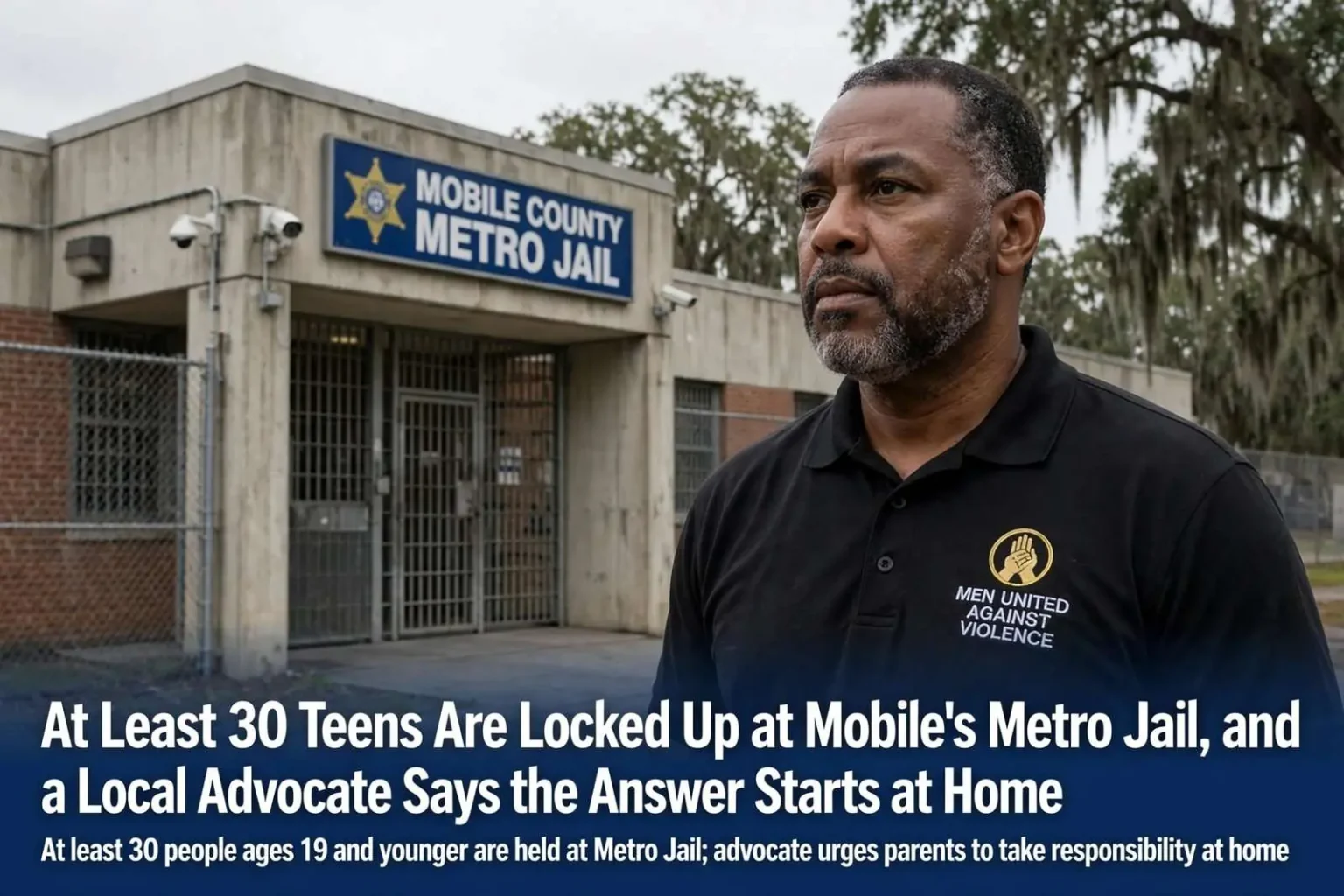
At least 30 people ages 19 and younger are currently being held at Metro Jail in Mobile County, according to the Mobile County Jail log. Of those, at least 20 face violent crime charges, including murder, robbery, assault and domestic violence, and at least five are charged with murder outright.
The figures, drawn straight from the public jail log, put numbers on a problem that law enforcement officers, prosecutors and community workers across Mobile describe in anecdotal terms every week. Teenagers awaiting trial on violent charges occupy a small fraction of the Metro Jail’s population, but the concentration of serious charges among defendants so young has made the group a subject of intense concern for everyone who works the county’s courts and streets.
Mobile Police Sergeant John Young, who leads the youth-focused group Men United Against Violence, said the numbers reflect a troubling pattern he has seen building for some time. Young said the figures are alarming, but not surprising to anyone who has spent time working with at-risk young people in the area. Men United Against Violence runs youth programs designed to intervene before young people turn to crime, and Young said the group’s summer campaign carries a direct message for parents: “Your children are your responsibility.”
The organization has built its approach around that principle, pushing back against the idea that churches, schools, police or community groups can substitute for engaged parents. Its members walk neighborhoods, speak at schools and community meetings, and show up at scenes of violence to urge calm and cooperation with investigators. Young, a veteran of the Mobile Police Department, has become one of the city’s most recognizable voices on youth violence, appearing at community forums where the same question recurs: what makes a teenager pick up a gun?
He said the foundation for a child’s behavior comes from the home, and when parents do not value education or engagement, that attitude tends to pass down to their children. “Now if you have an ignorant parent who doesn’t value education, then that is spread to that child,” Young said.
According to Young, many of the young people ending up in the criminal justice system come from homes where education is not prioritized and where parents are largely absent from day-to-day life. He said basic academic skills are often missing entirely. “The parents aren’t engaging with these children. They can’t read, they can’t write, they can’t count,” Young said. “That’s the result of parents being absent. They keep trying to outsource to other programs. We don’t mind going to speak at schools, but we should only be repeating what is said at home.”
The literacy numbers Young describes track with what educators across the region report. Students who reach middle school reading below grade level face compounding struggles in every subject, and those who leave school without functional literacy find themselves locked out of most legal employment before they are old enough to work. In Mobile County, as in districts nationwide, reading proficiency in the early grades is one of the strongest predictors of later outcomes — and one of the earliest places where a child’s home environment shows up in measurable form.
Young also pointed to unrestricted access to social media as a growing factor, saying many children are exposed to violent and harmful content well before they are equipped to process it responsibly. He urged parents to take a more active role in monitoring what their children consume and in building boundaries around technology at home.
The concern about social media reflects a shift that youth workers nationally have documented over the past decade. Disputes that once played out in school hallways now escalate online, where insults spread instantly to hundreds of peers and where videos of violence circulate widely. Investigators in Mobile and cities across the country increasingly find that beefs that ended in gunfire began as exchanges on social platforms — often between minors, often witnessed by dozens of other teenagers who did nothing to intervene. For parents, monitoring a teenager’s online life has become as fundamental to supervision as knowing where the child is at night.
Metro Jail, operated by the Mobile County Sheriff’s Office, houses the county’s most serious defendants alongside municipal arrestees, and the presence of defendants under 20 charged with murder underscores how young the county’s violent crime caseload has become at its edges. Prosecutors and judges who handle these cases describe a familiar biography that recurs: school suspensions, early gang exposure, absent parents and access to firearms — a chain that, in Young’s telling, starts with the home and rarely gets interrupted by outside programs acting alone.
The Prevention Movement in Mobile
Men United Against Violence is part of a wider network of prevention efforts in Mobile that includes church coalitions, neighborhood watch groups, mentoring organizations and the police department’s own youth outreach. These groups operate on a shared premise: law enforcement can arrest after a crime, but the conditions that produce the crime are set years earlier, in households and classrooms. Their programs — mentoring sessions, summer activities, conflict mediation — aim to place adults in the lives of young people before the criminal justice system does.
The summer campaign’s message — that responsibility begins at home — doubles as a challenge to the community’s habit of looking elsewhere for solutions. Young’s criticism of “outsourcing” parenting to programs is pointed, but it comes from someone who runs one of the programs parents are accused of relying on. His argument is not that programs are useless, but that they cannot overcome a household where no one asks about homework, checks a child’s phone or knows the child’s friends. Programs, in his framing, reinforce what families teach; they cannot replace it.
What the Jail Numbers Mean
The jail log’s snapshot of 30 defendants aged 19 and younger represents one day’s count, and the number shifts weekly as arrests are made and cases are resolved. But the pattern it reveals — a majority facing violent charges, a significant share facing murder — has remained steady enough that it no longer surprises the people who work with the county’s young offenders. Each of those defendants represents a path that, somewhere along the way, passed through a school that may have flagged the warning signs, a household that may have lost control, and a neighborhood where the intervention that mattered never arrived.
For Young, the count is evidence for the argument he has carried into churches, school auditoriums and living rooms across the city: the crisis is not primarily a police problem, a court problem or a program problem. The 30 young people in Metro Jail grew up in the same city as thousands of others who did not pick up guns, and the difference, in his view, is most often found under the roofs they came from. His summer campaign asks Mobile’s parents to consider that arithmetic — and to act on it before the next jail log is printed.
The call comes with an implicit offer as well. Community groups like Men United Against Violence continue to walk neighborhoods, mentor teenagers and stand between rival groups when conflicts flare, and Young says they will keep repeating the message — at schools, on street corners and in churches. What they need, he says, is for the first and loudest voice in a child’s life to be the same one they hear at school assemblies. Until that happens, he warns, the jail log will keep telling Mobile something its families already know.
The stakes of that message are visible in the county’s broader juvenile justice statistics, where the same names often reappear year after year. Youth who enter the system on their first charge face a fork: diversion programs, mentoring and family engagement can steer many of them back on course, while a return to the same environment with the same absences tends to produce a second arrest, then a third, each escalating in severity. The teenagers now sitting in Metro Jail on murder charges walked that staircase step by step, and the adults who work the system say almost every step offered a chance for someone — a parent, a coach, a teacher — to pull them off it.
Mobile’s experience mirrors what major cities across the country have confronted as youth violence has risen. Officials in those cities have found that enforcement alone does not bend the curve, and the most publicized prevention models — from hospital-based violence intervention to targeted street outreach — all depend on the same ingredient Young demands from parents: a consistent adult presence in a young person’s life. The programs that work treat families as partners rather than as substitutes, and the ones that fail are those left to compensate entirely for households that are absent.