At Least One Killed in Crash on Rain-Slicked I-65 Ramp to I-10 Eastbound
At least one person died after being thrown from a vehicle in a rainy-evening crash on the I-65 southbound ramp to I-10 eastbound in Mobile.
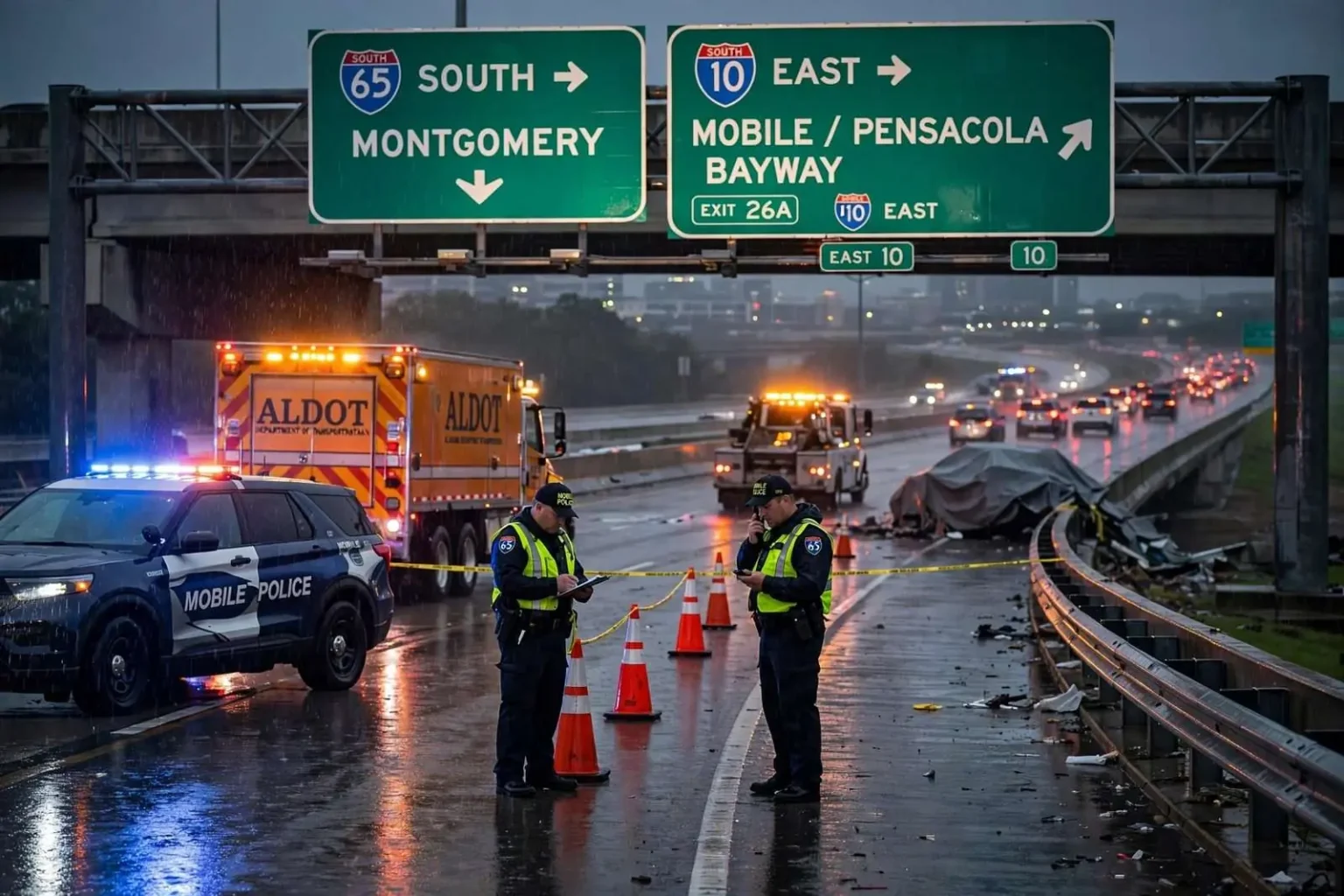
At least one person was killed Friday evening in a crash on the ramp from Interstate 65 southbound to Interstate 10 eastbound in Mobile, according to Mobile Police. The wreck happened around 6 p.m. at the heavily traveled interchange, one of the busiest junctions in south Alabama. Video from an Alabama Department of Transportation camera showed at least one person was thrown from a vehicle in the crash, though the footage made it difficult to determine how many vehicles were involved or whether anyone else was hurt.
Police noted that rain had just moved through the area, and a slick roadway may have been a factor. Investigators were working to confirm the details; the department had not released additional information about the victims or circumstances as of early Saturday. The identity of the person killed was withheld pending notification of family, as is standard practice in fatal crash investigations.
The Setting: Mobile’s Busiest Interchange
The ramp where the crash occurred carries traffic from Interstate 65 southbound onto Interstate 10 eastbound, a movement used daily by tens of thousands of commuters, freight haulers and travelers passing through Mobile. The I-65/I-10 interchange sits at the heart of the city’s highway network, where the region’s two primary interstates meet just south of downtown, and it has long been considered one of the more challenging driving environments on the Gulf Coast.
The interchange’s reputation stems from a combination of heavy volume, merging traffic from multiple directions and curves that demand reduced speeds, particularly in poor weather. Truck traffic adds to the mix, because Interstates 10 and 65 together form a major freight corridor linking the Port of Mobile, the I-65 corridor to the Midwest and the Gulf Coast routes to Florida and points west. Drivers heading east toward the Eastern Shore and the Bayway funnel onto the same ramps as local commuters leaving work on a Friday evening.
Friday at 6 p.m. sits squarely in the evening rush window, when volume on the interchange is at or near its weekly peak. Any incident on the connecting ramps quickly ripples outward, backing up traffic on both interstates and pushing overflow onto surface streets such as Government Boulevard and Airport Boulevard.
Rain and the Gulf Coast Crash Risk
Weather is a recurring thread in Mobile-area crash reports, and the timing of this wreck, just after rain moved through, fits a pattern that safety officials have warned about for years. The first minutes of a Gulf Coast rainstorm are among the most dangerous conditions on the road: rain mixes with oil and rubber buildup on asphalt to create a slick film, and drivers who fail to slow down immediately often find their traction gone before they realize conditions have changed.
Slick pavement is especially consequential on ramps and curves, where the combination of turning forces and reduced grip can trigger a loss of control at speeds that would be manageable in the dry. Interstate ramps in the Mobile area carry vehicles through sweeping curves and elevation changes, and hydroplaning or skidding on those geometries can send a vehicle across lanes or off the roadway entirely. State and local safety campaigns routinely urge drivers to reduce speed, increase following distance and turn on headlights at the first sign of rain rather than waiting for downpours.
The Friday-evening timing added another layer of risk. The end of the workday brings a mix of fatigue, impatience and congestion, and when those factors meet a wet roadway, the margin for error narrows sharply. Safety officials have consistently identified speed relative to conditions, rather than posted limits alone, as the decisive variable in rain-related crashes.
How Investigators Build a Fatal Crash Case
In the hours after a fatal wreck, Mobile police investigators face a methodical sequence of work. Officers secure the scene and document it through photographs, measurements and, increasingly, mapping technology that records the final resting positions of vehicles and debris. Investigators then work outward: identifying the vehicles involved, interviewing witnesses, pulling camera footage and examining the roadway for skid marks, gouges and other physical evidence that speaks to speed, direction and point of impact.
Camera coverage such as the Alabama Department of Transportation’s network has become a standard tool in that process. ALDOT operates traffic cameras along the interstate system in Mobile and Baldwin counties, originally intended for monitoring congestion and aiding incident response, but the footage frequently provides investigators with an independent account of how a crash unfolded. In this case, the video confirmed at least one person was thrown from a vehicle, even as its angle and quality left other questions open.
Those open questions matter for the record. The number of vehicles involved, the number of people hurt and the sequence of events all require confirmation before a department releases findings, which is why early reports on fatal crashes are often sparse. As of early Saturday, Mobile Police had not released additional information about the victims or circumstances, and investigators were still working to confirm details.
When investigators complete their work, their findings typically support decisions on whether any traffic citations or charges are warranted and feed into statistical records used by state and federal safety agencies. In crashes where roadway design or weather is a suspected factor, the documentation can also inform future discussions about signage, drainage and speed management at the location.
Ejections and the Role of Restraints
The ALDOT footage showing someone thrown from a vehicle underscores one of the starkest divisions in crash outcomes. Safety agencies have documented for decades that occupants who remain restrained inside a vehicle survive serious crashes at dramatically higher rates than those who are ejected, and ejection is among the most lethal events a crash can produce. Seat belts, airbags and modern vehicle structures are all engineered around the assumption that occupants stay within the cabin during impact.
Gulf Coast drivers hear that message most often during national and state seat-belt enforcement campaigns, which Alabama runs each year alongside its “Move Over” and impaired-driving efforts. Even so, nighttime and weekend hours, exactly the window in which this Friday-evening wreck occurred, remain the periods when restraint use dips and fatal-crash risk climbs, according to long-standing state safety data trends.
Investigators had not said whether restraints were in use in this crash, and no conclusion should be drawn before their work is complete. But the presence of an ejection in the footage guarantees that investigators will examine that question closely, both for the official record and for the family members who will eventually receive the findings.
The Toll of the Interstate Network
The I-65 and I-10 corridors carry an enormous share of the travel in south Alabama, and with that volume comes a steady toll of serious crashes. The stretch of Interstate 10 through Mobile and across the Bayway into Baldwin County, and the interchanges that feed it, have been the focus of long-running state planning, including the Mobile River Bridge and Bayway project that officials have proposed to rebuild and widen the I-10 crossing and add a new bridge over the Mobile River. In the meantime, drivers continue to navigate an interchange system that was built for a region with far less traffic than it carries today.
Local emergency response to interstate crashes involves a choreography that residents rarely see, with state troopers, Mobile police, fire crews and EMS units dividing responsibilities for scene control, medical care and traffic management while ALDOT alert systems warn approaching drivers. A fatal crash on a connecting ramp can occupy a scene for hours while investigators document evidence, converting an evening commute into a standstill for miles in every direction.
What Drivers Should Take From It
For commuters who use the I-65 and I-10 interchange daily, the crash is a reminder of the habits that safety experts tie most directly to survival in wet weather. Slowing to match conditions rather than the posted limit, leaving extra distance before the vehicle ahead, avoiding sudden braking on ramp curves and making sure every occupant is buckled are the measures that repeatedly show up in crash-prevention guidance. Headlights in rain, plus patience with merging truck traffic, close out the list.
Those habits carry extra weight at this particular interchange, where lanes divide between downtown Mobile, the Bayway and the I-65 through-routes in quick succession. Drivers unfamiliar with the junction often make late lane decisions, and a wet ramp punishes indecision. Regulars know the routine: choose the lane early, hold a steady speed and let the merge happen rather than forcing it.
The Investigation Continues
As of early Saturday, Mobile Police had not released the names of those involved, the number of vehicles or a final account of the sequence, and no further details were expected until investigators completed their review of physical evidence, witness statements and camera footage. Updates in fatal crash cases typically come in stages, with an initial confirmation followed by detailed findings only after the investigation closes.
The outcome will matter to more than the record. Families of the person killed and anyone else hurt will eventually receive answers about what happened on the ramp, and those answers become part of the long ledger that documents safety on Mobile’s interstate network. Until then, the only confirmed facts remain the ones from Friday night: a fatal crash around 6 p.m. on the ramp from I-65 southbound to I-10 eastbound, a person thrown from a vehicle on ALDOT camera, a slick roadway after rain, and investigators still working to confirm the rest.